
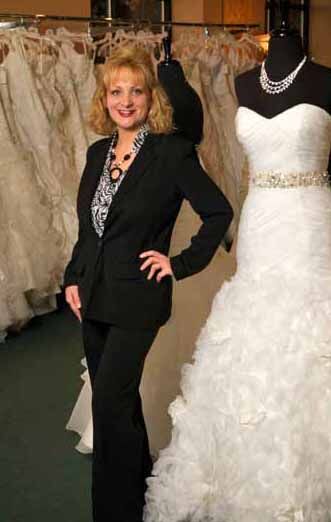

Beth Stone knows that even in the wedding business, tradition does not necessarily guarantee success. As the current owner of Eva’s Bridal Center in Oak Creek – an establishment that goes all the way back to 1946 – Stone has not been willing to stand pat and let newer bridal shops pass her by.
Once a fixture on Milwaukee’s Mitchell Street, Eva’s moved to its current location near Mitchell International Airport in 2005 following Stone’s purchase of the store in 2000. But when the business needed an infusion of capital in order to further grow, Stone wondered if tighter lending standards adopted in the wake of the subprime mortgage mess would ultimately scuttle her plans.
Stone turned to the Wisconsin Women’s Business Initiative Corp. (WWBIC), which offered invaluable mentoring, consultation, and training in addition to working capital to help Eva’s continue to prosper during shaky economic times – and that made all the difference.
“Without the support of WWBIC, my business may not have survived,” said Stone.
Of course, Stone’s story is hardly unique. Among the Wisconsin companies the organization has helped are Engaging Results Communications in Madison, Waterworks Garden Supply in Green Bay, Apple Ridge Academy in New Berlin, the R.A.D. Group in Racine, and Tracey Construction in Sturgeon Bay. And while the statewide organization will soon be celebrating its 25th anniversary, the WWBIC’s mission has never been more vital, with a lackluster economy making access to capital a tricky proposition for many would-be entrepreneurs.
| “Without the support of WWBIC, my business may not have survived.” Beth Stone, owner, Eva’s Bridal Center |
“We’re seeing many more people who traditionally would have been what we call bankable – which is able to receive financing from a traditional bank or credit union – have to look at alternative services like WWBIC to get their financing either in full or in part,” said Ruth Rohlich, director of the organization’s South Central Region office. “So we also do partnership loans with banks, and that type of loan has also increased, where maybe the banks are saying they’ll do 20% or 40% of what the business owner’s asking for, and [the owner] will come to WWBIC or an alternative group like WWBIC to get the rest of the funding.”Its total loans have surged from $2.25 million in 2008 to $3.4 million so far this year. Even more remarkably, the number of loan applications it has received has jumped from fewer than 100 in 2009, to 316 in 2010, and to a projected 500 in 2011.Not surprisingly, the WWBIC has seen an upsurge in both its lending activity and the number of loan applications it receives.
Geographically, the loans are apportioned pretty much how you’d expect, with the state’s larger metropolitan areas receiving the lion’s share of the money. For example, in 2010, the Greater Milwaukee area received $1.78 million in loans, Dane County received $428,200, and Southeast Wisconsin (primarily Kenosha and Racine) received $318,000. The rest of the state divided $735,000 among 22 loans.
But while the WWBIC has done a great deal of work in economically vulnerable urban areas, according to Rohlich, the organization is increasingly devoting resources to more rural population centers.
“In the last year, we have begun to focus on the rural market even more in addition to all the work we are currently doing in urban areas,” said Rohlich. “We have offered our services statewide for some time now, but in the last year we began a Rural Advisory Team and worked with funding from the USDA and SBA to help provide technical training and lending to even more individuals from rural communities throughout the state.”
Among those recipients are Renee Whirry and her husband, Gary. The two run the Barn at Cedar Hill Farm – a venue that hosts weddings and other events in Markesan. The couple recently took out a $50,000 loan in order to re-create the success of Cedar Hill by opening the Barn at Harvest Moon Pond, which will be an even larger venue located near Poynette.
“We’ll have one or two weddings there every weekend, and our hope is that we’ll have conferences during the week,” said Whirry.
According to Whirry, the couple will also be able to fulfill the WWBIC’s goal of providing jobs for local residents.
“When we went to the [WWBIC] board, that was one of their main concerns – how many people are you going to hire?” said Whirry. “And what we find is the people who usually come for conferences or events, such as weddings, they use local people, so that’s where we’re trying to help the community, and that’s what WWBIC was looking for.”
Lending money and time
WWBIC’s stated mission is to promote economic development through direct lending, business assistance, and business education. It also places an emphasis on serving people of color, people of lower wealth and incomes, and women – though it does not discriminate by gender when considering loan applications.
The loans range in size from $1,000 to $100,000, and loan terms are typically one to six years in length. The organization works with startups and growing businesses, and its loans are generally used for machinery and equipment, supplies, furniture and fixtures, inventory, and working capital. But first and foremost, the WWBIC’s programs are geared toward creating jobs. The organization estimates that, on average, each new loan it approves creates 2.7 jobs and retains 5.8 jobs.
Funding comes from low-interest government loans (the organization is an SBA lender), investments from private individuals, and investments from banks. For instance, PNC Bank recently announced a $500,000 equity equivalent investment into the WWBIC’s statewide loan fund.
“We work really closely with banks and credit unions, almost all of them in the state, and I think that they are really trying to get money out there, but they have different requirements internally within their organizations and from the government and so on,” said Rohlich. “And what we’re seeing is that they’re really looking at organizations like WWBIC, and so a lot of the major banks and credit unions donate money into our loan fund. …
“They love partnering with us now, too, because no matter how much we lend, every loan client of ours is assigned a business assistance person who basically just works one on one with that business throughout the term of that loan to just check in on them, check their financials, make sure they’re doing well.”
Financing also comes from unusual places – a fact that perhaps reflects the urgency of getting working capital into the hands of small business owners.
“I think people are really just looking at economic development as a sort of important charitable giving thing,” said Rohlich. “We get some donations from, like, groups of nuns, where they might want to invest $300,000 into our loan fund at a lower interest rate. So they’ll get a lower return rate than they might if they were playing the market, but it’s a socially conscious investment in their mind. So that has increased a little bit, too, in the last couple of years – so it’s just that new focus on economic development and helping small businesses.”
Still, the organization is quick to point out that it’s not a charity. While it serves lower-income individuals, applicants still have to have their ducks in a row.
“We are still saying no to people as well,” said Rohlich. “I think the last internal number was that we’re saying yes to one out of four, so there is still a need out there. We can’t say yes to everybody.”
The WWBIC currently uses an underwriting program that was developed by the national microlending organization ACCION. Designed for groups like the WWBIC, the program does an initial underwriting check of potential borrowers.
“So you’re looking at individuals who might not have perfect credit or are lower income and don’t have maybe a lot of savings or assets, and so it’s able to kind of look at an application from a person like that and look at other variables like the projections of the business plan, and it’s just a little bit more about who this person is,” said Rohlich. “And that’s something that we’ve always done, but now that so many people are finding themselves in a situation where, maybe their houses aren’t worth as much as they were before, they can’t borrow against them, or one person in the family has lost a job and so their income is down and maybe their credit has taken a hit as a result – there are a lot more people who fall into that category than maybe did before.”

