
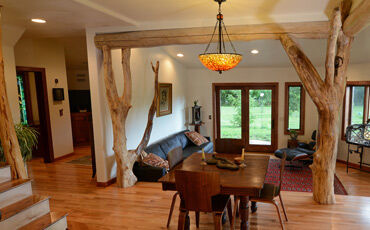

We humans have long had a complicated relationship with forests. Ask most people and they’ll tell you how much they love and want to protect trees – and we tend to wax poetic or nostalgic about unspoiled wilderness, revealing a connection to these ancient places that just can’t be replicated by suburban green space.
But people love progress, too, and when the choice comes down to preserving an old forest or creating jobs and prosperity, forests often become sacrificial lambs.
But what if that eternal choice – between preserving our forests and propping up our GDP – didn’t have to be made at all?
| “Forests are giant air- and water-cleaning machines, so more than regulating carbon, more than decreasing energy use, more than any other thing we’re doing and have to do, frankly, would be finding ways to keep our forests.” – Amelia Baxter, Whole Trees |
That’s a dream that Amelia Baxter, cofounder and president of the Stoddard, Wis.-based Whole Trees, would like to see become a reality. And the only way to do that in any sort of sustainable way, she says, is to make forests profitable just as they are.
“We have an economic relationship with every natural resource on this earth,” said Baxter. “Either we preserve it, which is a rare instance, or we utilize it in some form or another, and generally forests, because they provide such little economic payback, rarely get honored other than as a preservation area. So with every natural resource out there, it’s important to look at what’s the economic relationship that humans have toward it.
“With forests, the economic relationship is, how can we make money off this land by clear-cutting it? Either we can clear-cut it for agricultural purposes or we can clear-cut it for development, which is even more profitable, but there’s really very few companies capable of looking at a forest and saying, how can we keep this forest and make money off of it?”
Waste not
In some ways, Whole Trees’ business model is as traditional as they come, and in other ways it represents a radical new approach.
Essentially, the company uses round timber (i.e., whole trees) as a construction material in place of “traditional” components like steel and concrete. The company’s employees can walk a forest and select trees for their structural and design integrity, while also keeping in mind how harvesting the materials will affect the health of the forest. And since these are thinnings, it goes without saying that the overall integrity of the forest is preserved.
That’s step one. After sourcing the materials, the company enters the design phase, outlining design goals, creating a preliminary budget, and working the materials into an overall design before creating final construction documents.
Taking what would otherwise be forest waste and turning it into highly valued construction materials is impressive enough, but Baxter and her cofounder, Roald Gundersen, are not content to smugly rest on their laurels, content that they’re doing their small part for the planet.
They want to take their concept – sourcing forest cullings for use in custom projects – and make it workable for anyone.
“My co-founder, Roald, that’s a real forte of his; he’s managed his own forest here, and he’s been a part of his forest since he was a child,” said Baxter. “He moved here after practicing as an architect on the West Coast for 15 years, and he’s got a rather unique and unscalable way of doing that. He’ll design entire buildings, homes, and commercial spaces based on trees that he’s close to.”
The trick, says Baxter, is finding a way to bottle Gundersen’s expertise so that other interested companies can take advantage of it – and so more forests can be both saved and put to profitable use.
With that in mind, the company has been working with the U.S. Forest Products Lab on making the process scalable through a manufacturing system that sources the timber, grades it, and digitally engineers it.
“What we’re doing now at the Forest Products Lab is coming to understand the visual criteria of a tree and how it relates to structural design values and how we can over time capture that process through digital means,” said Baxter. “It’s like having Roald’s capacity as an architect, engineer, and forester in a digital device – a little more simple and less artistic. …
“As we move forward, we’re developing a manufacturing process that’s kind of largely based on digital analysis that will be something that other forest products companies can license. It won’t really be about us walking forests anymore, it will be more about providing the forest product industry with the ability [to do this].”
The ultimate karmic solution
While environmental preservation is at the heart of what Whole Trees is trying to accomplish, the company is also firmly rooted in pragmatism. The company anticipates that its product line will be cost competitive with steel and concrete (as well as more cost stable) and will be 50% stronger than milled wood. In addition, it promises to be carbon negative and LEED eligible for eight or more credits.
Right now, the company is gearing up to demonstrate the regional scalability of its model, but in time it hopes to expand to national markets. Its patentable grading software will also allow these methods to be used internationally.
While its gross revenues are still modest – $1.1 million in 2012 and a projected $2.5 million in 2013 – Whole Trees envisions much bigger things, and both public and private interests have been lining up to back the company. It has received an SBIR grant and angel funding, and was recently one of a handful of companies to receive certification for the Wisconsin Economic Development Corp.’s Qualified New Business Venture tax credits, which make investors in the company eligible for a 25% tax credit on their investments.
But if saving the planet and making money doing it sounds a bit far-fetched to both the entrepreneur and the environmentalist in you, you might change your mind after hearing Baxter’s passionate pitch.
“That’s kind of our tagline: The ultimate karmic solution; make forests profitable,” said Baxter. “Forests are giant air- and water-cleaning machines, so more than regulating carbon, more than decreasing energy use, more than any other thing we’re doing and have to do, frankly, would be finding ways to keep our forests. They’re what will clean up our air faster than any other solution we can offer as humans. And we’re not the only ones doing that. There are industries trying to promote the use of forests in new ways. But Whole Trees is innovating the most value-added possible products from forests, and that is trees for their structural capacity and the way to standardize that.”
Indeed, according to Baxter, Whole Trees is unique in the business world for its contributions to the construction industry.
“Hugely. Groundbreaking. There is no one thinking about round timber in our way because in some ways the obstacles appear insurmountable,” said Baxter. “You look at a tree and you say, there’s no way you can standardize that. How can you grade that? Look at our building codes. But the strength of Whole Trees is that one of the co-founders was light years ahead in his understanding of forest economies and also very stubborn. He started putting this stuff in buildings 20 years ago. …
“So that background enabled us to do something that no one else had probably had the guts to do without 20 years of that background, and that’s apply the concept of business scale and innovation to the use of timber. So I think the combination of stubbornness, guts, innovation, and business savvy got us to a place that no one else has thought to get to. That said, I don’t think it’s that hard for a forest products company to immediately start wanting to do this. Our thought is they will, and we will have the products ready for them that will enable them to reap the markets we’re creating for them.”
Still, it’s been a long road to get here for Baxter and Gundersen, and there’s still plenty of distance to travel. But success doesn’t just mean money in the bank to Baxter – it also represents a reservoir of good karma that’s enormously valuable.
“Management of growth expectations, management of IP, and projection into the future, and then managing the capital means of all of that in the early years – all entrepreneurs would agree that’s back-breakingly challenging, herculean,” said Baxter. “I don’t think I could do that herculean task without the sense that this fits my personal, spiritual, environmental sense of the world. So I would say I’m probably spiritually drawn to this as well as economically drawn to this work.”
Sign up for the free IB Update – your weekly resource for local business news, analysis, voices, and the names you need to know. Click here. If you are not already a subscriber to In Business magazine, be sure to sign up for our monthly print edition here.

