
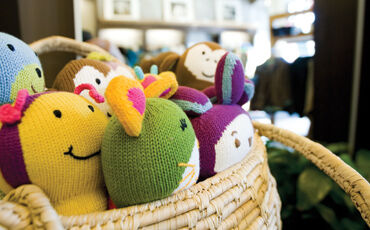

Tags on the soft Joobles animals at Oompa Toys’ new Middleton retail shop carry a familiar name. The items, part of a line of organic cotton fair trade toys and baby clothes, is sourced by Fair Indigo. Joobles were created by a family in Peru, who now train other rural and urban rural Peruvians to make the hand-knit apparel and accessories.
This year, Fair Indigo — the homegrown fair trade clothing company — ventured into the wholesale market, providing some of its branded goods to other retailers who want them on their shelves.
“Short term bank loans are like water for retailers. They’ve dried up,” explained Robert Behnke, creator and president of the Middleton company he helped found in 2006. “The main thing for us is to grow our business.”
Fair Indigo had planned to begin opening additional retail stores starting this year, according to Behnke. In addition to selling through its Web site (fairindigo.com) and a print catalog, the company two years ago opened a shop at the Hilldale Shopping Center. It was to be a model for other markets like Chicago, Minneapolis and Austin, where consumers want the company’s stylish clothing for men, women and babies made by workers who are paid a “living wage.”
That “living wage” means producers are “paid fair prices for the products they produce, instead of the minimum prices that the marketplace will allow,” according to Fair Indigo. It fluctuates from area to area, but means earning enough for housing, food, health care, education, with some disposable income left over.
Fair Indigo’s retail plan has been put on hold due to an economic climate that has many retailers struggling and essential credit all but gone
In a recent survey on consumer spending, the NPD Group said that 52 percent of respondents said they planned to spend less on apparel. This followed a continuing decline in shoppers’ desires to buy clothes.
Despite this, Fair Indigo (as a whole, with catalog sales) increased its overall sales for the first three quarters of 2008 by some 50 percent over the same period last year. But Behnke said that while the retail operation is doing fine, results there have nonetheless been “somewhat disappointing.” Wholesale business, it is expected, will provide the young company a bridge.
To grow the company into the future and expand its mission, Fair Indigo this fall reduced its now 15-person staff by six people, and started selling to its first wholesale accounts. Behnke remains the sole founding employee still on the payroll, with key investors and founders Bill Bass and Don Hughes continuing on the company’s board of directors.
This past summer, the company also secured $5 million in venture capital from Highfields Capital in Boston to help it add the wholesale channel to its stream.
One product in the line is an organic, fair trade hoodie bearing the Wisconsin collegiate logo to The University Book Store in Madison. Noted University Bookstores Vice President Kevin Phelps: “Fair Indigo was the first brand recognized (for selling fair trade clothing) certainly in the area, but also in the country at this point. We felt it was important to have that brand in the store.”
The hooded sweatshirts follow another line of fair trade T-shirts carried at the bookstore from Counter Sourcing Inc. Those shirts sold fast when the store began offering them in Fall 2007, attracting socially conscious students and other shoppers, who have demanded products made in non-sweatshop factories — as is the new Fair Indigo sweatshirt.
Franky & Ricky manufactures the Fair Indigo brand hoodies, made from organic cotton and certified non-toxic dyes. The garments are cut and sewn at a factory known for comfortable working conditions and for paying workers living wages in Arequipa, Peru.
Behnke said UW-Madison asked Fair Indigo to source product for its stores soon after its launch. Finding the Franky & Ricky operation made it possible to enter this market. “We said, ‘let’s start with Wisconsin and see how it goes,'” Behnke said, noting the lengthy collegiate licensing process.
This line could extend to other colleges and universities, if successful, and expand in the number of styles including T-shirts, sweat pants and zip jackets.
Fair Indigo is also marketing jewelry made by the Anonymous Angels — a San Luis, Peru-based cooperative of disabled artisans — to wholesale customers.
Oompa Toys’ Chief Operating Officer Jason Oliver said the Joobles stuffed toys were a good fit for the Madison-based retailer, best know for its e-commerce site (oompa.com) that sells safe toys and children’s gear. The Madison company offers the Joobles both online and in its flagship store.
Madison toy and clothing retailer Capitol Kids on Carroll Street downtown, now stocks some infant wear sourced by Fair Indigo. This spring, the store will carry the Joobles children’s clothing.
“We’re interested in fair trade, we’re interested in organic, and we’re thrilled to be doing business with a local company,” said Capitol Kids owner Peg Scholtez of sourcing through Fair Indigo. “We try to shop local as much as we can. It’s really, really unusual.”
UW-Madison Consumer Science professor Cynthia Jasper also said it’s unusual in Dane County to find an apparel wholesaler. Fair Indigo is in a unique position to take advantage of its niche market.
“Fair Trade and sustainable goods are what a lot of people are looking for at this time,” Jasper said. “It may be more profitable at this point to sell in larger amounts and not have a storefront that you have to operate.”
Wholesale selling also could mean a bigger sales impact for manufacturers Fair Indigo works with, Jasper said.
Bass, Fair Indigo’s board chairman, also said that adding the wholesale channel to its business model is good for people who they work with around the world.
“We want to grow this as big as we can,” Behnke agreed.
To reach more retailers, Behnke said the company is aggressively marketing the Joobles line, with stuffed animals and accompanying clothes, at several trade shows this year including the huge Toy Industry Association’s Toy Fair in New York next month. He said the Joobles are iconic, and have the potential to capture a great deal of attention, and sales.
“Our job is to tell the story and make this possible; to show the human impact and the fact that we’re all connected. You don’t see that anywhere else in the market,” Behnke said.

