
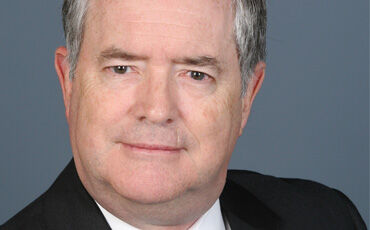

The two most recent monthly jobs reports have sparked hope for faster economic growth, but a local wealth manager expects the economic recovery to continue on a gradual trajectory.
Commenting on a recent In Business radio program, Steve Musser, founder of Musser Capital Advisors, talked about the state of the economy and his post-“retirement” career in wealth management.
Musser believes the stock market, which in recent days alternately has surpassed and fallen below the 13,000 mark, will continue to move higher but not excessively so because volatility will continue to dominate the landscape.
A contributing factor to that volatility is the European debt situation. Musser noted the European Union has not come to a conclusion on how to handle debt and trade imbalances, and with 27 member nations, and at least as many national legislatures that need to reach a consensus, it’s difficult for the EU to come to an agreement.
Musser said the Europeans might have an economic union, but they don’t have a strong fiscal union. “If each nation had the same fiscal restraint or constraints, they would have a whole different situation today,” he noted. “When you take capitalist democracies and mix them with communism and socialism, it will not mix well.”
In the U.S., the sectors he most likes are large-cap stocks, those with a market capitalization of $7.5 billion or higher – companies like IBM, Microsoft, and Apple Computers. In general, the recession gave them a chance to restructure their balance sheets and, at the moment, they are sitting on a lot of cash, more than enough to buy other companies. Cash, in fact, comprises 25% of their capitalization, he said.
“That’s a very large amount of money to have sitting around,” Musser stated. “I don’t know what their plans are for it.”
Another economic metric, consumer behavior, will be driven by employment, he added. In recent months, consumer confidence has experienced its ups and downs, but it’s gradually getting stronger. According to Musser, as automobile companies make progress in getting back to the level of producing 13.5 million autos per year, some pressure will come off the consumer because more people will be going back to work.
“Consumers are driven long-term by employment prospects,” Musser noted. “One of the things, from a personal view, is that some people have allowed themselves to become unmarketable. They haven’t kept up on job skills. I think it’s harsh to say that it was their mistake. It’s one of the lessons you have to learn along the way.”
Wealth management
Musser has worked the “sell side” of the street as a stockbroker with Piper Jaffray, and ended his career on the “buy side” with M&I Investment Management Corp. He retired in 2007, just before a historic financial storm blew in, but boredom prompted him to hang out his own shingle. In the post-2007 environment, when people look at wealth managers with “somewhat of a jaundiced eye,” he doesn’t regret taking the entrepreneurial plunge.
When considering investment vehicles, his advice for consumers is to sit down and talk with each provider to find comfort level and get a sense of who is going to give you the attention you deserve. As a fee-based advisor, he says it’s best to trust a wealth manager that links its fees to the growth of your investment portfolio, or more precisely, “the money you have chosen to invest with me.”
His target market includes individuals with an excess of $250,000 to invest, plus businesses, foundations, endowments, small-to-mid-sized banks, and credit unions. The latter two, he notes, have specific portfolios that have to be invested and they may not have the necessary in-house expertise.
To stay ahead of the game, his reading list is more universal, thanks to the sheer volume of transactions that occur at the click of a mouse.
Back in 1984-85, he noted that Sir John Templeton predicted that by the year 2000, we would see the market shift by upwards of 1,000 points per day and that roughly 1 billion shares would be traded each day thanks to the information flow made possible by the personal computer.
By the end of the ‘80s, you could sit at a desk in Madison, buy stock on the London Stock Exchange, and sell it in Singapore or Hong Kong. “When I started in business in 1979, 11 million shares was a big day,” he said. “Now we do that in the first quarter of a second.”
This volume has created immense liquidity and market volatility, which is why Musser sits down with his staff at least once a week to discuss global events. He wants them thinking ahead about the risk various hypothetical events would bring to the marketplace. Events like the 9/11 terrorist attacks had an immediate impact, while the market effects of last year’s tsunami in Japan, which damaged a nuclear reactor, took some time to unfold as the scope of the disaster became more apparent over time.
While many lament the regulatory volume created by laws like Dodd-Frank, it also creates business opportunities. A prime example is the law’s new rules pertaining to ERISA, which is the Employment Retirement Income Security Act (1974). Under Dodd-Frank, ERISA requires more transparency with respect to retirement plan costs, so fees must be disclosed and explained more thoroughly. It is the plan sponsor, the employer, who has a fiduciary duty to make sure all those fees are disclosed so that employees have a better understanding of what the fees are and who is paying those fees.
This transparency enables a participant to understand how much of a plan’s expenses they are responsible for and how those expenses directly impact their account. When you consider both “hard (direct fees) and soft (commissions, i.e. loads and 12b-1 fees)” charges, the fees incurred by a plan come at a number of different levels. The plan provider must gather information on fees and expenses and report them in such a way that plan sponsors can inform participating employees (this information will be reported on the participant’s statement and at the plan level).
Musser has taken advantage of this by working with plan sponsors on investment policy formation, conducting performance measurement, helping with the manager-fund selection process, including assisting with the RFP process, and ultimately helping them make the decision on a plan provider.
For information on fee disclosure rules, visit http://www.mussercapital.com/feb12_003.htm.

