
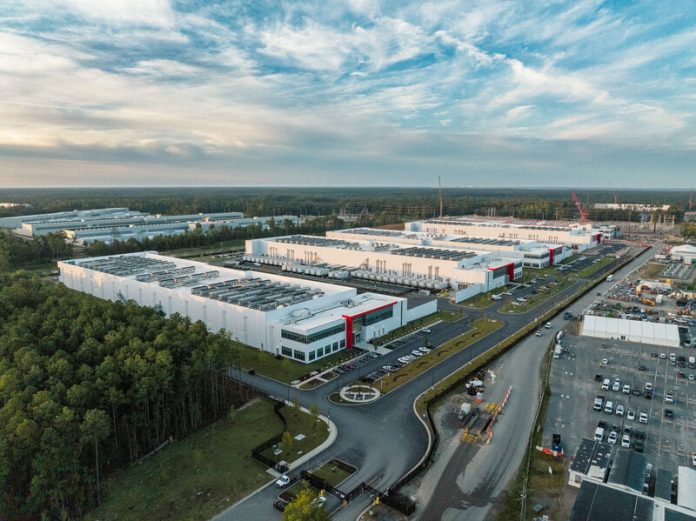

With controversial plans to build a massive data center campus in De Forest, QTS Data Centers will partner with a venerable Madison institution in the hope that the resulting carbon footprint won’t overwhelm the landscape.
QTS recently announced it will commit $1.5 million toward a research initiative to advance data center sustainability in partnership with the University of Wisconsin-Madison’s Nelson Institute for Environmental Studies, an acknowledgement that innovation will be the key to achieving what the company calls “sustainable digital infrastructure.”
The large, hyperscale data centers that accommodate artificial intelligence applications have raised concerns about land and water usage and energy consumption.
Paul Robbins, dean of the Nelson Institute, said the institute has long worked with government organizations, nonprofits and community groups and now is excited to partner with leading industries to create more sustainable outcomes.
Robbins said in an email that AI data centers are the sustainability question of the decade, if not the mid-21st century as a whole. He said that’s certainly the case in Wisconsin, a state that is quickly becoming a focal point of data center activity.
“If I didn’t think so, I would not have embraced the research mandate that this effort reflects,” he said. “We need to know a lot more about data centers and environment, land and energy load. UW is needed in this space and that’s our commitment.”
The QTS funding will support research projects focused on advancing responsible data center development, including energy systems to enhance grid stability and improve efficiency and reduce carbon emissions.
Among the innovations are hydrogen-enabled virtual power plants and carbon dioxide energy storage. According to QTS, this requires evaluating chemical and hydrogen fuel storage as virtual power plants utilizing excess renewable energy, and examining carbon dioxide-based energy systems for dispatchable energy storage.
Madison Williams, chief investment officer of QTS, said in a press release that the insights gained from this research initiative are essential to shaping the next generation of sustainable digital infrastructure while supporting the growing digital demands of daily life.
The UW-Madison partnership will involve faculty across UW–Madison, which has established RISE initiatives in several areas, including AI and sustainability.
Also among the key research areas are:
- Advancing sustainable siting and land use, including brownfield mapping, water quality improvements, soil carbon storage and agrivoltaic systems (using solar power to help grow crops);
- Investigating how large, rapid power swings from AI workloads affect electric grid stability and identifying ways to mitigate these fluctuations;
- Considering hybrid energy systems that leverage advanced nuclear power and cogeneration; and
- Supporting biodiversity and wildlife habitats through initiatives such as AI-enabled monitoring of pollinators, migratory birds and fish habitat.
Environmentalists are concerned about hyperscale data centers due to their large energy and water requirements. Two prominent environmental groups weighed in on the UW-QTS research partnership through prepared statements.
“We have a lot of work to do to ensure data centers will not harm our climate, water, and air,” said Chelsea Chandler, energy and air program director for Clean Wisconsin. “Innovation that helps avoid these harms is critical and should be the standard for data center development.”
RENEW Wisconsin released a statement calling for renewable energy to be part of the mix.
“RENEW Wisconsin believes that all data centers can and should be powered by clean, renewable energy,” the organization said. “Renewables can be deployed quickly and are proving to be more financially competitive than fossil fuels.”
The QTS data center also will need Wisconsin’s skilled labor to fill construction jobs.
On Nov. 18, the Building Trades Council of South Central Wisconsin announced a partnership to build the proposed data center campus. The council is comprised of 17 local building trades unions representing more than 6,000 building trades members who live and work in Wisconsin
Tracey Griffith, executive director of council, said in a press release that when local union members are on the job, the economic benefits stay in Dane County.
“By formalizing this partnership, we are investing directly in our workers and in the economic vitality of the communities they call home,” Griffith said.
Related stories:
Environmental group calls for full transparency on QTS Data Center

