
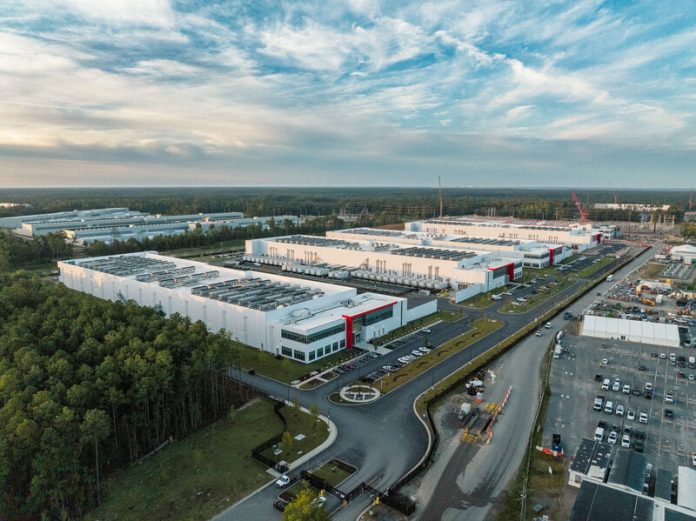

With promises of millions of dollars in tax revenue, thousands of construction jobs and hundreds of full-time positions, QTS Data Centers has submitted plans for a data center campus in northern Dane County.
At the same time, the environmental group Clean Wisconsin claims QTS data center buildings will require “far more” energy than all the homes in the county combined and is calling for full transparency on its energy and environmental impacts as the project is evaluated.
The multibillion-dollar development, which will accommodate artificial intelligence applications, is touted as a plan that strengthens Wisconsin’s role in what QTS called “sustainable digital infrastructure.”
The company said it is looking to build five data center buildings on the campus over the first three years. Initial plans announced in July would include up to 15 buildings over the next 10 years and add up to 450 permanent local jobs.
Like other proposals for large, “hyperscale” data center campuses, it will undergo scrutiny when QTS submits plans this month for a zoning application to the DeForest Village Board.
QTS, an Ashburn, Virginia-based company led by co-CEOs Tag Greason and David Robey, has pledged to pay for all of the project’s energy infrastructure and said there will be no additional costs to existing utility customers.
In an email statement, QTS said the project represents a transformative investment in Dane County’s future, infusing billions of dollars into local growth and development.
“This investment will create thousands of jobs and generate lasting economic growth across Dane County,” the company said, adding that the project will partner with local building trades unions.
QTS also said the project will generate millions of dollars in tax revenue, creating an opportunity to reduce tax burden for local residents.
Environmental effects
Water conservation has been a controversial aspect of some large data centers, but QTS said the DeForest campus would use a “water-free” cooling technology that does not consume water for cooling and therefore will not affect water supply in Dane County or the Yahara Watershed.
In 2024, the company said its water-free cooling technology saved nearly 1.5 billion gallons of water across other data center sites.
Still, Clean Wisconsin remains concerned about water use at the proposed DeForest data center campus.
In an email, Amy Barrilleaux, communications director for Clean Wisconsin and host of the The Defender Podcast, which is focused on environmental issues, said it’s extremely important for data center developers to disclose both how much water they will use during the hottest, driest days of the year when municipal water systems are most stressed, and disclose how those energy and water needs will be met.
“It’s important to note that any power plants built to serve the data centers will also use water,” Barrilleaux said. “Power generation is responsible for more than 70% of water withdrawals in Wisconsin.
“Offsite water use for the QTS data centers could be as much as a large Wisconsin city if gas, nuclear and coal power plants are used to meet their energy needs,” she said.
A recent analysis by Clean Wisconsin also addressed the scale of energy demand of large AI data centers in Wisconsin. Barrilleaux said more information is needed regarding the projects’ energy demands.
“Based on our analysis, it’s likely these QTS data centers will require far more energy than all the homes in the county combined,” Barrilleaux said.
Overall, according to the analysis, there are at least five proposed or approved AI data center projects across the state, but just two — the Microsoft data center in Mount Pleasant and Vantage data center in Port Washington — have disclosed information about potential energy use.
The analysis said those two projects will require a combined 3.9 gigawatts of electric power, which is enough energy to power 4.3 million Wisconsin homes. Citing census data, the analysis said Wisconsin has just 2.8 million housing units in the entire state, which includes both occupied and vacant units.
Community benefits
QTS and Alliant Energy Corp. also announced an agreement in principle to build renewable energy across Wisconsin with the goal of lowering the cost for Alliant Energy’s planned renewable facilities.
The proposed agreement will be facilitated by the sale of Renewable Energy Credits (RECs) from approximately 750 megawatts of new renewable energy sources, essentially enabling 750 megawatts of renewable generation in Wisconsin.
In a press release, Raja Sundararajan, executive vice president of strategy and customer solutions for Alliant Energy, said based on projections and identified trends, the agreement would provide a mix of energy generation “including wind, natural gas and energy storage.”
Yet Barrilleaux of Clean Wisconsin said it’s still unclear what is meant by the term “renewable,” and Alliant’s reliance on natural gas remains a concern for the environmental group.
“While wind and solar may spring to mind, tech companies and energy utilities often lump in expensive, slow-to-build nuclear power plants and even gas-burning power plants when they use this term,” she said in an email.
“Burning new methane gas plants in our communities will harm Wisconsin families for decades to come and push our state further from its climate goals,” Barrilleaux said.
Barrilleaux also said We Energies successfully pushed through two new gas-burning plants, a new liquid natural gas storage facility, and a liquid natural gas pipeline to serve the first phase of the Microsoft data center in Mount Pleasant.
As plans are presented to the DeForest Village Board, QTS said it will share more details.
QTS, which previously proposed the construction of a 615-acre campus in the town of Vienna, is reportedly considering annexing property to the village of DeForest, according to an Oct. 27 report in The Star.
The report said developers often seek to annex land to a city or village to access urban services like water and sewer or to expedite the development process.
In the meantime, Clean Wisconsin’s Barrilleaux called for full transparency so the public understands the full impact of the development.
“Full transparency from developers, tech companies and our energy utilities is critical because these are such resource-intensive projects,” she said. “Communities need to be able to see and understand the full impact of what’s happening before a project is approved.
“These are resources we all share.”

