
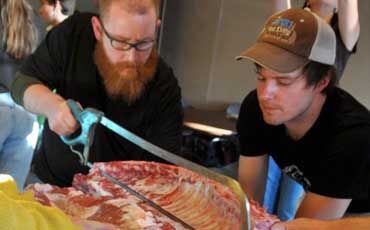

Underground Food Collective is one of those institutions that simply belongs in Madison. Conscientious, cooperative, socially relevant, refreshingly imaginative, and aesthetically astute, it’s grown into a local favorite in a relatively short amount of time. So when the collective’s signature restaurant, Underground Kitchen, was damaged beyond repair by a fire in late June of this year, it was a blow not only to the organization’s partners but to a disappointed public as well.
The June 30 apartment fire at 127 E. Mifflin off the Capitol Square not only displaced residents of 24 units, it also dealt a death blow to Underground Kitchen 1.0 – prompting its managing members to contemplate their future and, happily, the establishment’s second iteration.
“I don’t even know how to explain it,” said Underground Collective managing member Garin Fons, when recalling the blaze that shocked downtown Madisonians and left dozens scrambling to pick up the pieces. “I could use generic phrases like ‘getting the rug pulled out from under you’ – you know, that feeling of, you’ve just worked so hard to do something, and then all of a sudden it’s gone. In some ways, it’s super surreal. You still wake up thinking like it’s just going to be a matter of days until we reopen, or wait a second, we’re just on a break. But it sort of comes in waves of, ‘Oh, that’s right, that’s not there, and that’s not going to happen again in that space probably for a long while if at all.’”
Faced with the type of setback that few businesses ever encounter, Underground Collective – an organization that encompasses a unique meat CSA, a catering business, and the now-on-hiatus restaurant – is for the moment resting its fortunes on the remaining two legs of its three-legged operation.
Naturally, that takes balance – as well as patience, optimism, and a bit of faith.
“In some ways, it’s a mixed blessing. We get to ask ourselves the question of, ‘Gosh, how would we do this again?’ And a lot of times people in these situations probably don’t get this opportunity. – Garin Fons, Underground Food Collective |
“I think it’s been a challenge, certainly,” said Fons. “It’s also been a really interesting learning experience. We’ve had to deal now with the insurance company, we’ve had to deal with thinking about how do we move on, whether that’s a new space or a new concept. In some ways, it’s a mixed blessing. We get to ask ourselves the question of, ‘Gosh, how would we do this again?’ And a lot of times people in these situations probably don’t get this opportunity. They decide to open a restaurant and either it goes really well and they do it for 15 or 20 years, or it doesn’t go well and they close their doors.
“We were open less than a year, and now we can kind of ask the question of, ‘Well, if we’re going to do this again, what will we do differently and how will we do it?’ And we’re still energetic enough right now to actually undertake it again.”
Of course, few businesses are going to face anything as dramatic as a fire. The vagaries of the marketplace – particularly in the restaurant business – are enough to traumatize many owners of start-up ventures. So while it may be difficult to draw too many lessons from Underground Collective’s experience, there are nevertheless some valuable takeaways.
“I never anticipated this being the challenge that we’d face,” said Fons. “I thought maybe we’d find ourselves in a really great period of demand in the first year and then potentially see ourselves hit by economic factors or something like that. But I think there is that sense of, we have to remember to just be patient with a lot of things, keep costs incredibly low, and say, ‘What’s our mission here? What are we trying to provide?’ And I think as long as you’re true to that, you can realize that it’s really possible to keep going.”
Optimistic about the future
Fons said having the other two entities up and running has allowed Underground Food Collective to maintain the momentum that should keep plans for reopening the restaurant moving forward. And its unique organizational structure – which is non-hierarchical and cooperative, allowing its members to “work together, drawing on our experiences and training to produce food that’s better than any one of us could do” – likely provides the kind of support that might be lacking in a more conventional business.
For now, the group is eyeing a spring or summer 2012 reopening, and would like to locate downtown.
“That’s huge, for sure,” said Fons of being able to keep the meat CSA and catering businesses going. “I can’t tell you how many conversations we’ve had at events or just being around selling meats or being at an event where people are saying, ‘It’s great to see you. What’s going on? We can’t wait for the next thing.’ If we didn’t have those other entities, it could potentially be, ‘Oh, that was such a great place.’ Who knows? And it also might be in our minds, are we really going to do this? Are we really going to try? But having those other entities really pushes us to make it happen.”
So what’s it like to be part of a business that’s essentially in reboot mode instead of start-up mode? While it’s not the kind of scenario any business would like to face, if nothing else, it gives one a chance to get things right that may have been fumbled the first time around.
“I think we’ve all strangely been very optimistic about the next step,” said Fons. “We did things really well in opening the first restaurant, keeping costs incredibly low. We did a lot of aesthetic changes inside the restaurant, we didn’t hire out a lot of people to do work like, let’s say, figuring out how to set up the restaurant, set up the kitchen. We had the collective experience to have known how to do that, and so were able to keep those costs low. And so the optimism in this next phase as well, we could probably use not only that collective knowledge that we had to begin with, but now the knowledge that we have of running something for nearly a year. Now put together a plan, really consult with people on areas we don’t know – because obviously that’s what we didn’t do before – and move forward pretty quickly, and can hit the ground with a new venture. So I think we’re excited with that – I think we’re young and excited enough to be able to do it.”
Sign up for the free IB Update – your weekly resource for local business news, analysis, voices, and the names you need to know. Click here.

