

Five years ago, John Haugen-Wente, owner of Carl & John’s Paddlin’ in Madison, was in a world of hurt.
It was 2004, and the first phase of the 5-year East Washington reconstruction project was about to begin. Having just purchased the store a year earlier, Haugen-Wente was concerned about the impact construction could have on his business. He attended city-sponsored pre-construction meetings, planned as best he could, and hoped for the best.
What followed were two years of hell.
How bad is bad?
“That was the worst I’d ever seen,” recalled Michael Gay, now the City’s Business Development Coordinator, referring to the situation soon to befall the retailer.
With East Washington, Thornton and Dayton Streets the only routes to his store, Haugen-Wente said he “was assured by city engineers that all three roads would not be closed at any one time.” Yet that’s exactly what happened. And when legal issues delayed the project, Haugen-Wente had to sustain a second year of construction and lost business.
“It was very, very tough to get to the store,” Haugen-Wente recalled. “Some days, all three roads had ‘road closed’ signs. I had to go out every day to figure out how a customer could get to the shop.” When he asked the city if he could erect signs directing people to his shop, it refused. Haugen-Wente was stunned. (In the end, that decision was reversed.) To make matters worse, a “huge ditch” was carved between the store and the river, making test paddling — critical to canoe and kayak sales — difficult at best. The store never closed, he said, but there were days when not a single customer walked in. That year, sales at Carl and John’s Paddlin’ were down 25 percent, “and that’s a huge amount when you’re talking about a small retail operation,” he said. In 2005, Haugen-Wente wrote the city, saying he’d been “crushed by construction.”
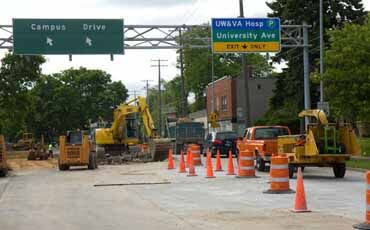
Carl & John’s Paddlin’ certainly wasn’t the only business affected by East Washington reconstruction, though it may have been the final nail in the coffin for two notable casualties: The Union House Tavern and Fyffe’s Corner Bistro. Looking back, Gay admits there were problems. “The first time we did this, we weren’t so good,” he said. “We’ve learned lessons, and we’ve spent a lot of time trying to minimize the construction impact on businesses.” Still in the throes finalizing the East Washington project and with another huge project underway on University Avenue (among others), Gay is proud of the strides the city has made.
Learning from Early Mistakes
“We start meeting with business and neighborhood associations long before construction begins,” Gay said. Discussions are already underway with Williamson Street businesses, for instance, in anticipation of a future resurfacing project. This year, in a partnership between the city, the Greater Madison Chamber, and the Small Business Advisory Council, a “Road Construction Survival Guide” was published, providing businesses with tips on how to prepare for looming construction, what to expect once it begins (including signage), and how to rebuild once construction is complete. The city also has a Web site that explains all current and future construction projects, for anyone’s use and planning.
Gay said that every major project now also has a team assigned to it, comprised of engineers, representatives from zoning, traffic, Madison Metro, and others to make sure customers can get around. “We hold team meetings beforehand, then the city hires a project manager whose sole purpose is to be the single point of contact in the field,” he said. Every two weeks, that person, who also serves as the liaison between the city, businesses and contractors, holds outreach sessions for affected businesses. “These are very well attended early on,” Gay said. “Then, as businesses learn more about the project, the attendance typically drops.”
Business Turnaround
On University Avenue, one business affected by the University Avenue construction is Tex Tubb’s Taco Palace in the Lakepoint Commons retail center. Manager Larry Curtis, who said he’s been kept informed of the project’s progression through the building landlord, said he’s noticed a slight downturn in business over the last few weeks. “As a business, you have to roll with it,” he said, though he admits he’s probably losing the casual customer. “The movement of cars (along University Avenue) hasn’t been that bad,” he said. “But because of all the media attention, I think a lot of people just avoid the area entirely.” His solution? “We are forced to run a better business, provide better food and better service to make it worth our customers’ while. And that’s a positive thing.”
Around the corner at Dykman’s Time Shop, manager Carol “C.J.” Schnier calls the summer construction “a necessary evil,” but appreciates the fact that the city waited until after UW’s graduation to begin. Her frustrations are mainly in telling customers how to get to the shop. Owner Glenn Gardner said last week’s business “was horrible,” but when he compared it to the same week a year ago, it was just as bad. “Whether the slump is due to the economy, summer, or construction, I don’t know,” he said.
On the far East side, Highway 30 construction, part of the last leg of the East Washington project, is also progressing. Dr. David Heitmann, who just opened a new chiropractic practice a 3109 Commercial Ave., knew about the impending construction project before he purchased the property. His biggest complaint has been the noise, which shakes his building whenever concrete is pulverized. But taking a more active role, Heitmann has signed up for weekly construction update e-mails offered by the city, and he’s made lemonade from the lemon handed him: “People during rush hour have to slow down in front of my business and are more likely to see my sign,” he said.
Meanwhile, back at Carl & John’s Paddlin’, which has since moved to 200 S. Dickinson St., the retailer is still trying to make up for lost business. “At the time,” he said, “I felt like the city did everything they could to shut down our business.” When informed of the city’s efforts to improve the effects of construction on local businesses, Haugen-Wente seemed pleased. “It’s good,” he said, “if in the end, people are helped by our situation.”

