

For all the well-documented headaches our animal friends might cause us – from late-night potty breaks to the Furmaggedon that overtakes crannies and couches in what can seem like an instant – almost any pet owner will tell you that all the fuss is worth it. And that’s not just cloying sentimentality. No, the joys of pet ownership are now backed by real, hard science.
Studies have shown that owning a pet can improve your mood, reduce stress, and even lower your blood pressure. In fact, a University of Buffalo study concluded that owning a dog or cat can help patients control their blood pressure more effectively than drugs such as ACE inhibitors. Another study, this one from the schools of Business, Medicine, and Nursing at Virginia Commonwealth University, found that taking dogs to work with you can lower stress and increase employee satisfaction.
So it’s no surprise that business executives, who typically live demanding, stress-filled, blood-pressure-spiking lives, are well represented when it comes to welcoming animal companions into their homes.
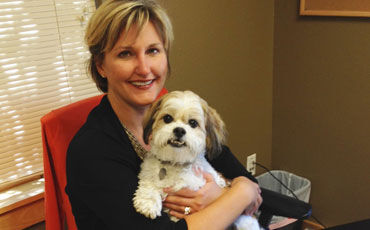
“I just like that you can come home from work and it doesn’t matter what kind of mood you’re in, they always want to be with you,” said Sheila Jenkins, president of the Fox Valley’s Network Health Plan and the owner of a 7-year-old Maltese-Shih Tzu mix named Benny. “And having a smaller dog means that he can sit beside me in the chair, and he can sit on my lap. It makes it a very good environment as far as just that companionship, but I think that part helps with stress reduction.”
Joys outweigh responsibilities
Of course, any non-pet owner would likely look at the frequent walks and feedings and general caregiving required of pet owners – not to mention the continual barking and/or fussing – and conclude that time-pressed execs would be the last candidates for pet ownership.
And that’s just what Lisa Cruz once thought. The president and founder of Red Shoes PR in Appleton, Cruz became something of an accidental dog owner when she adopted her family’s dog, Patches, an approximately 9-year-old Maltese-Shih Tzu, after her uncle moved into a nursing home and could no longer care for the animal.
| “It’s not embarrassing if your dog does stupid stuff. That’s different than if your children do really bizarre stuff.” – Sheila Jenkins |
“I grew up with a family of pets,” said Cruz. “We always had dogs and cats and everything, and then when we were first married, my husband and I had a couple cats but we ended up giving them away before we moved back to Wisconsin.
“Then we started a family, and I jokingly said for the past 11 or 12 years that we’re never getting a pet because we have four boys to take care of, so to me getting a pet was just putting me over the top with responsibilities.”
Cruz quickly changed her mind, however, when the family dog became, well, part of the family.
“He has just been a great blessing to our family life, and has helped with stress relief,” said Cruz. “It’s been wonderful.”
Work companions
Cruz also touts the complementarity of pets and workplaces – something that no doubt still raises eyebrows in a lot of boardrooms but whose benefits are, as noted above, backed by research.
“We have an open policy that if anybody has a dog, they’re welcome to bring their pet in,” said Cruz. “And when you bring a pet into the office, it’s wonderful how it just lightens the atmosphere and how great it is for the culture, so we really encourage that.”
Having a pet can also help office denizens in subtler ways.
Danielle Machata, a shareholder with Godfrey & Kahn in Milwaukee and the owner of a 7-year-old pug named Beasley, said that pets can be a good icebreaker in social environments.
| “Of the pictures on my phone, I think 90% are my dog. I think I have one of my husband in there.” – Danielle Machata |
“A lot of the co-workers and clients that I work with have pets, and I think that’s a good way to connect with people,” said Machata. “They get very excited to show pictures, and I’ve gone to happy hours with clients, and I find it hilarious that instead of everyone sharing pictures of their kids, everyone’s whipping out their phone to show pictures of their dogs. … I think it’s a good conversation starter.”
For Jenkins, owning a dog serves a social role as well, particularly within the office. She said she meets with all new employees after 30 days, and talking about their children and pets is a good way to relate to them on a personal level.
Talking about pets offers one very keen advantage, however.
“People love talking about their pets, love talking about their children, but when you talk about your pets, you can maybe express unusual characteristics they might have that you might not want to express about your kids,” said Jenkins. “So you’re freer in talking about your pets.
“I never really use it that much as an icebreaker or networking on a peer-to-peer professional level, but with new people that I’m meeting or staff that I’m working with, it’s a wonderful way to get people to start talking and getting to know each other on a very different level.”
Strong bonds
Of course, much of the stress-relieving potential of pet ownership lies in its intimacy.
While unconditional love is something that’s rarely a mainstay of the boss-employee relationship, many pet owners would say it’s the defining characteristic of their relationship with their animals, and that is bound to take the edge off life’s travails, no matter who you are.
“He’s a great stress reliever, just in the fact that you come home and he doesn’t care what you’ve been doing but wants attention, wants to be snuggled with,” said Machata. “It’s pretty relaxing.”
“They’re very needy, but it makes you feel good,” said Jenkins. “Even if you’re in a bad mood, they still want to be with you.”
Sign up for the free In Business Wisconsin Report – your weekly resource for local business news, analysis, voices, and the names you need to know. Click here. If you are not already a subscriber to In Business magazine, be sure to sign up for our monthly print edition here.

