

The Great Recession has provided a dramatic and painful reminder that economic fundamentals matter, and while the eight-county Madison Region certainly has catalytic industries or clusters, the long-term economic development strategy for the region has to be driven by a healthy balance between nurturing those clusters and ensuring a diversified economic base that diminishes the peaks and valleys.
The question is: how does that happen? True regional work recognizes that all borders are amorphous and they ebb and flow according to the challenges at hand, people’s shared cultures, and geographic attributes. Quality growth does not just happen — it’s cultivated through proactive leadership, and we must want it more.
That’s precisely the strategic logic behind the growth strategy of Thrive, the eight-county economic development organization serving Columbia, Dane, Dodge, Green, Iowa, Jefferson, Rock, and Sauk Counties.
According to Sean Robbins, Executive Vice President of Thrive, the regionÃÂÂÂs formula for quality long-term growth boils down to the following equation:
Diverse Economic Base + Culture of Economic Innovation + Quality of Life = Success
“By ensuring a diverse economic base, we experience less cyclicality and volatility and provide a broadened range of workforce options,” explained Robbins. “As we make existing industry better and draw on our culture of innovation to develop new industries that are high ‘value-add’ wealth-creation engines, we increase our region’s overall economic climate and quality of life.”
Noted Robbins, “While quality of life can be a hard-to-define term, what we want for our region can be summed up as ‘world-class lifestyle infrastructure,’ which requires assets like good schools and continuing education, good parks and recreation options, and world-class arts and transportation,” all of which helps area businesses attract and retain labor talent.
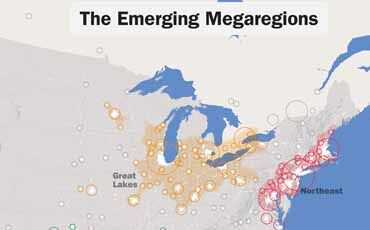
Greater Madison is part of a larger economic system throughout the Great Lakes Region, and Thrive is working to ensure that the eight-county Madison Region not only connects the dots inside the region, but connects them to the broader “mega-region.” Robbins points out that our true competitors are no longer Minnesota, Illinois, Iowa, or Michigan, but Latin America, Southeast Asia, and Eastern European countries, for example. “Neighboring states need to be seen as partners because our economy is more predicated on where economic transactions take place than it is on political borders,” Robbins added.
For the Madison Region to prosper, we have to remind ourselves that we are a part of a much larger economic ecosystem, and we have to start stitching ourselves into that fabric with a greater sense of urgency, Robbins said.
Thrive’s role in this new economic mindset is to develop strategic initiatives and projects that deliver tangible and relevant results — results that continue to build the economic and cultural strengths of the Madison Region, making us a strong, active participant in the mega-regional economy.
From Rust Belt to Robust Belt
Knocking down the traditional boundary system means thinking beyond our municipal boundaries, even pushing out across state borders, to better connect Wisconsin to this regionally diverse economic base that serves as a shield against significant market fluctuations. States in the Midwest Mega Region, one of 11 emerging mega regions identified by America 2050 for its collective economic might (see map), are exploring ways to grow their economies in the face of a shrinking manufacturing sector. This growth can come by leveraging regional assets like abundant natural resources, renowned research universities, and dynamic industry clusters.
The Midwest Mega Region includes parts of Minnesota, Iowa, Missouri, Wisconsin, Illinois, Indiana, Michigan, Ohio, Kentucky, and Pennsylvania. Taken as a whole, this region is an economic dynamo, with a population of 53.8 million (19% of the U.S. total), and a gross domestic product of just over $2 trillion (17% of the U.S. GDP).
By focusing on where economic transactions take place, Thrive and other regional economic development organizations intend to strengthen the connections between regions of Wisconsin and the Greater Midwest. It starts with appreciating the role of existing businesses in the current economic climate. For decades, an emphasis was placed on attracting established businesses from other states, a tactic that continues to this day (witness the outside courting of Harley-Davidson). There is, however, an emerging consensus that “growing your own” is a much more effective, and sustainable, economic development strategy.
The role of business retention is underscored by research from organizations like Blane Canada, an Illinois-based economic development consultant, and the International Economic Development Council. The IEDC generally states that up to 80% of new jobs and capital investment come from existing businesses. With this in mind, states have shifted more resources into building a better infrastructure for commerce, employing strategies like Thrive’s Business Link (more on this later) to stay ahead of emerging problems, retain businesses, and train their workforces to meet the ever-changing demands of a global economy.
With this consensus comes the realization that locally grown businesses must take on an expanded, regionally focused definition — and to make our regional businesses global players, Southcentral Wisconsin must strengthen its capital base for businesses. One initial need is to provide capital for companies in what has been called “the Valley of Death,” that phase between initial early-stage angel funding and venture capital funding that typically comes at the point of commercialization.
This funding is critical to business growth because second-stage companies, which the Edward Lowe Foundation defines as those with 10 to 99 employees and annual sales between $1 million and $50 million, are considered powerhouses for job creation. From 2005 to 2007, Wisconsin’s pool of resident companies averaged more than 33,500 second-stage establishments, according to YourEconomy.org, an online resource of the Lowe Foundation. Those second-stage companies employed more than 800,000 workers, which represents 36.7% of the jobs created by companies headquartered in Wisconsin.
“I think there is quite a bit of money here to foster invention at the university,” said Rock Mackie, co-founder of TomoTherapy, a UW-Madison medical device spin-off company. “There is even some angel money that will keep start-up companies going. But there is kind of a Valley of Death between the small entrepreneurs and where venture capitalists come in, and getting companies through that valley is crucial to building technology industries.”
Joe Kremer, president of the Wisconsin Angel Network, defines that Valley of Death as between the $1 million most angel networks are willing to invest, and the $5 million mark where VCs typically enter the picture. To make that valley greener, WAN is working across state lines to link Wisconsin’s 22 angel investor networks with similar networks throughout the Midwest. By helping to establish the Midwest Co-Investment Network of angel networks and funds, and the IQ Corridor Investment Forum, WAN is getting multi-state investors to learn about and discuss potential deals via conference calls and video conference links.
Kremer views such collaboration as another way that Wisconsin, which ranks in the bottom half of the 50 states in terms of angel and venture capital deployment, can leverage its assets. “We’re getting investors to collaborate across state lines,” Kremer noted. “Every investor group within the IQ Corridor now has an opportunity to work together on deals that interest them.”
These efforts haven’t gone unnoticed in the business community. More than any other type of business organization, global businesses understand the relative unimportance of political and geographical boundaries. Increasingly, they support the case for linking the eight-county Madison Region to the broader commercial world.
Electronic Link
Before the regional connection takes place, Wisconsin’s own distinct regions must come together, a process that is well underway with seven regional economic organizations like Thrive, the Milwaukee 7, and the New North. All of them meet quarterly to collaborate on a range of economic development and public policy issues.
Thrive has invested in a license with Blane Canada to launch Business Link, an online data-sharing project to support regional Business Retention and Expansion (BRE) programs by making key data available to business, government, and economic decision-makers. Business Link will enable them to proactively, rather than reactively, respond to fast-changing economic conditions.
The information will be gathered through standardized questions put to regional C-level business leaders by local economic development professionalsÑthis is currently the process. With Business Link, this data can now be entered into an online system and, armed with this data, decision-makers will be able to compare and contrast the data within the eight-county region and with their national counterparts, pinpoint expansion opportunities, determine their workforce needs, and identify at-risk companies or businesses that might be close to moving. That way, economic development professionals, elected officials, and business leaders can partner to address competitive business issues before layoffs and other negative cost-reduction measures occur.
A steering committee made up of representatives from seven of the eight counties in the region represented by Thrive, along with the cities of Madison and Fitchburg, Alliant Energy, and Madison Gas & Electric, has spent the past several months working on the system. Thrive has purchased the agreed-upon software (known as Synchronist), adopted a participation agreement, and is training local professionals to use it.
Karna Hanna, executive director of the Sauk County Development Corporation and chair of the regional Business Link project, said since the majority of new jobs come from existing employers, business retention lies at the core of any economic development program. At the moment, she said local entities rely on paper or disconnected computer records, but Business Link will enable them to electronically gather, share, and report data on how local companies and economies are performing.
“It will drive people to engage in retention work that has to be at the heart of economic development,” she said.
Thanks to the Thrive license, and support from Alliant Energy and Madison Gas & Electric, Business Link will be free to participants, with additional administrator rights available at a discounted rate. Brad Elmer, a project director for Thrive, said the BRE tool would help leverage scarce resources. “It’s work that has been done in the region for years,” Elmer noted. “Individual counties or municipalities would go out and do this work, but they were all using different interview questions, saving the information on their own personal computers and in their own databases, whereas this is an opportunity to leverage all that work these groups are doing in a shared system.”
Bruce Kepner, economic development manager for Alliant Energy, said Business Link is deployed in enough areas around the nation to enable regional benchmarking. “This gives you a lot of good comparison data,” he said, “and a lot of it is focused on strategic questions. We really should be asking companies about markets they are serving, clients they are gaining, and other questions that would indicate how they are moving forward.”
Compelling Vision for a Regional Economy
Thrive’s Sean Robbins views Business Link in the same context as the high-speed rail line between Milwaukee and Madison; that is, as one of many linkages that need to be made throughout the Great Lakes region. “We have to find as many ways as we can to stitch ourselves into the fabric of the economies throughout the larger region,” Robbins summed up.
In his view, the formula for long-term success includes becoming host to some of our nation’s most livable communities, its most diversified economies, and its most innovative cultures. That won’t happen unless we first start thinking in terms of economic activity borders, rather than geographic and political borders.
“We have now very 18th and 19th Century political systems and boundaries, with a very 21st Century economy,” Robbins noted. “Where we see conflict, it’s usually with an outdated political system trying to keep pace with what has become a very fast-moving, innovative economy.”
And while no single constituency can define the vision for the eight-county Madison Region, or define “what it wants to be when it grows up,” Robbins believes Thrive and its collaborative and proactive approach provides the foundation to bring collaborative change.
Thrive Snapshot
The selected metrics provide insight into economic changes and the direction of the eight-county Madison region. When drawing conclusions about conditions in the overall region, it is important to note that economic trends may vary among individual counties. Furthermore, the size of Dane County’s economy relative to other counties in the region often influences aggregate regional economic trends.

