
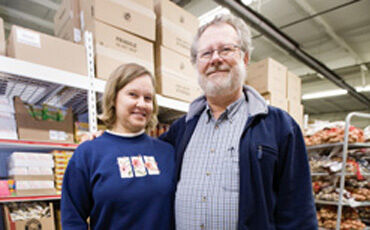

It’s 9:00 a.m. on an unusually bitter Thursday morning and Jenny Czerkas, project director of the The River Food Pantry, is on a mission: She’s “shopping” at the Second Harvest Food Bank, a trip she makes twice a week.
Czerkas has planned ahead. She’s already submitted a “pre-order” for countless foods and supplies and knows how many pounds of items she’ll be limited to, but she does not know exactly which items will be available when she arrives. Yesterday’s wish-list included, among other things, 20 cases of cereal, 400 pounds of curly ribbon pasta, 20 cases of spiral ham slices, and 25 cases of hand soap. Whether she receives any of it depends on Second Harvest’s inventory.
Joining Czerkas today are two volunteers — Mike and Omar — from the Ferris Center, on work-release. The River uses six Ferris Center volunteers five days a week, Czerkas says, and if it wasnÃÂÂÂt for the Huber program volunteers, the program would be severely impacted. “They run the show,” she admits, watching keenly as the men clear the shelves of sauces, crackers and peanut butter. “Take everything on that shelf,” she directs, “and get some bottles of marinade.” The men fill boxes on carts with dizzying speed, moving down the aisle from dry goods towards health and beauty products.
A refrigerated storage room is piled high with boxes of donated sandwich meat, lettuce and packaged baby spinach. Czerkas scans the boxes carefully for expiration dates. “We’re good,” she sighs, after verifying. Produce is free, she notes, as she checks the pre-order to see how much she is allowed. The threesome fills a huge box with potatoes, squash and apples. She seems genuinely pleased. “When I can get all this produce, it makes up for the lack of variety. Our clients love it!”
In the freezer, Czerkas is thrilled to find some frozen turkeys remaining after last week’s Thanksgiving holiday. “We serve 350 to 400 families every week,” she said. “And Second Harvest limits the amount of certain items regardless of the size of the organization.” So Dane County’s largest food pantries must adhere to the same item restrictions (coffee, for example) as pantries serving 25 families a week.
The River crew weighs the day’s haul: 620 pounds of lettuce and apples, 1,613 pounds of potatoes. In total, they leave with 2,233 pounds of free produce and over 3,000 pounds of dry goods and other products — which will be billed at 18 cents per pound. On average, Czerkas purchases 14,000 pounds of food every week.
In the loading area, Czerkas watches the volunteers wrap and then wheel the pallets into The River’s truck. “For a small percentage of these Huber guys, working with us has changed their lives,” she says, “and that makes a huge difference to us.” The truck with 220,000 miles on it, was also donated.
Waiting at the pantry is Czerkas’ husband, Andy, also a project manager and founder, who works full-time as an instructor at MATC and volunteers at The River at least 20 hours a week. Andy runs the kitchen, prepares the menus and cooks.
Following lunch with the volunteers (“We feed them well!”), shelves will be stocked, donations handled, clothing sorted, the building cleaned, and the room set for Friday evening’s free dinner, which feeds nearly 180 families every week. A local company donates 28 floral table decorations weekly, and when they can, the Czerkas’ find local musicians to provide a musical distraction from everyday struggles. Twice on Tuesdays, the pantry opens its doors to the public to allow people to “shop” for food and clothing at no cost to them.
“It’s a myth that people are trying to milk the system,” Jenny says, explaining that often, people wait outside for three or four hours to get inside. “You wouldn’t do that if you didn’t really need the food.” And pantry clients cross all socio-economic lines, she says, noting an increase in people from upper middle class neighborhoods. “They’re often embarrassed to be here, but their current situation leaves them few options.”
Indeed, the numbers are alarming. Through November, the Czerkas’ purchased nearly a half-million pounds of food and served 12,514 meals — up from 10,977 meals in 2007. All this, on a budget of $150,000 funded largely through individual and
corporate donations. Also noteworthy is the number of employed individuals visiting the pantry, which jumped from 4,022 in 2007 to 9,672 in 2008.
The Czerkas’ have been providing meals and clothing to Madison’s north side neighborhoods for nine years, and opened The River (a faith-based, non-denominational food pantry) in 2005. Last year, Jenny left a 23-year career in IT to devote all her time to the charity. “We just have a desire to serve people, and this allows us to express our Christianity without being judgmental or apologetic,” Andy says.
“This is church,” he adds emphatically, and Jenny agrees: “The more you give your life away, the more you get.”

