

It’s the call everyone dreads. The shocking, surreal life interruption announcing the death of a loved one or friend; or it’s that last kiss just before a final breath is expelled. It’s that moment when reality becomes clouded with disbelief, then overwhelmed with incredible sadness. It is a moment when many feel especially out of control and vulnerable. And it is a moment the funeral industry trains for and thrives on.
After all, someone’s got to do it.
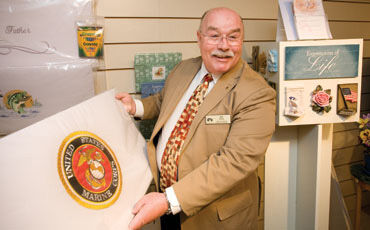
Bill Cress, president and funeral director at Cress Funeral and Cremation Service, did not plan on becoming a funeral director. But when his father, Bob, a funeral director and former casket salesman, decided to purchase the Madison business from the Frautschi family in 1977, the younger Cress, who already had a psychology degree, decided to go back to school.
It takes two years of college, one year of mortuary school, and a year as an apprentice to become a funeral director, said Cress, who received his Mortuary Science degree from Southern Illinois University. A state license is also required in Wisconsin, though that’s not the case in every state.
Cress Funeral Service, which has eight buildings and nine entities (including an a la carte Informed Choice facility offering basic services at budget prices), conducts about 1,000 funerals a year, and has a staff of 32 employees, including 12 licensed funeral directors. The directors average 50 hours a work week, Cress said, and rotate an on-call overnight schedule. They also get four-day weekends. The trade-off? Their day begins when that middle-of-the-night call comes in.
Funeral directors are instrumental in the entire death process. They handle the body, and collect and deliver it to the funeral home. Since 9/11, Cress said those who die while away from home can only be flown in to larger airports where they might be subjected to inspection or customs. So that middle-of-the-night call could also mean a drive to airports in Milwaukee or Chicago.
Directors consult with the family on final wishes, help with obituaries and planning the service, keep the service on time, drive the hearse if necessary, and even see that flowers are disbursed appropriately afterward. In Wisconsin, all funeral directors are also embalmers, Cress said.
Cress has a care specialist who prepares nearly all of the firm’s decedents for funerals. He is also a specialist in artistic restoration (needed in the event of a tragic death) and embalming practices. Though we were unable to get inside the embalming room (“guests” were present), Cress explained that the embalming process fixates proteins in the body so bacteria cannot cause decomposition. Blood and other bodily fluids are replaced by a formaldehyde-based embalming fluid; the body is bathed, clothed, makeup is applied and hair is styled. But even embalming is a temporary state.
The grieving process has changed significantly over the decades. Black is no longer the required color, and widows no longer wear black for a year, though Cress believes that extended mourning periods helped people deal with grief. While the psychologist in him feels cremation is “a way to avoid the grief process,” Cress said their responsibility is to see that family wishes are carried out as completely as possible, with dignity and reverence. “It’s all about saying ‘I love you…. goodbye.’ Everything we do should have meaning attached, or deliver healing moments.”
In the bereavement business, nearly everything can be personalized to create those moments and celebrate a life. Prices, of course, vary accordingly. Cress said the average cost of a funeral these days runs between $8,000 and $9,000. Cremations tend to cost less, averaging between $3,600 and $5,000, but like anything else, can run higher.
For those concerned about the environment, any funeral can be eco-friendly, and “green” burials are gaining interest, Cress said. Though no truly “green” cemeteries yet exist, some cemeteries have designated “green” burial areas on their grounds.
“Contrary to public belief, cremation is not green,” Cress emphasized, explaining that a significant amount of natural gas is used during the process. While pollutants are reduced, the heat and water used in the burning process creates carbon monoxide.
Caskets designed especially for cremation and constructed with biodegradable materials are readily available. One cardboard model at Cress is priced at $695. Ceremonial wood caskets can also be rented to achieve the “look” of a traditional funeral. Inside, the body rests in a temporary cardboard compartment that is later removed for cremation. One ceremonial casket on display is priced between $2,380 and $2,870, and includes a corresponding urn for the cremated remains. Standard wood or metal caskets can cost that much, and more.
Urns, like caskets, come in all variations and sizes, from the simple wooden box to full artistic sculptures. Those on display at Cress range between $295 and $1,000. Ashes for scattering can also be divided into decorative scattering tubes, and small amounts of ashes can also be stored in keepsakes or made into jewelry, and even diamonds.
When traditional burial is chosen, vaults or grave liners are required, said Cress. Vaults come in various combinations of concrete or plastic and they, too, can be personalized with family photos or pre-designed artwork. (Bottomless vaults for “green” burials are also an option.) But the widespread belief that vaults preserve a body is a fallacy, said Cress. “Their purpose (other than to house a casket) is to assure the cemetery grounds are supported and do not collapse.” Though they can be water tight, Cress said everything decays eventually, depending upon temperature and humidity.
Cress Funeral Homes perform cremations in accordance with CANA (Cremation Association of North America) guidelines, and is the only CANA-certified operation in Southern Wisconsin, according to the Cress president. The firm owns two crematories, one at its University Avenue location and one in Sun Prairie. Cress said the cost of a cremation unit can range between $80,000 and $100,000 depending upon installation, permits, and fire marshall approval.
At Cress’ University Avenue location, the crematory is in a lower-level room, sparsley decorated with a couch, chairs, and a couple of tables. Across the room stands an imposing, stainless steel-encased, fire-brick oven with a small door that opens at the push of a button. Though not required by law, family members can stay and witness their loved ones’ final journey into the searing light.
At temperatures of between 1,400 and 1,800 degrees, it takes about three hours to fully cremate a typical body, said Cress. What remains is calcified bone structure, and sometimes fragments of certain metals, such as those found in prosthetics, military metals or dental bridgework, which is recycled. Gold, he said, disintegrates quickly.
After about an hour, the oven cools and the cremated remains are collected. Typically, those remains would fit into a six-inch cube weighing between six to 10 pounds, said Cress. And based on a family’s wishes, they are then disbursed according to plan.
Despite the old joke that “people are dying to get in,” Cress said the funeral business is not recession-proof. “People will always die,” he said. “It’s a matter of how much they’ll spend.” And they’re spending less these days, resulting in a decline in revenue. Vice President Carey Cress Fose said they are well aware of the economic burdens people are facing. “We’ve seen price increases, but we can’t necessarily raise prices.”
The funeral industry is unique in that it plans for the future by focusing on the end, and we will all likely be a customer one day. With the onslaught of aging Baby Boomers, the industry anticipates an increase in business over the next 10 years. “We’ve been gearing up for 15 to 20 years,” Cress acknowledged, noting that the nationwide death rate has remained relatively flat of late, as people are living longer, healthier lives.
To budget for that future, Carey Cress Fose said they track costs; then, on the demand-side, they study state and regional death rate statistics and historical death rates. Armed with that information, they “get a pretty good idea on where the market is going,” she said, and they plan accordingly.
Then they wait for the phone to ring.

