
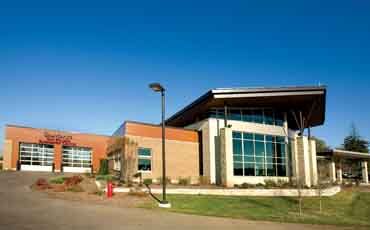

With the promise of critical medical care, immediate walk-in service, and 24/7 availability, St. Mary’s Hospital officials believe their mission is expressed in the new 13,500-square-foot Sun Prairie Emergency Center, but development of the facility would not have been possible without recent business process improvements and the adoption of electronic medical records.
The center, situated on 17 acres at Highway 151 and Reiner Road, opened in July and represents a merging of visions of St. Mary’s Hospital and city government. In trying to match the hospital’s mission of integrated health care with the community’s desire for improved health care services, the intersection turned out to be the state’s only free-standing facility emergency care facility.
The business case for the center revolves around faster care. The facility’s initial performance, as measured in a higher number of patients seen than forecast — over 2,600 in the first three months — has prompted SSM to think about whether this model may be appropriate in other markets it serves, according to Dr. Frank Byrne, president of St. Mary’s Hospital.
“We didn’t invent this model. I’ve seen it deployed in other parts of the country,” Byrne said. “While unique to Wisconsin, it’s something we may see more of in the future.”
Door-to-Doc Care
Manufacturing companies are not the only businesses that are consumed with process improvements. In recent years, health care organizations also have gotten into the process improvement act, adopting metrics like “door-to-doc time.”
If the Sun Prairie facility is the beginning of a trend, the care model associated with it might also be copied because it has played a role in improving the hospital’s door-to-doc time, according to members of St. Mary’s emergency care staff. With the door-to-doc system, the hospital tries to get an emergency patient in front of a board-certified emergency physician and implement life-saving measures as rapidly as possible. St. Mary’s implemented its door-to-doc system two years ago, measuring the time it takes for patients entering the front door to see a physician. The times decreased from 46 minutes to an average of 16 minutes, basically eliminating the need for a waiting room.
Christine Modena, director of emergency services for St. Mary’s Hospital, oversees the Sun Prairie Emergency Center, and part of her job is to develop and maintain an efficient process in which emergency patients flow through emergency care procedures. With a door-to-doc goal of 29 minutes (exceeded by 13 minutes), she said St. Mary’s examined every process it had in place as emergency patients moved from initial points of contact to the doctor, and it trimmed away as much as possible. For example, prior to the change, patients had to be critically ill to be taken back to a room without a 20 -to 30-minute wait. “If you were having a problem but weren’t in immediate danger of dying, you went to the waiting room and waited your turn,” she said.
Modena said St. Mary’s has taken the new emergency care system from its Madison hospital campus to the Sun Prairie Emergency Center. “We have a cultural change that we have been able to put into place where we work to get the patient to the doctor as quickly as possible,” Modena said. “People come to the ER to see the doctor. They don’t come to see a nurse. They don’t come to wait.”
Quicker treatment not only means quicker results for individual patients, it means more patients can be served. Since the hospital can get a patient admitted or discharged more quickly, “This allows the physician to more quickly move on to the next patient,” noted Dr. Anthony Callisto, associate medical director of emergency services for St. Mary’s.
Callisto said the Sun Prairie facility is unique because it was designed from the ground up with the hospital’s emergency care model in mind. The facility’s racetrack design, which features a central charting station surrounded by treatment rooms, accommodates the door-to-doc system with a rapid triage room, a 13-bed design that can quickly expand to more than 15 rooms as needed, and in-room registration.
The design allows for clear lines of visibility from the charting station to the patient rooms, “especially if they are unstable,” Callisto said. Openness and view lines, balanced against privacy for patients, are considered a critical planning concept for emergency centers.
The central station is referred to as a charting station, not a nursing station, for a very specific reason — teams of doctors and nurses work together as care partners on the same patient.
For a patient having chest pain, Modena said there would be two nurses, a doctor, and a technician who would all come into the room at one time and explain to the patient what each is doing. Care partners are there to support the physician because that’s who the patient really wants to see, but everyone plays a role in the delivery of care. “We’re all part of one big team that works together to help the patient flow through the system,” Modena said. “Every room at Sun Prairie is visible from that charting station, including the room that you’re actually received in.”
Processing Patients
At the Sun Prairie facility, patients are greeted by security — softer uniformed security, but security nonetheless — because emergency care departments have to be mindful of unstable patients.
The nursing staff also greets every patient that comes through the door, asking a few questions to figure out who is sick and not sick, which helps determine what type of room patients are referred to. Patients also fill out a five-question “fast triage” form and immediately are taken to the triage room, where vital signs are obtained. At the moment, St. Mary’s is having emergency patients fill out a screening tool for the H1N1 flu virus so that infected people can be identified before they have contact with anyone else.
After vital signs are obtained, the patient is transferred to a treatment room according to complaint. The facility has pediatric, ENT (ear, nose, and throat), cardiac, trauma, and resuscitation-specific rooms, but all rooms can take any type of patient. Registration, insurance, and billing questions are handled in the room simultaneously with the initial physician assessment.
The center, created in part for patient comfort, has designed a “fire engine” exam table for children’s exams. “We have a room set up specifically for children,” Modena noted, “but I can move the bed out and use it for an adult. We also have a room that is designed for patients who are not making good decisions, patients who come with mental health problems, and we actually have something that almost looks like a garage door that comes down over the medical equipment so they can’t injure themselves or break equipment while they are there.
“The rest of the rooms are all multi-purpose,” she continued. “We have a room where, in the middle of that room, the wall collapses like an accordion folds and that becomes a large trauma room where the lights converge on the patients. That allows you to work all the way around the patient.”
The emergency center is able to care for 90 percent of the patients who come to the facility, with no further transport needed. The 10% of cases that require hospital treatment are typically transported via Ryan Brothers Ambulance, a private ambulance service, but patients are allowed to arrange other transportation via a relative, assuming they do not need stabilizing en route.
If ambulance transportation is required, it comes at a cost of between $485 to $1,000 per trip, depending on the level of care needed (advanced versus basic life support). Ryan Brothers submits the bill to Medicare, Medicaid, or the patient’s private insurance carrier.
As is the case with most emergency care centers, the majority of the people seeking care at the Sun Prairie site arrive by themselves or with a loved one. Byrne felt it necessary to dispel a rumor that the only way to get to the Sun Prairie Emergency Center was by ambulance.
“We’ve made sure it’s very accessible by ambulances, and we separate the EMS staff from the weather [in an enclosed garage],” he said, “but most people come in on their own.”
Electronic Recordings
Without the implementation of Epic System’s electronic medical records (EMR) product in 2008, St. Mary’s would not be as efficient in establishing an off-site emergency care center. Finding and sending paper records back and forth would have rendered faster patient care impossible, and potentially compromised patient privacy. “That’s one of the things that made this emergency care program possible,” said Byrne of St. Mary’s $30 million EMR investment. “The Epic EMR is fully deployed in the Sun Prairie emergency room, and the records are immediately available on Park Street or out in Sun Prairie so that doctors and nurses and staff out there can access records of a patient from Park Street, if they have been hospitalized here before.”
Emergency personnel work in both the Park Street and Sun Prairie facilities, and all are trained on Epic’s electronic record system. (St. Mary’s has emergency staffers who work 80% of their hours at Sun Prairie, and 20% of their hours at its Park Street campus in Madison, and vice versa.) In an emergency care setting, among the most important data points in an electronic record are medication history and medical images of previous tests involving X-rays and MRIs.
Byrne said St. Mary’s also has, along with Dean, physicians who also are on the Epic EMR, the ability to have its ER physicians access Dean outpatient records. Their medical images, if they are having a CT scan or an X-ray, also are available in each emergency care facility. “In fact, the images out there are read by the radiologists here (on Park Street),” he said. “They are transmitted and read by the radiologists here.”
Added Modena: “It is vitally important that we have information about the past medical history in treating patients in the Emergency Department. The primary provider for the patient may have already ordered testing, have the patient in a specific treatment plan or could have treated the patient successfully for the complaint they have presented to the emergency department.”
Modena said personnel at the Sun Prairie site can access the records at Dean System and at St. Mary’s, and they are working with Group Health Cooperative to set up an account and look at their records, too. “So we’re able to make sure that we’re not repeating a lot of tests, not wasting a lot of dollars, or wasting a lot of resources,” she noted. “We’re able to provide almost that seamless care for the patient when they have gotten sick and they are not able to access their own doctor.”
While fully deployed, St. Mary’s Hospital is working to optimize its electronic records with all the functional bells and whistles. Once that is completed, the hospital expects to rise from Level 6 on the Health Information Management Systems Society (HIMSS) scale, a level occupied by about 30 hospitals nationally, to Level 7, the highest level because it signifies a system that is fully deployed and fully optimized. The HIMSS Level 7 designation has been achieved by only a couple of hospitals — both located in California, according to St. Mary’s spokesman Steve Van Dinter.
Health care Integration
One lament about health care is that hospitals tend to operate in their own silos, but St. Mary’s has a more integrated model. In assessing the local health care market, the decision to build the Sun Prairie site was not made because most of St. Mary’s patients come from the eastern part of Dane County. They don’t, but a significant percentage of its patients — almost 40% — are from even further away, including some from outside of Dane County.
St. Mary’s is a regional hospital, providing tertiary and other hospital care for people in an 18-county region. In SSM Health Care’s regional model, the organization has a sister facility, St. Claire Hospital in Baraboo, and it has affiliated hospitals in Dodgeville, Stoughton, Columbus, Boscobel, and Edgerton.
The organization also has physician collaborations with Dean Health System, including the regional Dean and St. Mary’s Clinics which are spread over 150 family physicians in the 18-county area.
St. Mary’s primary care clinics support care in local communities, and the hospital collaborates with its affiliated hospitals and some of nonaffiliated hospitals in the region. For example, colleagues at Columbus Community Hospital were involved in the development of the Sun Prairie Emergency Care Center. Given the proximity of Sun Prairie and Columbus, St. MaryÃÂÂÂs anticipates that some patients who seek care at the Sun Prairie site, and who receive their primary care in Columbus, will want to be hospitalized in Columbus.
With an integrated model, SSM Health Care has a history of delivering care in local communities, closer to where patients live, so developing the Sun Prairie Emergency Center was not a reach. “As part of the SSM Wisconsin health care model, we know we don’t have the market cornered on all the ideas,” Byrne said. “We have some ideas about what’s needed in various communities, but the Park Street campus was developed and expanded with input from the community, neighbors, the leadership.
“We used that model in developing Sun Prairie.”
In terms of assessing the Sun Prairie operation, Byrne said St. Mary’s had projected conservatively in terms of number of patients that would be seen, and the facility has exceeded its projections in the first three months — including a 30% increase from the first month to the second.
The patient-served statistics, 2,622 from July through September (720 in July, 935 in August, and 967 in September) and an additional 842 through the first 25 days of October, is a little bit misleading because it includes cases of both emergency and acute care. Examples of emergency situations would be breathing obstruction, drug over doses, poisoning, and large bone fractures, while urgent care typically includes mild cases of asthma, back pain, skin rashes, or small bone fractures of the toe, foot, or finger.
Theresa Weiland, nurse manager for the Sun Prairie Emergency Center, said the center’s staff is working to educate the community about the difference between the emergency care and acute care, but it won’t turn patients away in the meantime.
Designs on Health Care
The trend in health care today is to provide warm, inviting settings for patients, and it’s something that now is done routinely in new and renovated health care settings.
The Sun Prairie facility opened following a 16-month planning, design, and construction time frame. Byrne said the new emergency care facility required St. Mary’s staffers to work with Flad Architects to design something from a clean sheet of paper that made sense for patients. “When you are doing something that hasn’t been done, or something that has rarely been done like this, first it’s a lot of fun because there is no precise template of ‘this is how you do it,’” Byrne remarked. “Secondly, it’s a big obligation because you’ve got a responsibility to get it right, and in many cases there really isn’t an answer key of ‘this is how you do it.’
“We were able to look end-to-end at the patient experience, at the staff experience, at the work flow, and integrate that with our design team,” Byrne added.
Laura Stillman, principal and health care practice leader for Flad, the project architect, said a key design goal was to take advantage of the site by making the facility prominent and visible from Highway 151, so the building’s atrium, complete with a high-volume ceiling, has the highest visibility on the site.
The building exterior is accented with indigenous stone, a vaulted entrance, and double-height space with glass — allowing natural light to penetrate to the interior.
While the general public uses a secure entrance, ambulances drop off patients in a drive-through garage. Access for emergency vehicles is separated from the access for patient and staff traffic to avoid mixed populations trying to get to the front door. “That’s a critical issue in emergency facility planning,” Stillman said. “Ambulances must have a different direction of entry.”
The goal for the interior was to create an environment of warmth and comfort, similar to what has been attempted at St. Mary’s renovated hospital facility on Park Street. Design elements include wood detailing, translucent glass, and the elevated views, resulting in ample natural daylight that can penetrate into the interior and the work spaces. This is not a trivial feature because the amount of day lighting seems to elevate patient moods. “For patients who are frightened, having that little bit of sun in their room is very helpful,” Modena said.
Future Development
SSM Health Care, the Missouri-based parent organization of St. Mary’s Hospital, invested $7.9 million to build the center and $4.2 million to buy the land. The Emergency Center is barely five months old, so the hospital is taking a wait-and-see approach on plans to develop a more complete health-care campus, including an inpatient hospital. “It’s premature to speculate how that might evolve in future,” Byrne said. “Our focus at this time is refining and growing the free-standing ER business.”
Byrne noted that St. Mary’s has “campus availability,” and it selected a location that has substantial future potential — not only in one of the fastest-growing communities in the state, but in a section of the city that is experiencing a lot of residential growth.
He said the Sun Prairie ER was designed with expansion in mind, and the hospital has pre-determined how it could double the size of the facility if need be. The ER’s placement on the campus also allows St. Mary’s to provide other services around it as the need arises.
Asked if it could become the site of an outpatient health clinic, Byrne said the organization’s outpatient services, which work in collaboration with Dean physician partners, already has a strong clinic presence in Sun Prairie. Who knows, he speculated, whether these services could end up on the same site, possibly along with other services?
Some people in Sun Prairie already have posed this question to Byrne: When are you going to build the rest of the hospital around the ER? His response is more physical than verbal — a big smile. Byrne appreciates the enthusiasm, including a big turn out at the June open house (3,000 people) and in-kind and other support from the business community, but he feels the need to curb his own enthusiasm. “We were fortunate enough to assemble a campus that allows the opportunity for future growth,” he said, “but I think there are so many variables that it’s premature to speculate on how that might grow in the future.”
Community Concept
The free-standing emergency care facility could not have been built without support from the community, both residents and leadership. With a population that has increased 93% since 1993, Sun Prairie (population 28,322) is one of the fastest-growing communities in Wisconsin. Mayor Joe Chase was among city and hospital officials that were engaged in what Byrne called a ÃÂÂ’multi-year conversation involving a lot of stakeholders’ as the Sun Prairie Emergency Center was developed.
Byrne and Chase both say the Sun Prairie facility not only makes possible more convenient emergency care, but more time for local Emergency Medical Service personnel to get their vehicles back in service. Chase said the emergency-care facility has delivered ancillary benefits not only for the community, but for all of eastern Dane County.
“The ER staff is also offering our EMS paramedics valuable hands-on training,” Chase noted. “The location of the ER has cut EMS patient transportation time, which allows our ambulances to be back in service with a quick turn around.”
Paul Huemmer, director of security services for St. MaryÃÂÂÂs Hospital, splits time between the Sun Prairie and Madison facilities. He is getting positive feedback from his fellow Sun Prairie residents about the benefits of having the center in the community. “I’m hearing that people like knowing it’s close,” he said.
“I think there are people that don’t know it’s open 24 hours because we still get cars that drive up with people asking, ‘Are you open?’ We’ve only been here since July 1 though, and I haven’t heard anything negative about it.”
Sign up for the free IB Update — your weekly resource for local business news, analysis, voices and the names you need to know. Click here.

