
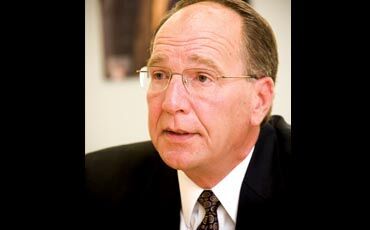

Tim Cooley, a former economic development director for the city of Madison, has led the effort for the Wisconsin Economic Development Corporation to create a $500 million [venture fund] authority to boost capital formation in Wisconsin following the collapse of the “fund of funds” approach. IB recently conducted a “Take Five” interview with Cooley to flesh out the basic structure of a Wisconsin Competitiveness Fund that soon will be presented to the Wisconsin Legislature. Key components include funding via tax credits to help fast-growing “gazelle” companies, in-state fund management, and a true statewide focus that is “industry agnostic” and doesn’t only look for deals in the Madison-Milwaukee corridor.
“Every other state is trying to do something,” said Cooley, who has been involved in a similar venture program design in California. “This is the first to take a hybrid approach, and I’m pretty sure this model will be duplicated. It just does more than other models will do.”
IB: Tell me how this new venture capital strategy is shaping up.
Cooley: We’re making significant progress. We’re taking a look at everything that has been done in the past, including the initiatives that were put on the table in January, to understand exactly what the drivers for each component of those are. We took the best parts of what’s already been done and combined them with what was needed specifically in Wisconsin to support new business formations and job growth, and developed a framework to address the entire spectrum of early through expansion-stage equity capital needs within our state. Our focus was to structure a way that actually allows rapid deployment of investment capital to the entrepreneur and company level, geographic coverage to the entire state, will be available to a wide range of industries with national and international market potential and that are important to our state now and into the future, reduces costs to the state, and, most importantly, creates jobs for Wisconsin workers.
Some of these are things that, knowingly or not, the original proposals didn’t address. They were concentrated only on traditional venture capital. The problem with that is most opportunities in Wisconsin that need growth capital are not venture capital-level deals. They may be in industries not focused on by VCs or have growth potential in the $25 to $50 million level in sales, far less than what a typical VC would normally look at. Nevertheless, these companies all create good jobs, add to our overall state competitiveness, and are candidates for good returns on investment.
As for industry types, most venture funds are focused on a particular technology or market, as they should be, to develop deep expertise and market knowledge within a particular technology domain, be it information technology, biotech, biopharmaceuticals, medical devices, energy, software, mobile applications, social networks, or other “high-tech” industries. But there is a tremendous amount going on in Wisconsin that doesn’t fit into one of those categories. Specialty food and beverage manufacturing is big in Wisconsin, and there’s an international market for those companies and their brands. Water and agricultural technology, basic manufacturing, OEMs, financial services, and gaming for entertainment, training, and education are all important industries in the state with strong growth and job-creation potential. These types of companies together with high-tech companies are where capital is a critical need to create opportunities for our workforce and talented entrepreneurs. But there’s a choke point in Wisconsin that limits growth no matter what the industry, and that’s availability of early through expansion-stage equity capital.
If we don’t or can’t create the opportunities here, we lose our most valuable resource to places that are supporting new businesses to start, take root, and grow. We’ll lose our people and our families, who will look to other areas of the country to find jobs and raise their families.
David Birch was founder of a firm called Cognetics back in the late-1990s who defined “gazelle” companies. These are companies that grow at 20% plus a year and are exporting goods or services outside of their immediate area to create new regional wealth. They sell to customers throughout the U.S. and world. And they’re not always what are normally considered “high tech.” These are the kind of companies that we want to help get started and support and what we should be focused on developing more of in Wisconsin.
“If we don’t or can’t create the opportunities here, we lose our most valuable resource to places that are supporting new businesses to start, take root, and grow. We’ll lose our people and our families, who will look to other areas of the country to find jobs and raise their families.” |
From an investment effort, we’re not concentrating on the purely local market or lifestyle businesses. Yes, those are important to a healthy economy, but they don’t, for the most part, create net new prosperity in the state.
Will what we’re proposing help those companies? Of course it will. It’s that new wealth that the gazelles bring into Wisconsin that allow the local merchants, retailers, restaurants, service businesses, and entertainment establishments to grow, flourish, and provide jobs for the entire spectrum of our population. It’s also what contributes to the ability of government to provide necessary services, supports education, and provides opportunities for our students when they graduate, and adds significantly to the overall health of our state’s economy. This may be an oversimplification, but you get the idea.
We want to take a look at how we can fund and support those gazelles and get funds to promising entrepreneurs and their businesses throughout the state. So instead of just concentrating on a strict venture capital-level strategy, which is what the previous proposals have advocated, we expand on that. We’re developing a structure that includes angel co-investments at the seed-capital level, support for new and emerging early- and mid-stage venture and growth buyout funds, expansion capital for when companies start growing rapidly and start manufacturing and shipping products, and a small allocation for strategic relationships with established funds to bring new investment, expertise and contacts into Wisconsin from outside-the-state investors to leverage our efforts and further support our entrepreneurs and their companies.
We want to help new and emerging venture funds get up and running. We need more professional fund managers and early-stage venture funds in Wisconsin to take advantage of all we have going on here. There are investors like Toni Sykes and Calumet Venture Fund or Peak Ridge with Jason Smith or Geo Investors Fund with Clay Norrbom. There’s Capital Midwest in Milwaukee, led by Dan and Steve Einhorn, and BizStarts with John Torinus and Dan Steininger. In Appleton, there’s Charlie Goff and New Capital Management. These are just a few of the investment teams that are currently raising funds. There are also a number of angel and seed funds throughout the state that are being organized, as well as growth buyout funds and a small handful of established funds like Venture Investors and Facilitator Capital.
These are the types of funds we need to try and help get established and support. We need them to set up offices and have investment teams working throughout the state. But it’s very difficult for a first-time fund or a first-time team to raise funds from institutional investors, the normal source for venture capital funds. So the idea is to put up to a certain percentage of their investment capital from a fund-of-funds, the Wisconsin Competitiveness Fund, which is what we’re calling this, to help get those new and emerging fund managers started so they can get to Fund II and III and eventually be able to go and raise outside money from investors, like pension plans, foundations, endowments, corporations, and other institutional investors that make allocations to venture capital. This is like a farm team in baseball, and through the fund-of-funds we’re working to greatly increase the depth of the bench as the players move into the major leagues.
The other major difference between the other proposals and what we’re proposing is that the earlier, and some current, proposals are looking at out-of-state fund managers to run the fund-of-funds. That’s not necessary. We can develop that capability in Wisconsin and keep the management and profits in the state. In fact, it’s better to run it locally because, at this stage, relationships count. The reality is that unless you are “on the ground” with a strong statewide presence in Wisconsin and are part of the entrepreneurial networks and ecosystem, it’s much more difficult to have a feeling of the team, the integrity, the ability, the knowledge, and the expertise of investment managers especially when assessing the capabilities of a new team without an established track record. You really don’t have the same kind of handle on it when you’re an outside fund manager.
There was a study done by the University of Chicago and UCLA that looked at the issue of proximity to early-stage investing. It basically quantified what we all knew instinctively, that early-stage investors want to be near their investments at the very early stages and be able to “kick the tires” to help the companies grow. They want to be close by, both for strategic needs, mentoring, relationships, and for good governance. There’s a dramatic falloff of investments in companies that are farther away than 100 miles from the investment fund’s offices at this stage of investment activity. It’s why so many entrepreneurs feel that they have to move and start their companies in venture capital centers like Silicon Valley, Boston, Southern California, and, increasingly, Manhattan for companies formed around social networking and entertainment software.
IB: All the more reason for a home-grown solution regarding VC. It sounds like you’re really tailoring the program to our state’s needs, correct?
Cooley: We are. I’m adapting a plan we had 15 years ago, when I and a team of experienced VCs were asked to do this in Southern California where, at the time, there was also a lack of early-stage capital and good opportunities were either failing to get off the ground or forced to move up to the San Francisco Bay area. That original plan morphed into a national venture capital fund-of-funds management company when our board saw that the same situation existed in other regions of the U.S. The strategy was an actively managed fund-of-funds investing in both top-tier performance venture funds on both coasts that were looking for additional deal flow in other areas of the country, and in emerging markets often overlooked or ignored by the major institutional investors and their investment consultants. We spent quite a bit of time here in Wisconsin looking at leading firms like Mason Wells and Venture Investors, and spent time meeting with institutional investors like SWIB, NML, WARF, and American Family Insurance, who were investing in venture capital on a national basis as well as leading corporate attorneys and other professional service providers to get a feel for who had the best teams and deal-flow networks because we wanted to get money invested into these promising emerging entrepreneurial markets. We knew from research by the Kaufman Foundation and Milken Institute, the SBA, McKinsey & Co., and others that some good things were happening here and in other lesser known regions for research and innovation, but they weren’t getting the coverage either by the West Coast funds or institutional investors.
The “actively managed” strategy we had for the fund-of-funds was much different than any other fund manager that typically is simply an aggregator of institutional investments. … They offered very little in value-added to their investors. Our team’s strategy, on the other hand, was to actively connect coastal funds with syndication opportunities in emerging markets like Wisconsin and make strategic connections between individual portfolio companies to enhance performance. We also had a relationship with the Ministry of Technology in China to set up an RMB-denominated sub-fund to finance joint ventures with our underlying portfolio companies that needed access to that region for manufacturing and markets. All in all it was a very active, value-added role.
Back to the other proposals that have been discussed in Wisconsin over the past several months, the other big difference is that, unlike others, the Wisconsin Competitiveness Fund’s structure retains all the profits from investments in the state. In some of the earlier proposals, up to 80% of the profits left the state.
IB: Which makes no sense at all.
Cooley: It makes no sense if you have the ability to manage it here, and we have the ability to do that.
The current plan being formulated by the Wisconsin Economic Development Corp. (formed on July 1 from what used to be the State Department of Commerce), in conjunction with legislative leaders from both sides of the aisle in the state Senate and Assembly and the governor, is to form the Wisconsin Competitiveness Fund (WCF). The fund’s manager, WCF Management, will have the ability to closely work with the Wisconsin Economic Development Corp. and other state agencies to better coordinate all the programs they have available to further support individual portfolio companies as we bring them along. The fund and manager will be structured to be fully accountable and transparent at the fund level yet isolated to avoid political influences that have plagued initiatives in other states. We’ve put in a great deal of time and effort working with the Legislature, industry participants, entrepreneurial community, and investment professionals to design a structure that accomplishes what’s needed while avoiding the negatives and traps of previous proposals and efforts elsewhere.
IB: What about the specifics of the structure?
Cooley: The key to the Wisconsin Competitiveness Fund (WCF) is that it’s a hybrid fund-of-funds. It has four distinct investment strategies and allocations built into it.
The first one is a Wisconsin-based angel co-investment allocation. This is how you deploy investment quickly to the individual company level and into the very early stages getting it to promising deals in all parts of our state. We have some good angel groups that have been established throughout the state. We also have good individual angels and what are called “super angels,” who are individuals who have been very successful in their careers and are now investing in companies where they have firsthand knowledge or experience in the target markets or with the underlying technologies. They have made a lot of money in their fields and they want to keep doing it but instead of starting and running a company on their own, they prefer to invest in promising entrepreneurs and help them to grow their companies. It’s back to the metaphor of increasing the “depth of the bench” by developing new CEOs and managers to run fast-growing gazelle companies in Wisconsin.
Right now, the angels are a bit paralyzed. They’ve been making investments over the last 10 years but now, with the dearth of exits, they are in a position of not making new investments but performing triage on their existing investment portfolio to keep them alive until the economy improves and they can exit out. What we want to be able to do is go to these individuals and groups and say, listen, if you’re sourcing the deal, doing the due diligence, and more often than not, as we know from angel investing research, at least one of you will have strategic knowledge of the space of that investment. You’re qualifying it in the best way possible – you’re writing a personal check out of your own account.
“Right now, the angels are a bit paralyzed. They’ve been making investments over the last 10 years but now, with the dearth of exits, they are in a position of not making new investments but performing triage on their existing investment portfolio to keep them alive until the economy improves and they can exit out.” |
We’ll match your investment and double your capacity to do good deals. It’s going to be on the same terms, the same identical terms as your investment, so if you need $300,000 and the most you can come up with is $200,000, we’ll take the other $100,000. If you want to let us match it and just put up $150,000 of your own, we’ll take the other $150,000. This increases your capacity to source deals, do deals, and support deals.
Our proposal is for Wisconsin Competitiveness Fund to match the initial angel investment round up to a maximum of $250K on the same terms and conditions as the angel investors.
The second allocation will be to Wisconsin-based new and emerging venture funds because we need strategically to be able to build up bench strength of professional investment teams and get them dispersed throughout the state so that we have more than just professional venture investors in Madison and Milwaukee but can get teams up and going in other regions of Wisconsin.
In this category, the fund-of-funds will match outside investors in the new or emerging fund for up to one-third of the total fund capital up to a maximum amount that will be determined by the eventual size of WCF approved by the Legislature.
IB: Will the funding source be the same as the bills introduced earlier this year?
Cooley: No, but I’ll get to that.
The third allocation pool will be for Wisconsin-based follow-on investments. We want to be able to do direct follow-on investments in deals that have been originally funded under the angel co-investment and new and emerging funds strategies and now require another round of financing. Part of our agreements with the angels and funds will include the right to co-invest in subsequent rounds in individual companies.
In the case of an angel investment, if an angel-backed company needs a little bit more money to get to the point where a VC will look at it, then we can come in and do a direct investment with another round that the angels may be doing, but we have a choice as to whether we do that. We’re talking about initially getting involved in over 200 new companies, so there are a lot of individual deals. Out of those 200, maybe half will go to the next stage but of those you might be able to have 50 go to a venture capital round. The national average is 35% of all organized angel group investments go on to secure professionally managed venture capital. We’re being conservative.
Now, that doesn’t mean you’re losing money on those companies that don’t move on to a VC round, it just means that this is how the continuum runs. Those companies may be a great investment for the state and individual angel investors if they grow to $10, $20, $40 or $50 million in sales and are acquired by another company or buyout fund. Regardless of eventual outcome, all of these companies are creating jobs, adding to whatever industry cluster they’re part of, and building Wisconsin’s position and reputation as supporting entrepreneurs.
The fourth allocation pool is to invest into regional and national top-performing funds. The reason for this is we have syndication potential of being able to bring money from outside the state in and leverage what we’re investing through WCF. These funds have tremendous Rolodexes, contacts, corporate partners, investment banking, and analyst relationships. They’ve been around for a while. There are some good regional funds in the Midwest that need to be exposed to what’s going on in Wisconsin. A regional fund is everything from Baird’s private equity group, which is based in Chicago but has a strong and respected Wisconsin presence, to some that are in the Minneapolis area that addresses western Wisconsin. There are others throughout the region. So while we’re doing all this other stuff, let’s build up the regional capacity because the reality is capital, innovation, and talent don’t really care about state lines. Once a critical mass of entrepreneurial successes is achieved and known in a region, capital at later investment stages flows pretty effectively.
Where it doesn’t flow effectively is from the coasts to the Midwest. It’s an inefficient market, and denying that fact is the basis for the argument that has been put forth against any kind of a government-backed initiative like this – the argument always goes that the market will take care of it. The markets don’t work at the early stage. They’re not efficient. There is not perfect information or willing buyers for every seller just to negotiate on price. Remember what I said earlier about proximity. Like real estate, location matters.
In the early days of Silicon Valley, over 75% of the venture money came from government funds. They were in the form of SBICs, small business investment companies, but it wasn’t until the advent of the limited partnership regulations where you saw a flip. You saw wealthy individual investors find out that, number one, the returns the government was making were pretty good, and two, that they can get involved not only on an individual basis but on a pooled basis to get diversification and exposure to a number of opportunities. Once that happened, it was only a matter of time, around the mid- to late-‘70s, that institutional investors started to make allocations to venture capital and other private equity investments.
Another reason we want an allocation in those larger, top-performing, established funds is that they help smooth returns to the upside. Top performance funds historically and statistically are likely to remain top-performing funds. Team experience, deal-flow quality, syndication networks, and corporate relationships are only gained over time and with prior success.
And let’s face it, angel investment and emerging and new funds may be risky but they’re absolutely critical to jump-start what we have here in Wisconsin and keep talent from leaving to get funding somewhere else. But we also have to be responsible to the taxpayers and the state that we are asking to basically fund this, so we have to be concerned about not losing money. So we want to be able to have that smoothing function that comes with a small allocation to established top-performing funds. We of course would like to have those investments in Wisconsin-based funds but, unfortunately, we only have one or two that could be considered in that category. We will, however, ask that these funds make a best effort to invest at least as much as we put into them back into Wisconsin. If we’re right in what the opportunities are here and get the early-stage funding into the hands of good entrepreneurs and companies, then I have no doubt that multiples of what we invest in these funds will be reinvested back into our state.
As far as the financing of the WCF, originally we were looking at doing it as a note, a debt offering backed by tax credits. It would look, feel, and smell like a triple-A bond. That way, institutional investors like SWIB (State of Wisconsin Investment Board) and other public pension funds could put it into their debt portfolio and insurance companies and other regulated financial entities, could put it in their portfolio without taking a charge against reserves. (A bond is accounted for differently within an insurance company than is an equity investment.)
But the problem with that is, you’ve got a hurdle, you’ve got a coupon rate, and in order to do this, Michigan for instance is paying triple-B rates plus 100 basis points, which brings it up to about 7.25. For SWIB to do this easily, we’d basically have to match their actuarial assumption on their portfolio. So now we’re talking about a 7.5% coupon – I wish I could get those returns on bank CDs at M&I – and you have to pay the money back. It’s a debt. We’re looking at a fund that over time will invest $500M. If we went the debt route we’d see an immediate haircut of nearly 35% just to provide a debt service reserve knocking our investable funds down significantly on day one. It’s just not a very attractive structure for what needs to be done.
Well, about a week and a half ago, we started to think … actually, the suggestion came from Chris Prestigacomo, who runs the Wisconsin portfolio at SWIB. He asked, “What if we just do a tax credit?”
IB: So you changed your structure to eliminate debt to fund the fund?
Cooley: Yes. Instead of the note structure, we really started to look at it again. It made sense to do tax credits. We could have the tax credits authorized by the Legislature and administered by the WEDC. As the WCF needs cash to meet capital calls from the funds its invested in or cash for the co-investments, it lets WEDC know and the credits are monetized through their sale to corporate taxpayers. There are tremendous advantages with this approach: one, we are not paying a 7.5% interest rate to institutional investors, so we’re able to save that expense. Two, the organization costs are much less because the bond offering size we were talking about would cost well over $1 million in bond counsel and other legal fees alone. Three, it allows all the profits to stay within the state and “evergreen” the fund, which means we’ll be able to reinvest proceeds and keep building the investment pool and investing in new opportunities for years to come without having to go back to the state for additional funding. The other proposals on the table are for a one-shot deal. The WCF has been structured for long-term self-sustainability. Four, which would actually accrue either way, is that we’ll be able to show that the incremental growth in the state sales taxes, state personal and corporate income taxes, and property taxes resulting from WCF investments will more than make up for what is being given up with the tax credits, and it makes for a much cleaner deal. It’s a much stronger structure for the state.
The biggest advantage is the evergreen. Under the original note idea, you’d have to pay all those notes back, so you end up with nothing except whatever profit may or may not be there. With the tax credit structure, all the original investment that’s returned plus the profits stay within the WEDC and WCF and, by extension, the state of Wisconsin. It allows the state to have an investment pool available for competitive purposes to help businesses grow, and attract and retain businesses that are here for years and decades to come.
IB: With the use of tax credits, is it the same principle as Act 255?
Cooley: While Act 255 credits have been a great tool for us in Wisconsin and have been duplicated in other states, the credits we’re anticipating are fundamentally different. We’re not giving the credits to outside investors, they’re being retained in a state account under WEDC until needed by the WCF and then they’re still an asset of the state since WEDC is the sole investor in WCF. It’s just like an investment by SWIB into a fund. The value of the fund investment is still an asset on SWIB’s balance sheet. We’re working on the modeling now and we’re insisting that the assumptions and forecasts are based on bulletproof data from reliable sources. In the end, it will be up to the state’s fiscal bureau to score it for the Legislature to have during their deliberations.
IB: Is that the biggest potential snag that you see?
Cooley: In terms of people taking shots at the structure? No, I’m confident that the hybrid fund-of-funds model addresses the needs in Wisconsin; is adequately diversified as to industry and investment stage to mitigate risk; can be managed in-state to reduce costs, increase returns, and leverage other resources; and has the unique feature of being a sound foundation for an evergreen investment fund that’s sustainable well into the future. If we had done something like this 30 years ago when the first studies on the state’s competitiveness were put together and the need for early-stage risk capital was first stated, we’d be in a much stronger position today.
Will the Legislature and governor see this structure as the preferable solution to what they want to accomplish? We’ve been briefing the governor’s staff on a regular basis and meeting with individual legislators to get their input and feedback just as we have with angels and venture investors to fine-tune the structure. What’s come out of the process is a structure that satisfies needs for the entrepreneur, the investment community, and the policymakers.
Will some question our ability to manage the WCF in-state? Maybe, but I believe we have the talent and expertise available to put together a great team. I’ve already spoken to a couple of candidates and they’re excited about the opportunity. Personally, I’ve been working on issues and programs like these for over 20 years. In addition to the national fund-of-funds management company we formed in 2000, I’ve been involved in starting the nation’s largest angel network, Tech Coast Angels; have headed corporate finance for a national broker dealer; and been a senior financial consultant at the leading market strategy firm in Silicon Valley. I’ve worked with venture capital firms, their portfolio companies, investment bankers, and institutional investors. I’ve been a founder, CEO, board member, and investor in dozens of companies and entrepreneurial support organizations. I was part of the State of California Capital Formation & Business Investment Commission and the state’s Economic Strategy Panel. I’ve been a member of the board and a fellow at Larta Institute for over 15 years where we help U.S. states and governments around the world address issues such as these and have contracts with the National Science Foundation, the National Institutes of Health, the Department of Energy, and the USDA to help commercialize and grow their Phase II SBIR grantees. I’ve seen what works and what doesn’t work.
Look, we all realize that Wisconsin needs jobs. It’s in the headlines every day. Is this the complete answer? No, of course not. But when combined with a comprehensive small business agenda for the state that the WEDC is working on and that includes legislative reforms and leveraging of other resources, I believe that it will have a very real and tangible impact on developing good-paying, high-multiplier jobs and increase the state’s GDP, which translates into additional tax revenues without having to raise tax rates.
Key is to appreciate how the WCF segments interact with one another to provide the full continuum of early-through-expansion-stage funding and leverage other state and federal programs. It’s a balanced approach to get funds quickly, efficiently, and responsibly to those entrepreneurs and companies that have the best opportunities to build businesses and create jobs.
If there’s one caution, it will be to resist the temptation to hang unnecessary ornaments on this tree. The structure has been well thought out and is very efficient. Any unnecessary restrictions or requirements that don’t directly further the strategic purpose articulated by the governor, both houses of the Legislature, both sides of the political aisle, and that’s being demanded by the citizens of Wisconsin to create jobs need to be avoided.
We also need the flexibility to make future adjustments: As much flexibility as possible because situations change. We need to have the flexibility to do deals that make sense. The definition of sensible is fiscally responsible with job and competitive gains. Too many ornaments on this tree and it becomes very problematic.
What we want is balance to be able to grow the promising areas we have in Wisconsin, where we already have the kernels of a cluster and build up into a competitive regional, national, or internationally recognized clusters and centers of excellence. We need to leverage all the fantastic resources that exist in our state to realize our full potential and optimize the opportunities for our citizens. I believe the Wisconsin Competitiveness Fund concept and structure helps accomplishes that.
Sign up for the free IB Update – your weekly resource for local business news, analysis, voices, and the names you need to know. Click here.