
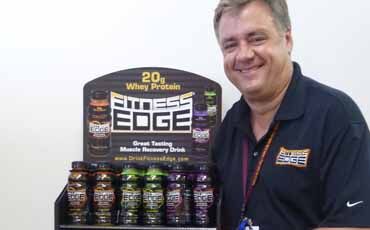

With all the dairy components – including whey protein and skim milk – produced in Wisconsin, Galloway Co. has introduced Fitness Edge, a new protein drink now available at Madison-area Woodman’s stores. While Galloway is based in Neenah, this is one product launch with a “Wisconsin Idea” underpinning, as Galloway’s Mark Gottsacker explains in this inaugural edition of “Take 5.” In case you’re keeping score, whey protein is a by-product of cheese making (curds and whey), with the whey coming from a large mozzarella cheese producer near Luxemburg, Wis., about 15 miles east of Green Bay. The skim milk is stabilized by Galloway using proprietary technology, the product is actually bottled by Century Foods in Sparta, Wis., and the inspiration comes from the UW-Madison Center for Dairy Research.
1. Where did the idea for this product come from?
About four and a half years ago, I was reading an article in Sports Illustrated about the NCAA regarding an investigation of 10 major university athletic programs providing supplements to their athletes. The schools were buying ready-to-drink protein drinks at retail and handing them out at practices. The problem was that the ratio of protein to carbs was outside the NCAA guidelines. For me, it created the realization that athletes were starting to turn to ready-to-drink products beyond the powdered protein that was the dominant source. It also helped us to see that there is a larger segment of the population that understands the nutritional benefits of whey protein, particularly for muscle recovery after exercise, than was perceived by beverage companies.
2. You indicated that the UW-Madison Center for Dairy Research provided the inspiration. How so?
We started the product development process by talking to people at the UW Center for Dairy Research. They had just completed making their own protein drink for UW athletes. After tasting their beverage, we felt that we could make a better-tasting product using our dairy beverage technology. In September of 2008, our beverage was awarded the Gold Medal at the World Dairy Expo for the “Best Tasting Protein Drink.” The CRD helped us in finding the best protein source for our product, and gave us some great formulation and processing direction.
3. How did you test it, and on whom, before bringing it to market?
Our focus groups for product evaluation and package design development were mostly made up of UW students. Some of the product content was defined by nutritional research. We believe that 20 grams of whey protein is the ideal amount to consume after a workout to fuel the body to develop strong, lean muscle mass. From a consumer standpoint, our target was to make a product that had less than 200 calories per bottle and was low in fat (1.5 grams).
4. You’ve now introduced it in the local Woodman’s Food Stores. Where are you in terms of bringing it to stores beyond Wisconsin’s border, and to what extent can you rely on your existing distribution channels to make that happen?
Our initial placement strategy is for Fitness Edge to go into the nutritional section of large grocery store chains. Woodman’s is our first chain, and the level of success we have there will have a big impact on what other chains will pick up the product. We have had meetings with SuperValu, Meijers, Roundy’s, and ShopKo to date. The Hy-Vee chain, based in Des Moines, Iowa, has been very aggressive in developing their nutritional products sections, and we think Fitness Edge would be a great fit in their stores. A success story at Woodman’s will be a big help. All the chains that we are currently talking to have direct-to-store warehouse distribution, which simplifies the distribution process for an entrepreneurial brand like ours.
5. What is your fondest hope for this product in terms of your place in the protein drink market?
As I mentioned earlier, the Galloway Co. is primarily a b-to-b company, not a consumer brand developer. When we started the product development process, we knew that to have any chance for success we had to create a product that had significant differentiation from what is currently available, and to that extent I think we have done that. Virtually every other product in our category is a milkshake-type product. Fitness Edge contains 10% fruit juice and is more like a smoothie to drink. It is very refreshing, and we believe it is a great option after a workout. Another benefit for us in the nutrition section is that consumers shopping that section are both label readers and early adopters, allowing us to reach them without an excessive marketing spend. Realistically, our hope is to be in a large percentage of the major grocery chains within two to three years.
Another aspect to the ready-to-drink protein segment is that there are numerous consumer group segments that can benefit from adding whey protein to their diet. More than 30% of the population over 55 suffers from sarcopenia, which basically means they are not consuming and digesting enough protein to meets their bodies’ needs. As we age, our protein digestive efficiency drops. The result is that the body will draw protein from existing muscle mass to meet its needs.

