

Chim chim-in-ey, chim chim-in-ey
Chim chim cher-ee!
A sweep is as lucky, as lucky can be
Chim chim-in-ey, chim chim-in-ey
Chim chim cher-oo!
Good luck will rub off when I shakes ’ands with you
Or blow me a kiss, and that’s lucky too!
Decades after Dick Van Dyke danced across London’s rooftops as a chimney sweep in Mary Poppins (1964), the chimney sweep profession thrives, despite its sordid past.
Centuries ago in Europe, chimneys were often swept by orphans as young as 4, or children who were sold by their parents to chimney masters. Luck had nothing to do with their lot in life. The unfortunate youngsters were required to climb up narrow chimney flues, scraping soot and creosote along the way. If they weren’t moving quickly enough, their masters were known to light a flame in the fireplace below to hasten the child’s work. Countless children and adults alike got stuck inside, and many died from asphyxiation.
Luckily, labor laws later abolished these diabolical practices, and a more favorable image of chimney sweeps – in their black top hats and tails – remains to this day. Romantic lore even claims it’s good luck to shake hands with a chimney sweep, be kissed by one, or see one on your wedding day. Some even hire themselves out for weddings. “They must be hard up for money, or want a free meal,” Dana Quigley joked.
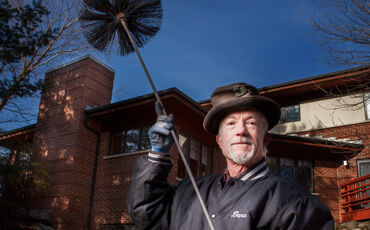
Quigley, owner of Bristle Chimney Sweeps, Inc. in Madison, represents one of about 5,000 chimney sweep operations nationwide, according to the Chimney Safety Institute of America (CSIA). For 26 years, Quigley has been ridding area chimneys of crumbling or baked-on remnants of chimney fires. For practical reasons, the traditional uniform of a black top hat and tails has been replaced, in Quigley’s case, with a baseball cap and jeans. For nostalgic reasons only, his well-worn, ash-gray top hat is always kept at the ready.
Quigley, 63, joined the ranks of chimney sweeps in 1987, after a 20-year career with Kinney Shoes. He’d seen an ad in Popular Mechanics magazine about being your own boss and sent for some literature.
After a competitor in the chimney sweep business offered him a taste of the work involved, Quigley was sold. “I’m an up-on-the-rooftop kind of guy,” he admitted. Six months later, he earned his certification through the CSIA and launched Bristle Chimney Sweeps as the sole employee with one pickup truck. The business now maintains a small office and three trucks, a second certified chimney sweep, and an office manager who keeps them on track.
The inspection
On a recent chilly day in Madison, Quigley was called to inspect two fireplaces at a west side home. After walking the outside perimeter of the 22-year-old Wright-styled home looking for visual clues, he used a tall ladder to climb onto the roof. Inspecting the top of the chimney, he replaced a missing screw and then checked the surrounding masonry and flue lines. With a long-handled rod, he gently brushed the inside of the chimney. Quigley keeps about five different kinds of rods in his truck – of various lengths and rigidity. They attach to one another if extra length is required.
Inside the home, he carefully laid a tarp on the floor in front of the main fireplace. As he opened the fireplace doors and removed the grate, he turned and smiled. “I’ve got the kind of job that rubs off on people,” he joked, alluding to what can be the dirtiest part of the job.
After inspecting the chimney from the ground and removing ashes from the firebox, he informed the homeowner that all was in good shape. Except for a minor pipe issue, the basement gas stove proved equally well maintained.
That’s not always the case, Quigley explained. Inspections can get much more complicated. “Most of the things we deal with are carcinogenic,” Quigley said. “In many cases, we use a mask or respirator, wear a suit down to the ankles, and long, leather gloves.” The goal is to rid the inside of the fireplace of soot and creosote, which accumulates over time.
Creosote is highly combustible, and Quigley says highly marketed creosote-burning logs do little to replace a chimney sweep’s expertise. “It’s like chewing Dentyne rather than seeing the dentist,” he opined. “You still have to see the dentist.”
Most people, he said, especially those in homes without fireplaces, don’t even realize they should be seeing that “dentist.” In fact, whether or not there’s a fireplace in the home, any building with a chimney or venting system should be checked regularly.
“We’re like doctors,” Quigley added, continuing the medical comparisons. “If there’s a problem, we have to explain to people they need Band-Aids, or surgery, and we try to soften the blow.”
While this particular inspection was uneventful, some can be particularly challenging. One situation Quigley will never forget was being called out to a farmhouse in the middle of winter by a homeowner who reported a terrible stench emanating from the basement. Unable to open any of the basement windows, Quigley described the visit as “the gaggiest job we’d ever encountered.” Quigley and his longtime business partner, Kevin O’Donahue, removed some pipes to expose a decomposing raccoon that had perished after crawling inside. “It was terrible,” he recalled.
With a five-gallon bucket nearby in case they needed it, O’Donahue extracted the upside-down raccoon. “It affected all our senses and took forever to get the stench off our tools,” Quigley grimaced.
One pleasant experience he’ll never forget was being part of a team of six Wisconsin chimney sweeps invited to clean the White House chimneys during the Clinton administration. “I cleaned Abraham Lincoln’s personal fireplace,” he said, beaming.
The Clintons were out of town at the time.
“We got into rooms nobody gets into,” Quigley recalled. “There was security everywhere, and detective-types with wristband walkie-talkies. They followed our guys into rooms they said they’d never been in before. It was fascinating.”
Two years later, White House staff allowed Quigley to return with his family for a family photo.
A tight fit
Back on the job, the most common problem Quigley sees is poor maintenance. “Masonry expands and contracts in the freeze/thaw cycle,” he explained, “and the brick-and-mortar work may decline. Everyone thinks masonry lasts forever – it doesn’t.” He’ll do small repairs and tuck-pointing, but long ago gave up the heavy masonry work because “it hurt too much.”
The use of video technology has changed the business. Chimneys can now be inspected through the mechanical lenses of video equipment. Quigley, though, still believes in the human element. While most work is done looking up or down a chimney using light and mirrors, he has had to crawl inside chimneys over the years, some just 12” x 12” in size. He compares it to climbing a mountain. “It’s a challenge, but you have to do it if the job requires.”
The job has taken a physical toll. “I’m getting old,” Quigley sighed. “In my mind, I’m a certain age, but the body tells you different. This is a very physical job, going into basements and small areas. It’s dirty, and eventually arthritis and other things set in and joints get worn out.” Luckily, he’s been able to get health insurance benefits through his wife’s job at a local insurance company.
Fall and winter are Quigley’s busiest seasons, with the first quarter typically the slowest. To smooth out the ebbs and flows, his company tries to schedule repeat customers well in advance (“like a dentist”) and offers maintenance agreements at a discounted rate.
The economy has presented additional challenges. “We’re a selective business,” Quigley explained. His company has taken a 20% to 25% hit from where it was in 2008, and warmer winters haven’t helped. But his dedicated staff remains, including O’Donahue, who was hired in 1994. They receive unemployment as necessary during the slow months, when he can handle the workload on his own, and he rehires them each fall.
Quigley enjoys the freedom his job affords. “I can do things at my own pace,” he said. “I come in about 9:30 each morning, take care of paperwork and schedule two to three appointments in a day.” That adds up to between 700 and 1,000 service calls a year. Most of those involve inspections and cleanings, but the company also cleans dryer vents and installs tubular skylights.
Despite the resulting body aches and economic pains, Quigley hasn’t given a lot of thought to a succession plan. “I’m the biggest limitation to the business because I want things just so,” he said. “I want my clients from the past 26 years to be taken care of.
“I wouldn’t be doing this if I wasn’t happy and making money.”
Now, as the ladder of life ’as been strung
You might think a sweep’s on the bottommost rung
Though I spends me time in the ashes and smoke
In this ’ole wide world there’s no ’appier bloke
“Chim Chim Cher-ee,” Mary Poppins
Sign up for the free IB Update – your weekly resource for local business news, analysis, voices, and the names you need to know. Click here. If you are not already a subscriber to In Business magazine, be sure to sign up for our monthly print edition here.

