
When the Class of 2009 enters the job market next month, its members will encounter the most challenging employment conditions in a quarter century, and the implications for student loan default rates and employee performance could be profound.
In a stunning turnaround since the fall of 2008, when hiring projections were flat, the National Association of Colleges and Employers now says that employers plan to hire nearly 22 percent fewer students from this year’s graduating class than they did from the Class of 2008. The prediction ends a five-year run of good job-market news for new college graduates.
Locally, Manpower’s latest employment outlook indicates that only 12% of Greater Madison employers plan to hire more employees in the second quarter of 2009. Another 12% plan to reduce their staffs, and 75% expect to retain current staff levels.
Nursing and computer science students will be in demand, and college graduates are less-expensive hires for financially strapped companies. However, the depressed job market means the Class of 2009 will have a more difficult time repaying loans.
In this look at how the college financial aid and student loan default picture could impact employers, IB interviewed Dick George, CEO, Great Lakes Higher Education Corp.; Mark Kantrowitz, president of MK Consulting, publisher of FinAid Page, LLC; David Dies, executive secretary, Wisconsin Educational Approval Board; Beverly Faga, director of
financial aid, Herzing University; and Herzing student Jesse Sole.
Grants and Aid
Employers benefit from a variety of financial aid grants and loans that ensure a quality pool of labor. The current availability of these grants and loans is a mixed bag.
On the grant front, the American Recovery and Reinvestment Act increases the maximum Pell Grant, an aid program for economically disadvantaged students, to $5,350 — a $619 jump that represents the largest increase in the history of the program. Not only will the typical student receive more in a Pell Grant, but eligibility has been expanded by 800,000 additional students, bringing the total number of recipients to seven million. In addition, President Obama’s FY 2010 budget would index Pell Grants for inflation.
At the state level, the Wisconsin Higher Educational Aids Board has requested a 3.9% increase, to just over $134 million, for its need-based grant and loan programs. Gov. Jim Doyle upped the ante with a proposed $24 million increase in Wisconsin higher education grants to help students from families earning $60,000 or less.
To some extent, the economy has even impacted Title IV federally guaranteed student loans, which include the popular Stafford and PLUS Loan programs.
Kantrowitz said there have been no problems with the availability of Stafford loans because they are not predicated on the borrower’s credit history. He has found an issue with Parent PLUS Loans for undergraduate students, which are influenced by adverse credit histories. This includes a five-year review of negative elements of a parent or guardian’s credit, whether it’s foreclosure, repossession, tax liens, or bankruptcy. “The key word there is obviously foreclosure,” Kantrowitz noted, alluding to the nation’s housing crisis.
In the most recent quarter, he said the volume for Parent PLUS loans is down 26.5% and the dollar volume is down 28.7%. “The Graduate PLUS volume is up, but the Parent PLUS is down, and the only thing I can think of that would cause that is an increase in foreclosure rates or other derogatory elements.”
Private Loan Issues
The recession’s most dramatic impact has been seen in the availability of private, alternative loans. Kantrowitz said private student loans, which typically address tuition costs above those covered by federally guaranteed student loans, have become significantly less available. Lenders that represent 25% to 30% of the loan volume have stopped making these loans, and the remaining lenders haven’t picked up the slack. Many are liquidity constrained and they have become more selective in making loans.
The minimum FICO credit score required to get a loan has increased, and lenders are requiring more borrowers to have credit worthy co-signers. FICO is a credit scoring system produced by the Fair Isaac Corp., and it’s used by credit reporting organizations to represent a consumer’s financial risk to potential lenders.
Thanks in part to declining home values, home equity borrowing for education expenses have been constricted, George added. This increased the demand for private loans just as the credit requirements for these loans were tightened for borrowers and co-signers.
In this environment, even people with decent credit scores are impacted. “We’ve heard some incredible stories about students with credit scores of 740, which is a pretty high credit score, who aren’t qualifying for financial aid,” Dies said. “I think that’s an indication of just how much the market has changed.”
Private scholarships have been flat to slightly increasing, compared to a steady increase in previous years, Kantrowitz said. So while there isn’t a decline in private scholarships, the pool of money is not growing to meet the increased need. “The year-over-year comparison of the number of FAFSAs [Free Application for Federal Student Aid] submitted is at 10.5% growth, or about 1.4 million additional students, so demand is going up but private scholarships are not increasing to meet demand,” he noted.
Taking (and Losing) Stock
Families that placed their faith in stock market instruments like prepaid tuition plans and 529 plans (such as EdVest) also have taken a hit. Kantrowitz is predicting financial difficulty for prepaid tuition plans because they use investment returns to keep pace with tuition inflation. That works well when the stock market is rising, but last year’s 38% drop in the S&P 500 was unprecedented and more severe than any of the plan’s actuarial models, which take into account a market fall during any 10-year period, had considered.
Not only are the returns headed in the wrong direction, the prospect of hyper tuition inflation could squeeze prepaid tuition plans from the other direction. In any recession, state income tax revenues decrease and components of state budgets are cut. One of the first items cut is state support of higher education, which forces public colleges to raise tuition. “You tend to see, in a recession, a very sharp increase in public college tuition inflation,” Kantrowitz explained.
The only thing that could moderate this, he said, is a maintenance-of-effort clause in the American Recovery and Reinvestment Act that requires states to maintain support of higher education at FY 2006 levels in 2009, 2010, and 2011. Tuition will still increase to some extent, but this clause may prevent significant cuts in higher education.
In the case of the 529 college savings plans, families that maintained an aggressive (stock-based) asset allocation plan last year as their students approached college are probably regretting it, Kantrowitz indicated. Ideally, families that invest in 529 plans will start aggressively with greater portions of their portfolio in equities, and gradually become more conservative as their childrens’ college years approach.
Not every family heeds this advice, and those that were still 100% invested in equities probably experienced a 30% to 40% drop in portfolio value. “I’ve been getting calls from families where college is a year away and they were 100 percent invested in equities,” Kantrowitz said. “They thought they had saved enough, but suddenly their plans were two-thirds of what they were the year before.”
Default Lines
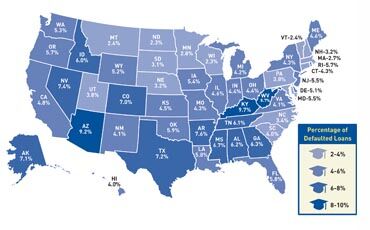
Given the dimming job prospects of this year’s college graduates, George and Kantrowitz expect an uptick in the reported cohort default rates — the percentage of borrowers entering the repayment period in a given fiscal year who default by the end of the following fiscal year.
According to Kantrowitz, the primary predictors of default are graduation rates, interest rates, and job-placement rates. The first two indicators are in good shape, but the latter has him predicting a 1% increase in the national default rate. The 10-K and 10-Q filings of education lenders like Sallie Mae already show an increase in defaults.
The national default rate, which stood at 5.2% in FY 2006, has gradually come down from its 1990 level of 22.4%, thanks in part to changes in the definition of a default. A loan used to be in default if there was no payment for 120 days, then it became 180 days; now it’s 270 days.
Wisconsin employers can take some solace because the state’s 81 schools report the second lowest default rate in the nation (2.3%). But George believes the existing default rates are misleading. Until now, the officially reported cohort default rates have been a two-year snapshot, but the Department of Education is moving to a three-year view. Part of the reason, George said, is that a two-year window camouflages a lot of delinquency and default because of the fairly extended deferment and forbearance periods.
“If you measure the life-of-the-loan default rates for student loans, they are significantly higher than the reported cohort default rates,” he explained. “While they vary substantially among institutions, both in terms of the type of institution — proprietary, two-year, four-year, public, and private — and the quality of the institutions, they are in every case substantially higher than the reported cohort default rates.”
For the top quartile of four-year, public universities, where the reported cohort default rates are probably less than two percent, George said the life-of-the-loan default rate is probably five times that “and well in excess of 10 percent.” As you get out into the proprietary sector and the lower-quality proprietary sector, the life-of-the-loan default rates are probably upwards of 30 percent or more, he added.
In addition, the average balance of indebtedness (ABI) for borrowers is increasing at a much more rapid rate than the growth in incomes, George noted. In the long run, a substantially higher growth rate for debt levels than incomes will expose more borrowers to unsustainable stress levels.
The Bankruptcy Abuse Prevention and Consumer Protection Act of 2005 amended the bankruptcy code to make student loans non-dischargeable in bankruptcy. Unless students can prove undue hardship — a somewhat arduous task — their student loan debt is not dischargeable in an adversarial proceeding, either. At that point, they will be subject to rigorous collection activities, including administrative wage garnishment, tax offsets (including any tax refunds), income-based repayment, and other resolution methodologies.
Why should employers care about default rates? When employees are in financial difficulty, it can affect their work performance. George said Employee Assistance Plan providers report that the single biggest reason for them to be called into counseling for employees is based on family stress associated with debt.
“When we have employees who are feeling financial stress, workforce performance is directly impacted,” George said. “What we’re seeing from the EAP providers is that financial stress has now become the number one reason for counseling intervention by the EAP providers, and that’s a change that has occurred in the last two years.”
The Student Experience
Herzing University’s 2007 draft default rate, an initial rate that can be challenged, is 8%; in recent years, Herzing’s actual default rate has ranged from 6 to 11%. Faga acknowledges that she is very nervous about the default rate at Herzing, where most of the 250 on-campus students — not counting another 800 or so online students —rely on direct loans to help cover tuition costs. “I can just see the loan indebtedness that these students have to take out becoming greater and greater,” she said, “and because of the economy, a lot of the students also are using additional financial aid for living expenses because they are losing jobs. Loan indebtedness is becoming a big issue, I think.”
To add to their stress, the decline of the financial markets is keeping a lot of older workers in the workforce longer than they had anticipated, which means that the normal job openings that would become available as those older workers retire — openings that would create opportunities for new college graduates — are not occurring. “A lot of people are going to be staying where they are, given losses in the stock market and in other financial instruments,” George predicted.
Herzing student Jesse Sole, 25, who is pursuing a bachelor’s degree in computer science, expects to incur $35,000 in federal student loan debt before becoming a full-time worker in about one year. Since he’s doing a four-month internship for Gillware, a Madison-based data recovery company, he might be one of the fortunate students to land a job upon graduation.
His fellow students, who range in age from the early 20s to people in their 40s, have mixed levels of economic anxiety. The younger students are so busy with school and holding on to part-time jobs that help pay their education bills, they don’t dwell on the condition of the job market as much as older classmates.
“It’s not that we’re not concerned,” Sole said, “it’s just that we don’t feel we have the time to be concerned or worry about it.” Yet.

