
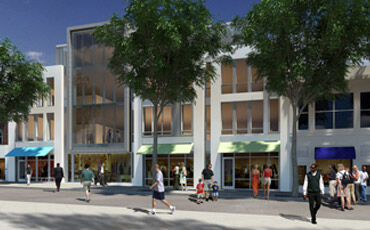

If you’re a believer in numerology, you might glimpse a flicker of good fortune in some of the numbers aligning for Potter Lawson this year. After all, in 2013, the Madison architecture and design firm is celebrating its 100th anniversary, while helping to renovate one of the more iconic stretches of road in the city — the 100 block of State Street.
But even if you’re not so mystically inclined, all you really need to do is open your eyes. It’s hard to soak in much of the urban landscape without eventually seeing Potter Lawson’s footprint. The company’s portfolio represents a hearty slice of Madtown, with projects that include the new Madison Central Public Library, the Overture Center for the Arts, the Monona Terrace, the University Square development, and Edgewood College’s The Stream (the latter of which earned the company three 2013 In Business Commercial Design Awards).
| “What we were able to do is kind of take the retail façades that exist on State Street and wrap them around the buildings and bring them along Fairchild Street to try to enliven that street.” — Doug Hursh, Potter Lawson |
Most recently, the firm has confidently stepped up to the plate in the ongoing State Street renovation, a project that’s seen more than its share of controversy. When city benefactors Jerry Frautschi and Pleasant Rowland first unveiled their proposal for the 100 block renovation, members of Madison’s Urban Design Commission and the Plan Commission balked, making it clear that they were reluctant to see the historic Schubert and Fairchild buildings demolished.
Eventually, Frautschi and Rowland returned with a pared-down proposal that preserved those historic buildings.
Now underway, the project includes six properties: The Francis Vallender Building, which is being replaced with a new building; the Castle & Doyle Building, which is being renovated and repaired; the C.E. Buell Building and the Haswell Furniture Building, which are being replaced; the Schubert Building, which is being renovated (with its interior spaces interconnected with the building at 122 W. Mifflin St.); and the Fairchild Building, which is being renovated.
According to the Block 100 Foundation proposal, the $11.6 million project, which launched a year ago this month, will “preserve the scale and architectural context of State Street while energizing North Fairchild Street with vibrant new retail, restaurant and office spaces.” In addition, net income from property rentals will be gifted to the Overture Center for the Arts.
Part of the goal is to activate North Fairchild Street, which currently acts as the back of the four buildings fronting State Street.
Of course, as any Madison-area developer knows, Madisonians feel a strong connection not only to the urban landscape but to the city’s history as well. Proposals to remake State Street from the Library Mall to the Capitol have hardly been universally embraced, and there remains some concern that the iconic street could lose some of its charm.
Into that fray steps Doug Hursh, who in his role as director of design for Potter Lawson oversaw the design of the 100 block redevelopment project.
As the 100 block redevelopment speeds toward a spring 2014 completion, we caught up with Hursh to get his take on the project.
IB: Are there any unique challenges that you’ve encountered with this project?
Hursh: I guess there are always unique challenges when working with historic buildings. We’re trying to put two new buildings in between other, older historic buildings on State Street on a site that doesn’t have a back door. Both North Fairchild and State Street, all the buildings kind of face onto those streets as well as Mifflin Street, so I think the unique challenge in both the design and construction is taking down those buildings while maintaining the historic buildings in their place.
IB: State Street is an iconic street that’s very strongly identified with Madison. There’s some question about whether this and other redevelopment will change the character of the street. Is that something you’ve tried to be sensitive to?
Hursh: I would say yes. It’s exciting for us. This project is a little bit different than a typical developer project, where it’s not entirely being done to gain large areas of developed space to rent. This is a very small project, very small scale, and I don’t think it would have taken place if not for the Frautschis wanting to really improve both State Street and Fairchild Street, so lucky for us we were able to design a fairly small building that I think fits in really well with State Street. It’s only three stories, and then we’re able to set back the fourth story in the middle of the block to maintain the scale along State Street. And we took into consideration the ribbon of the street when we were designing it and looked at ways to break the building up so that it wasn’t just one continuous façade, but we were given a fairly small site to contend with.
(Continued)
IB: Does that make it easier from your perspective — the fact that it’s a smaller area?
Hursh: It’s easier, if you look at the goal of trying to preserve the character of State Street, the feel of it. We were able to kind of selectively pick out the buildings that weren’t performing the way they should and weren’t designed with the transparency onto the street that we would like, and we were able to leave and restore the other historic buildings on the street, so to be able to blend both the new with the historic buildings is exciting to me — to really make the street come alive not just on State Street but on Fairchild Street by mixing both of those.
I think the main area that we made the most difference on was Fairchild Street, because that lot is so narrow, the buildings on Fairchild Street that faced State Street really looked more like the backs of those buildings. That’s where the trash doors were and the loading dock was, and the exit stairs. And even the flatiron building in the corner basically had only one window facing Fairchild Street. So that street became a little less desirable to walk down than State Street, and what we were able to do is kind of take the retail façades that exist on State Street and wrap them around the buildings and bring them along Fairchild Street to try to enliven that street.
IB: Overture is the dominant building in that area now. Was a lot of what you did done with an eye toward enhancing its presence? Does it integrate well with the Overture?
Hursh: It is an existing city block in the city fabric, so it is kind of a group of buildings — it’s not one sort of unified design, and that’s kind of the beauty of the street down there, having these smaller-scale buildings that were built at a time, and we start to put them all together and they create this environment that’s friendly to walk in, and I think what we were doing on Fairchild Street was taking a look at the buildings, [and asking], ‘How do we make them better by cleaning them up, restoring them, putting in new windows, tuck-pointing the brick, and then infilling with projects that would make the street more lively, enhance the street, clean it up, put more windows onto the street, more access points to make it more pedestrian friendly.’ And I think all those things combined enhance Overture across the street.
IB: In what sense do you think the redevelopment will change the character of the block and change how people use the block?
Hursh: Hopefully, it’s going to change the uses for the better. We’ve created some smaller-scale new elements on the street that give the buildings a sort of longer useful life into the future. The Block 100 Foundation is going to manage the block so that it will always be in really good shape as far as maintaining the buildings and keeping them looking nice.
I think we’ve made the space more desirable for retailers in that the older buildings had fairly small retail spaces. Some of them were so small that they were very hard to rent, and we’ve made them more accessible and easier to access from the street, and we’ve lined them up with the street level, connected them internally so that there are some larger spaces. There’s flexibility. They can either be rented out as a large space, or they can be rented out to smaller tenants.
Then on the upper floors, we’ve added some square footage, so hopefully we’re gaining more office users on the block by connecting some of the upper floors between all of the existing buildings. I think we’ve made a space that’s more viable for commercial tenants, and [allowing more people to work] downtown and being there in the middle of the day, going to the restaurants on the street, adding to the retail viability of downtown as well.
IB: The redevelopment plan changed considerably from the Frautschis’ original plan, which called for demolishing the Fairchild Building as well as the Schubert Building. Do you think the current plan is ambitious enough, or do you think it strikes a good balance between looking to the future and preserving historic structures?
Hursh: On a positive side, I think this does strike a good balance by renovating some of the historic buildings that exist on the block. We’re saving those buildings, and I’m not sure anybody could do as good of a job at renovating buildings as the Frautschis can. They want them to be beautiful back to the day when they were built, or better, so I think in the end the project is going to be a really good project for the city, and that will save some historic buildings as well as infill new buildings, which will add to the vibrancy of the street on that block.
(Continued)
IB: As you know, this is an important block on an iconic street. Being right at the doorstep of the Capitol Square, it’s a busy area. Does that weigh on you, the fact that this is something a lot of people are going to use and see on a regular basis?
Hursh: Oh, yes. Absolutely. That always does, when we’re designing a building, especially in an urban environment. And downtown State Street being such an iconic street, we did want to make sure we put a really good design out there for the community. We’ve spent time working on the scale of the building and the details of the building so that people feel like it’s a building that fits in with the city and along State Street. It’s not going to be exactly the same as some of the historic buildings on State Street — at least the new part of the development — but we wanted to reinterpret what the traditional storefront building on State Street would look like if it were designed today. And it has traditional elements to make it feel like it belongs on State Street. It’s mostly masonry, a brick building similar to most of the buildings on the street. It has some bay windows, sort of a modern interpretation of bay windows. It’s a building of its time. It’s contemporary, but it also speaks to wanting to belong with the other buildings along that street that work together to create that place that’s special to everyone.
Click here to sign up for the free IB ezine – your twice-weekly resource for local business news, analysis, voices, and the names you need to know. If you are not already a subscriber to In Business magazine, be sure to sign up for our monthly print edition here.

