
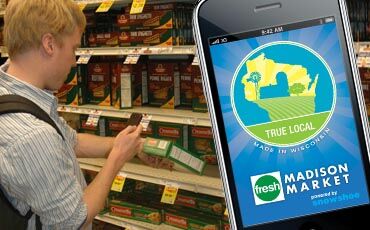

Even in the most benighted backwaters of our energy-hungry nation, you’d be hard-pressed to find anyone who isn’t at least somewhat familiar with global warming and climate change. And by now, most people have at least heard the term “carbon footprint.”
But ask people to estimate what their daily carbon footprint is or, indeed, why it’s important, and you’ll likely be met with the blankest of blank stares.
But now, through an innovative, fun, and user-friendly new smart phone app, three University of Wisconsin graduate students are hoping to erase not only those bewildered empty stares but also the knowledgeable empty stares of people who are forced to get the bulk of their climate-change info from Al Gore lectures.
The app, which is currently being developed by Madison’s SnowShoeFood, LLC, makes clever use of smart phone technology to give consumers an idea of how their simple food purchases influence climate change, which scientists say is caused by the release of greenhouse gases such as carbon dioxide.
The first version of the ShowShoe app, released Feb. 23 for the iPhone (and a bit later for the Android), will allow Fresh Madison Market shoppers to see whether the products they’re considering purchasing are manufactured in Wisconsin. Through the app, a shopper will be able to use his or her phone’s camera to scan the bar code from a food product and see whether that product is local – if it isn’t, the app can recommend comparable products that are locally produced. And because it takes significantly more fuel to transport a head of lettuce from California than from Sun Prairie or Stoughton, locally produced food contributes less to global warming.
Bigger plans
But that – to use a rather awkward if somewhat apt metaphor – is just the tip of the rapidly melting polar ice cap. Ultimately, says SnowShoeFood CEO Claus Moberg, a version of the app will be released that gives consumers in other areas a more or less complete picture of their carbon footprint, recommends environmentally friendly products, and allows consumers to post carbon stats on Facebook and Twitter and even buy carbon offsets to zero out the environmental impact of their purchases.
“[The app will take into account] fossil fuel inputs for a bunch of different portions of the product’s life cycle, and then also the amount of energy used to produce the packaging for the item,” said Moberg. “Items with less packaging would have a better score, and [the app would] also look at the agricultural inputs into the item to see what practices were used to grow it and whether we can assess the sustainability of that portion of the product’s life cycle.”
Of course, none of that is particularly useful if the general public has no clear idea what a carbon footprint is. According to Merriam-Webster.com, a carbon footprint is simply “the amount of greenhouse gases and specifically carbon dioxide emitted by something (as a person’s activities or a product’s manufacture and transport) during a given period.”
That’s all well and good, but most people still have no clue how much greenhouse gas is spilling into the atmosphere as a result of their daily choices. To illustrate, Moberg and his team – which includes company CFO Jami Morton and COO Matthew Luedke – produced a video in which students at the university’s Center for Sustainability in the Global Environment were asked about the carbon footprint that results from bringing a can of soup to market.
“We asked those students … to tell us how much carbon was embodied in that can of soup, what the carbon emission was required to produce it, and we got answers that ranged from 5 grams to hundreds of kilograms,” said Moberg. “So if leading scientists in climate research have no clue what the impact of a single food item is on the climate system, I’m pretty sure that your normal grocery shopper probably has no clue as well.
“They very well might care about it. In fact, our research shows a lot of them do, but until now it just has been almost impossible to calculate it let alone know what that calculation means, and it makes the problem a lot more intractable, so our hope is by providing this information in a fun, interactive, well-presented manner, we can help people reduce their carbon footprint and also help educate them as to what their carbon footprint means.”
Making a difference
Significantly, the app will also allow consumers to do something about their carbon footprint. In addition to making it easy for shoppers to buy environmentally friendly products, the advanced version of the app, which will be released in the summer or early this fall, will give them the opportunity to buy carbon offsets.
“Consumers can choose products that have the lowest carbon footprint, but we know that there are some cases where a recipe calls for a certain ingredient and it may be a very carbon-intensive food product that you have to buy and use, and if we know what the carbon footprint for that product is, we can offer a carbon offset directly through the app where you eventually pay some third party to reduce their carbon footprint by the same amount as the carbon footprint of the food item the person is buying,” said Moberg.
SnowShoeFood, LLC (the name comes from the fact that snowshoes reduce the depth of one’s footprints) was started as a vehicle for developing and marketing the SnowShoe app, which Moberg, Morton, and Luedke – who were all students together in the Energy Analysis and Policy Certificate Program at the UW – originally created for the university’s Climate Leadership Challenge competition. In addition to a $15,000 cash prize, which provided the company with some working capital, the team won a year’s lease on office space at the university.
SnowShoe will seek a patent for the app, which will be distributed free. The company plans to make money through advertising and sales of coupons to food manufacturers. In one of those rare best-of-both-worlds scenarios, simply by getting the app into people’s hands, the company will tap into some lucrative revenue streams while also helping to save the environment.
“For advertising purposes, the customer segment that is represented by smart phone owners who care about climate change tends to be high-income, high-education, tech-savvy – a very desirable advertising segment and a relatively high-consuming market segment,” said Moberg. “So if you’re trying to incentivize them to make a food purchase, oftentimes they’re beyond the point where a financial coupon really matters that much, so through the carbon footprint app, we’ll be able to offer a carbon footprint coupon.”
That kind of coupon, says Moberg, would provide a benefit both to food producers and the environmentally conscious consumer.
“The cost of that to the company is actually a lot less … than the price of even a 50-cent or a dollar financial coupon, and yet our research shows that it’s a much larger incentive to purchase that product than a 50-cent or dollar-off coupon would be.”
For more information on SnowShoeFood, go to SnowShoeFood.com or Facebook.com/SnowShoeFood.
Sign up for the free IB Update — your weekly resource for local business news, analysis, voices and the names you need to know. Click here.

