

Our June 2009 issue of IB gives the warden’s point of view. In this IB Web exclusive, we explore what it’s like at Oakhill from the prisoners’ perspective.
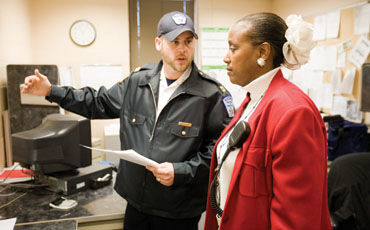
Deirdre Morgan, Warden of the minimum-security Oakhill Correctional Institution outside of Oregon, Wis. has a theory on her success: “I’ve always felt that inmates let you run the institution,” she said. “And a good staff lets Wardens make changes to the institution.” During her tenure, she has made her share, from renovating a chapel or administrative space, to changing how recreation time is scheduled in an effort to thwart gang, or thug, activity.
Oakhill Correctional Institution, originally constructed in 1931, opened as the Oregon School for (wayward) Girls in 1941. In 1976, the girls’ school was converted into the all-male prison. When Morgan arrived in 2004, she noticed some of the older stone housing units were lacking something rather important to its male occupants — urinals. “This is a men’s prison!” Morgan said, “They needed urinals!” And urinals they got.
Behavior Means Everything
Being a minimum-security facility does not mean inmates have free reign of their time. Far from it. While there are no guard towers at Oakhill, an electrified “stun” fence envelops and divides the grounds. Inmates are carefully monitored by the institution’s 173 security officers, phone conversations are tapped, mail is screened, and rules must be strictly adhered to. Recreational and occupational activities on prison grounds are carefully scheduled. Good behavior is rewarded, and bad behavior might relegate an individual to the maximum-security housing unit on-site, where five officers maintain a 24-hour watch.
Not every inmate can participate in programs offered by the prison, because so much is determined by behavior and recommendations from prison staff. Inmates are afforded recreation time every day, and if they follow the rules and stay out of trouble, other opportunities exist, such as time at an arts and crafts facility. Inmates can sell their artwork, though they cannot charge for labor. The artwork is displayed in glass cases lining the visitors’ room.
Life at Oakhill
For the most part, Oakhill inmates share living quarters with one or two roommates. Some rooms can accommodate up to four bunk beds, but that’s a last resort, as Morgan admits four in a room is “just too close.” While each inmate has a key to their own room, all are encouraged to keep the door locked at all times. “There are people here who will steal from others,” Morgan says, “The inmates know that.”
Inmates are allowed to purchase televisions or radios for their rooms from Badger State Industries, where specially-designed, see-through plastic housings assure nothing can be hidden inside. Personal care items (shampoo, deodorant, soaps, shaving cream) are an individual responsibility and must be purchased. Food items are also for sale. “They are not given cash,” Morgan says. “Everything goes on their account.” A portion of the proceeds collected from inmate sales and purchases gets reinvested into prison programs and services, and is also donated to charities. In FY 2007, for example, donations were made to the local Rape Crisis Center ($956.66) and Domestic Abuse Intervention Services ($694.67), among others.
Money Behind Bars
So where do inmates get the money? “From their families, mostly,” Morgan said. And if an inmate is ordered to pay restitution or child support, a portion of any money they receive (or earn) is collected toward that debt before being released to the inmate. In 2007, Oakhill collected $16,249 toward restitution, while $19,660 went toward child support.
Inmates are encouraged to apply for paid programs designed to educate and rehabilitate. They are paid to attend school, for instance. Three teachers help individuals earn their HSED (high school equivalency diploma) or GED. Vocational programs are also offered, such as Horticulture, Computer Literacy, and Building Services, which teaches inmates light renovation skills, including tiling, carpeting, or plumbing, for example. “These are skills they can put to use on the outside,” says Morgan. And these are the individuals Morgan calls upon when she needs to move a wall or two.
A Good Neighbor
Oakhill also works to be a good neighbor in its surrounding communities. In FY 2007, the prison provided work crews to help the city of Middleton Parks department, Oregon Summerfest, Fitchburg Days, and the Oregon Community Halloween Party. In 2008, when the area was stricken with heavy rains and flooding, Oakhill inmates filled 35,000 sandbags to assist in the relief effort.
Warden Morgan is outwardly proud of the institution she runs, and the changes she’s made. But most important to her is the opportunity the facility can provide to everyone within its boundaries. “We want people to leave here in a better condition than when they came in,” she said. “And that includes both inmates and staff.”

