
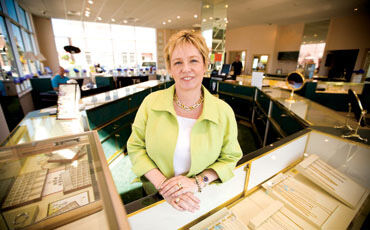

Beverly and Peter Diny will never forget the sinking feeling they got when their bank asked them to sign a document that spelled out the demise of their family-owned business of 26 years. It was a complete shock
“They slid it across the desk and said, ‘We’d like you to sign this. We believe your business is no longer viable.”
That searing recollection of Beverly Diny is not uncommon in this economy, where the phrase, “Gimme some credit,” is a rallying cry even for established businesses that once had much less difficulty securing loans.
In this look at how companies are struggling to stay afloat during the credit crisis, IB talked to Diny’s Jewelers and to Contrail Aviation Support, two businesses that are having varying degrees of success with their bankers.
Diny’s Jewelers
As local jewelry devotees know, Diny’s Jewelers has reacted by launching what they believe will be a store-saving sale. Their 2,200-square-foot store on Cayuga Street in Middleton carries signage that advertises up to 70% off on its merchandise, and Beverly Diny is quick to point out that the signs posted around the store say “Bank Demand” not “Going Out of Business.”
The sale, which is being conducted during traditionally high-volume sales months, is how the Dinys are responding to the bank’s refusal to provide a $50,000 loan they had anticipated but were denied. Over a three-day period in January, the Dinys went from the usual bank loan interview to seemingly endless paperwork to the unusual step of their bank wanting to photograph their inventory rather than settle for the usual detailed list.
That made the couple uneasy because they had never received such a request, but they agreed in order to secure the loan. On the third day, a Friday, a loan officer called to inform the Dinys that bank representatives wanted to meet them. They came to the store with a four-page document requiring the Dinys to liquidate, sell off their inventory, and pay the bank off in 45 days.
Needless to say, Beverly and Peter were stunned and devastated, but there was no way they were going to sign. “We said, ‘you’ve got to be kidding,'” Beverly recalled.
(IB contacted the CEO of the Diny’s bank, who said it would be inappropriate to comment on the Diny’s situation or even acknowledge that they are a customer.)
This isn’t the only tough economy the Dinys have confronted in their 26 years in business. They began in Darlington in 1983 as the economy was starting to turn around following a period of hyper inflation, high unemployment (11%), and double-digit interest rates (18%). They opened the store after Peter had completed a 3-1/2-year apprenticeship with a jeweler, and Beverly had worked as a welder in a factory in Tomah.
Starting a jewelry store in a rural community in the midst of a recession would test anyone’s mettle, but Peter and Beverly, who were raised on farms, both served in the military together after high school. The gruff, forbidding Vietnam-era drill sergeants gave them the discipline needed to withstand tough times. “It was just innocence,” she remembered. “We had met when we were 16 or 17, and we got married two weeks out of high school. Six months later, we joined the Army National Guard out of the Sparta unit.”
Their resulting can-do attitude has helped them run four stores in the past 26 years, starting with their original shop in Darlington, one of several communities identified by the Wisconsin Department of Commerce as needing a jewelry store.
Securing credit wasn’t always this difficult, even in the economic conditions that existed in the early 1980s. The Dinys went to a bank seeking to borrow $10,000, and the banker naturally asked if they had a business plan. “We said, ‘What’s a business plan?'” Beverly recalled, laughing at the memory.
Since her brother-in-law Richard owned a farm, a bank representative asked if the brother could co-sign the loan. Instead, her brother-in-law borrowed the money for them and charged the going interest rate.
When they started in Darlington, they were comfortably surrounded by farmers. The Darlington store was a humble one, with jewelry pieces spread out in beautiful little boxes. As Beverly explained, the Dinys wanted their customers to like the jewelry even more after it was purchased than they did at the moment of sale.
That approach helped the Darlington store survive until the economic boom of the 1980s, which came slower to rural Wisconsin. They were treated like royalty and had not considered a move until a couple of years had passed and a Milwaukee-area supplier advised them to get a bigger store. With that, they moved to Stoughton, where they ran a store for 15 years while raising their children. They were wooed to Hilldale Mall in Madison in the mid 1990s, but they could not foresee the gathering competitive challenges that were bringing that mall’s initial glory days to an end. For four years, they continued to operate their store on Main Street in Stoughton before closing it and focusing on Hilldale, which was a challenge from day one. “Hilldale was an uphill, nonstop battle,” Beverly acknowledged.
Not to mention time consuming. Wanting a change from the workaholic lifestyle of the typical mall entrepreneur, the Dinys moved to a new store in Middleton in 2003. Their decision to try a fourth location was all about, well, location. One day, after exiting the Beltline on a drive through the west side, Peter Diny saw a new building and decided to plant a seed. Cautioning his wife to keep an open mind, he suggested another move. In time, they both saw the potential of the new building and negotiated a new lease.
The move paid off handsomely. It took them only one year in Middleton to match their best sales year at Hilldale, with 60% less overhead. Best of all, their location off the Beltline has helped them remain connected with old friends, Diny noted, because Darlington and Stoughton customers easily get on the Beltline . Location is everything.
The Dinys reached the debt-free point at Hilldale, but to complete the build-out in Middleton, they took on more debt. As the economy expanded from 2003-2007, Diny’s Jewelers enjoyed strong years, but the couple could sense the economy changing in 2007.
They started making changes in their personal life and economizing their business operations, lowering inventory, aggressively paying down debt, and even making the excruciatingly difficult decisions to lay off their own son and a valued office manager that has known the family since she was a child. The broader economic forces were taking their toll as the store’s sales plummeted 40% last year, well within the national average of a 30 to 60 percent retail sales decline.
Ironically, the steps they had taken to economize helped them produce a profit in 2008. With that profit came a higher-than-expected tax bill and more scrutiny from their bank, which felt Diny’s inventory was too low, according to Beverly. As she explained, the store operates by the 80-20 rule, meaning 20% of its stock will be the fastest sellers; upon a sale, those are the items that are reordered because they have the most impact on volume.
So a family-owned jewelry store that started out modestly in the worst of times had come full circle, but folding was not an option. Since refusing to close, Diny’s has celebrated its 26th anniversary (ironically on tax day, April 15) and is counting on typically strong months like May (college graduations) and June (weddings and high school graduations) to help clear its inventory.
Interviewed part way through this process, Beverly was optimistic that the family business would survive. Yet she harbors a lingering frustration that the bank doesn’t understand her business. Liquidation, she noted, would have produced only 20 cents on the dollar, and the goal at the end of the sale is to be debt free and stay in business.
Diny said retailers, especially those who sell luxury items, are on the front line of the economy.
“We’re sandwiched between the consumer coming in and buying the goods and the wholesalers,” she noted. “If the consumer stops coming in here, we’re the first to feel it.”
Contrail Aviation Support
Faring better, but leaving nothing to chance, is the husband-and-wife executive team of Joe and Miriam Kuhn, the proprietors of Contrail Aviation Support in Verona.
They sell commercial airplane engine components to airline support businesses. Given that the average price point of their inventory is in the six figures and higher, lining up credit to cover each sale is difficult in this environment. It is the sheer size of those transactions that makes it challenging to get credit even in good times, and there was a period recently when the Kuhns worried that they would encounter some turbulence in securing bank loans. Yet even though their banker’s parent company, Amcore Financial, Inc., reported a net loss of $30.4 million in Q1 2009 and has let go of 116 workers, the bank came through on a key deal.
The Kuhns have established a solid track record in nine years at Contrail, but they had some reasons to be concerned about the availability of credit. In Madison, the financial mix includes regional banks with varying states of financial health and local community banks that lack the means and willingness to finance a Contrail-sized transaction.
A lot of the large regional banks that seem to be in the most trouble are the ones that “typically are going to offer a higher line of credit, but their hands are tied,” Kuhn said. “The ones that seem to be healthier right now are the smaller local banks, but they are not typically the banks that offer large lines of credit. Their balance sheets are healthy, but they max out with you at a certain point.”
In addition, local banks are not necessarily comfortable with Contrail’s business model and the fact that most of its business is international. The company does business in Great Britain, Israel, Jordan, Japan, and South Africa, to name a few. “They [local banks] really feel uncomfortable with the mix we have overseas,” she said.
“Right now, I would say the overseas revenue that we have is at least 60% if not more of our business — depending on the month, possibly up to 75%. So they want to try to secure that somehow. That’s just not the way our business works.”
The company, which now uses just one bank, started in 2000. Between January of 2000 and October of 2004, it went through three banks. Since 2004, it has been with Amcore, a regional bank that has $5 billion in assets and more than 70 locations in Illinois and Wisconsin.
The key deal that Amcore recently financed involves a shipment that arrived from Japan. At multiple seven figures, it represents the largest purchase Contrail has ever made. Although Kuhn suspects that most banks are feeling the pinch and have certain internal constraints — “even though we’re in a growth period, fewer deals are getting done,” she noted — the couple is happy with their relationship with Amcore.
“For right now, I would say we’re happy, particularly when I take into account the credit markets and what’s going on everywhere else,” Miriam Kuhn said. “We’ve been able to do the deals that we’ve really wanted to do.”
Still, the couple has investigated alternatives because bankers don’t easily understand their business. One route the Kuhns have taken to circumvent bank financing is to offer aircraft engine components on consignment. In that case, another entity owns the asset and Contrail simply sells the parts, taking a percentage of the sale as revenue. In the consignment agreements Contrail has in place, the basics are no different than situations in which a person takes their furniture or clothing to a consignment store. The individual owns the item (clothing or furniture), and the store has the expertise and the knowledge to price it and sell it. For providing that service, the store receives a percentage of revenue generated from selling the item.
Contrail is the consignment store in that scenario because it has the expertise to sell the jet engine components, so it provides that service to the owner of the asset and in return receives a percentage of the revenue from the sale of the engine component. In a consignment arrangement, the benefit to Contrail is that “we do not have to take on the risk of acquiring the asset and the financing of the purchase,” Kuhn noted. “So in that case, you’ve minimized your risk. You don’t own the asset, and you’ve taken the bank out of the equation.”
With consignment, the normal upside is somewhat diminished because one of the trade-offs is reduced profits on assets that can be worth upwards of $1 million or more. “Your profit can be a little less than if you actually owned the asset, but there are pros and cons to the situation,” Kuhn said.
Contrail also has looked into angel and mezzanine financing, planting seeds with a couple of potential investors. “We have the ability to run a profit-and-loss on each engine for each project; so if we were to pursue that, it’s really on a project basis,” Kuhn said.
“For us, pay back on those projects can be relatively quick, from 90 days to a year. In terms of investing, it’s pretty black and white in seeing where you’re going to end up, and how it would play out.”
Contrail’s sales cycle operates differently than most. After purchasing engine components, Contrail decides which ones are to be dissembled and ships them out to the appropriate facility. It does not manufacture the parts or manipulate them; in most cases, it simply owns the assets.
The engine is placed on a truck and sent to a dissembler in Miami, Fla. that is regulated by the Federal Aviation Administration. The Miami company disassembles it, and those parts are sent back to Contrail, which sells them to third-party repair facilities that serve the airlines.
Engines are disassembled into different parts, which collectively are worth more than the whole. Kuhn said Contrail essentially extends the life of an engine by recycling its components.
“We don’t deal directly with the airplane manufacturers,” Kuhn said. “We deal directly, in terms of selling the part, with maintenance facilities that need those parts to maintain the engines for airlines. Most airlines don’t do their own maintenance anymore. It’s just too capital intensive.”
Kuhn, who has an MBA from the University of Michigan and has worked for companies like Sara Lee, said there is only one other company in the state of Wisconsin that does what Contrail does. The industry tends to be concentrated elsewhere, primarily around airline hubs in Miami, Texas, California, and Chicago.
While the recession has hit the airlines hard, Contrail is in a high-growth mode. Its 2009 revenue will be in the $6 million range with four employees, but it has large costs drivers. Since the purchase of just a single jet engine starts in the high six figures, a substantial portion of its cost structure is simply the expense of the engine components. Add to that the transport of a large engine to a disassembly facility, the cost paid to the disassembler to take it apart, and the cost to have multiple crates of individual components shipped back to Contrail’s 21,000-square-foot facility in Verona. Then add the cost of shipping the components to an overhaul facility, which could be located in Asia, and Kuhn said Contrail’s costs are substantial.
Its Verona facility, large enough to accommodate expansion, has enough inventory to help determine what customers need. But the parts have to be segregated in a certain way in the warehouse. The company is regularly audited for the tidy sum of $3,000, which Kuhn calls a cost of doing business. “This is a highly regulated industry, and it should be,” she stated.
Community Banking
Charles Saeman, president/CEO of the State Bank of Cross Plains, agreed there is a difference in the activity levels between larger banks and community banks like his. Citing statistics from the Community Bankers of Wisconsin’s “Banconomics” report, he said Wisconsin’s banks with assets under $1 billion saw their lending increase by 33.5% in 2008 over 2007, while state banks with over $1 billion in assets grew their loans by only 4%. From March of 2008 to March of 2009, State Bank of Cross Plains grew its loans by 15%, or $71 million.
Even with higher down payments and other tight underwriting standards for real estate loans, including those mandated by federal mortgage financiers Fannie Mae and Freddie Mac, “Community banks are doing the lending,” Saeman asserted.
The current economy, he added, is an opportunity for community banks to fill a void left by larger banks. That includes working with homeowners and businesses during a rough patch like the present. “It’s not in our interest to be foreclosing on mortgages or closing businesses,” he said.
“Those are last resorts.”

