
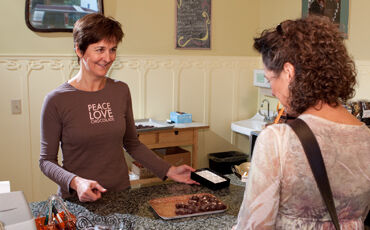

For chocolatier Gail Ambrosius, it was a case of deja vu. There she was, standing before a Small Business Development Center class and talking about the importance of writing a business plan, knowing full well she once again was about to practice what she preached.
Ambrosius likes to joke that her chocolates save marriages because many a customer (okay, man) has engaged in chocolate-inspired relationship repair, but she also would like to prolong the romance between her product and chocolate lovers. Her company recently celebrated its fifth anniversary, and the proprietor is plotting her next move by developing a revised business plan.
That plan will shape her future course, which is the point she was trying to make to those aforementioned business students. “I was trying to convey to them how important it is to do the plan because it’s really a good road map,” said Ambrosius, who took the same class six years ago as she plotted her own business course. “When I pulled out my old business plan in the last month or two, it kind of made for humorous reading. On the other hand, I could check off things that were accomplished.
“I had done some market research, and I spelled out what my target market was going to be. Pretty much everything I had laid out, I had either accomplished or, yes, it held true over the years. I think it will help me going forward because I have ideas in my head, but I really need to see things on paper and really put them in context.”
Consistent Model
The fifth-year anniversary may be a good time for an updated business plan, but other than size, Ambrosius had a hard time identifying any differences between her start-up business model and her current one. She basically went with the flow.
“I still grow organically,” she stated. “When I started, I had no idea what was going to happen. I loved my product, and I thought other people would love it, too. Certainly, when I did my test marketing, everybody seemed to respond pretty positively, so I just kind of let it grow as it needed to.
“So it was just me, and then I hired an employee after maybe six months, and then I added another one, and then another two.”
Now it’s up to 10 employees, including several who produce thousands of handmade chocolates daily during the peak seasons, and a general manager that, according to Ambrosius, has taken a tremendous workload off her.
Having moved into her Atwood Avenue shop in 2006, it’s hard to say how long this space will be large enough, but since she now knows the true costs of things, the redo of her business plan will allow her to examine a few options.
“Do I stay here and just kind of keep everything the same? Do I add another store somewhere, maybe across town or maybe in Chicago or another city? Do I add cafe space? There are different options I’m looking at, and I’m going to try to do projections for each one of them and just sit and really think, when I take my vacation in January, about my comfort level.”
Ambrosius, whose love of cooking was fostered in her mother’s kitchen, is very comfortable creating different varieties of dark chocolate. Her favorite treat is derived from cocao beans, or cacao (pronounced ca-cow), which also is the name of the tree that produces the bean. To make the dark chocolate, the bean is crushed and a little bit of sugar is added, but not nearly as much sugar as contained in milk-chocolate candy.
Ambrosius gets her chocolate from Peru, Columbia, Ecuador, Venezuela, and Costa Rica. Like fine wine from the Bordeaux region of France, each country has a different flavor profile. To Ambrosius, Ecuadoran chocolate tends to taste a little floral; the Peruvian chocolate is earthy, almost savory. The Columbian chocolate, which is kind of like toasted marshmallows, is one of her favorites.
“I’m only getting it from Central and South America because it’s grown there,” she explained. “In most cases, it’s processed into chocolate there, and then I get it in bulk from those places rather than it being grown there, shipped to Europe, processed in a European factory, and then shipped back.
“There is a lot less energy being used than in shipping it back and forth across the ocean. So it’s more of a sustainable idea.”
Sustainability is important theme for Ambrosius. To offset the company’s energy usage, she partners with Madison Gas & Electric in buying credits for solar and wind power, and she’s working with an organization called “Big Tree Climate Fund” to help calculate the costs of transporting goods. “I pay them a certain amount of money based on that calculation,” she explained. “They are planting trees in Brazil, cacao trees, actually, to help offset the carbon.”
Between the Christmas and Valentine’s rush, Ambrosius planned to spend the first 12 days of the year in Costa Rica, where she works with the cacao farmers who provide her with much of her chocolate. “They are growing it for me, so I’m learning about the whole process — how it’s farmed, how it’s fermented — every step of the way,” said Ambrosius, who grew up on a dairy farm in Seymour, Wis.
“But then I’m also giving back to the women that are part of those farm families. I’m teaching them how to actually make chocolate bars, so they can sell some chocolate bars and try to make a little extra cash, themselves. So, it’s kind of a vacation, but kind of a work trip at the same time.”
Retail Realities
Ambrosius’ chocolates are available for purchase at the shop, through retailers in the Madison area, and online for national [not international] distribution. Recent sales were up thanks to the holidays and to a new Web site with an online authorization. “We’re getting all that to run really smooth,” she said. “That’s kind of new for us because we had been taking the orders, and then we’d have to [process] all the cards ourselves.”
When it comes to forecasting how much of each chocolate product the company has to make, “it’s somewhat instinctive,” she said. The business analytics are mostly in her head, not buried in a computer program. For example, the company made over 5,000 chocolate bars to sell at Christmas, but the holiday season isn’t the only barometer.
“I looked in October to look at the last quarter, and I realized that in that [third] quarter I made nearly 80,000 truffles. This [fourth] quarter, you add a little growth and so now I’m projecting 100,000 truffles in the last quarter, and most were for December.
“It’s instinctive and just a feeling of what the traffic is like. I can get a pretty good sense of, ‘Okay, maybe people are shopping a little less, maybe they are shopping a little more. This is a big week. This is a slower week.’ So I think I’ve learned.”
Ambrosius has customers all over the U.S. — Hawaii, Alaska, Florida, and California. “Really, they are everywhere,” she said, “and then it’s funny because we have pockets. We have a big following in Los Angeles. I’m not sure who they are.
“We get a lot of people who are visiting friends, who live in Madison, and we get so many people who stop on their way to the airport. So they are taking things back home with them, and they take it and share it with their friends. Then I get a call from someone, ‘Oh, my friend just got back from Madison and she was visiting. I have to have more of these.’
“There’s a lot of word-of-mouth.”
Word-of-mouth and occasional media plaudits, that is. Ambrosius’ caramels sprinkled with grey salt were recognized in the February issue of Midwest Living as part of the publication’s “Fantasy Box of Chocolates.” Midwest Living editors selected eight chocolatiers from across the Midwest, and Ambrosius was the only one from Wisconsin.
Recognition aside, Ambrosius is mindful of straying too far from her core business, which is why she’s not rushing into expansion. A cafe, for example, would probably feature coffee drinks, a variety of hot chocolate drinks, and chocolaty desserts.
“This is something I’ve been thinking about for a year now, but I don’t want to move too fast because I know myself,” she said. “When I move too fast, I tend to make more costly mistakes. It’s always a learning experience and I don’t regret it, but now I think, ‘Well, maybe I should just slow down on that decision.’”
Really, it’s good for me.
The purported health benefits of pleasurable things like red wine and dark chocolate have become a running joke in many homes. The punch line goes something like this: “Honey, if you really love me, you’ll serve me a glass of Cabernet and a candy bar after dinner, but I’m willing to make the sacrifice for my health and well-being.”
It’s no joke to Ambrosius, however. Nor is it a matter of clever, health-conscious marketing. With a high level of “flavonoids,” which are antioxidants that protect the body’s cells and tissues, dark chocolate is considered to be a good-health insurance policy. “The darker the chocolate, the less sugar, so you get all those great antioxidants,” she asserted, “plus it’s good for your heart.”
As Ambrosius has discovered, the chocolate business also is good for sales in recessionary times, especially with price points that don’t get particularly high. “We have an advantage because it’s not a big consumer good object,” she noted. “It’s not as though you’re going to buy a car or a new appliance for somebody, but you can afford a six- or 12-piece box of chocolates.”
Sign up for the free IB Update — your weekly resource for local business news, analysis, voices and the names you need to know. Click here.

