
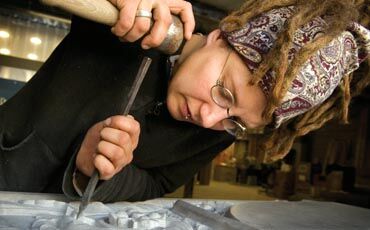

Tap. Tap. Tap. Ane Tempelmann, a master stone carver at age 33, chips away at an elaborate stone carving before her. With a simple tool resembling a flathead screwdriver, she smooths and creates fine detail on a decorative limestone frieze that will, in the end, match and elongate a doorway at the Kansas state capitol building. She has already created a clay mold of the original stonework, repaired flaws and broken areas and, where necessary, added to the design. The process is slow and meticulous. In fact, it has taken Tempelmann many days to work on this three-foot section, and when the project is complete, her artwork will blend perfectly with the building’s original facade.
In today’s “I want it now” society, the concept of true craftsmanship might seem somewhat foreign. But for Madison-based Quarra Stone, working “in the stone ages” is a multi-million dollar business, and for its team of stone carvers, the company perpetuates an art form born centuries ago, and still practiced in much the same manner.
Jim Durham, president, was first introduced to the stone fabrication industry as a college student. He later ran a quarry in Illinois and was part owner of Madison Block & Stone before selling off his interest in 1989 to start the new venture.
In 1990, Durham received a federal grant to train stone carvers, but knowing how long and arduous that training process was, he took things one step further. He traveled to a master stone carving school in Wunsiedel, Germany and persuaded the technical director to come to Madison to train students and develop training videos.
Stonework is a “long lead-time item,” Durham explains. After receiving an order and determining the exact stone type and color from samples, the stone is purchased from quarries in blocks, by tonnage. Blocks usually range between 10 and 20 tons and can cost up to $20,000. White marble from Italy, for instance, typically ranges between $8,000 and $12,000 per block, he says, and the bigger the better, because of the yield. One block of stone the size of four office desks yields about 8,000 sq. ft. of 3/8-inch thick tile. “I just bought a 36-ton piece of granite in Italy,” he beams, from a quarry that has been in operation since the 1400s.
Durham now spends as many as 90 days a year traveling to quarries around the world in search of the perfect stone. Each quarry produces stone of different textures, colors, and “flexural” strength. One in Utah, for example, is known for red sandstone that Durham utilized on projects at both Harvard University and Trinity College in Hartford, Conn. [Locally, the company will use five to seven different types of stone from the Midwest, Canada, and Israel on the Wisconsin Institutes for Discoveryproject on the UW-Madison campus.]
Shipping stone can account for up to 20% of a project’s expense, Durham says, noting that a typical transport container costs around $7,000. When it arrives, whether for a granite table-top, floor or wall tile, an architectural frieze, or historical restoration, each project is unique and calls for individual study and care. When those more ornate and difficult carvings are required, the artists take charge.
There are electronic “artists,” for example, a massive blocksaw that slices through a piece of limestone, sandstone, or granite the size of an SUV; or a huge robot laser with a diamond-coated tip that “roughs” a chunk of stone from a 3-D scanned image into a chiseled sculpture.
Then there are the stone carvers, highly-skilled craftspeople who use their high-end expertise to transform a rough design into a finely-detailed piece of art using hand tools that haven’t changed much since biblical times. The fact that Quarra uses both makes it unique in the industry, Durham says.
Now with 63 employees, Quarra has the largest contingent of carvers in the U.S., with 16 on staff. Three years ago, the company added Frank Haufe and Templemann, German master carvers, and both graduates of the Wundsiedel school, who also help mentor staff. Eric Kudrna, another carver who has worked with Durham for 24 years, boasts a resume of 2,000 ornate projects using 150 different kinds of stone. All of the carvers are working on the three-year Kansas state capitol project involving the repair and replacement of over 26,000 pieces of stone, including decorative leaves on its Corinthian columns. Some work on-site in Kansas.
To date, a just-completed, five-year project for the new U.S. Capitol Visitor Center in Washington, D.C was by far the company’s largest. Quarra fabricated and delivered 150 truckloads (between 200-300 very large blocks) of custom-finished sandstone that was meticulously matched to the stone in the Capitol rotunda. The ambitious 150,000-sq.-ft. project was so large, in fact, that each shipment had to be reported to the Senate Appropriations Committee.

