

What if Madison, or any municipality within Dane County, suddenly came under a terrorist attack requiring large-scale evacuations? Or, a tornado rips through Fitchburg? With media images of Katrina, Florida, or New York evacuations playing back clearly in our minds, how would the response be here?
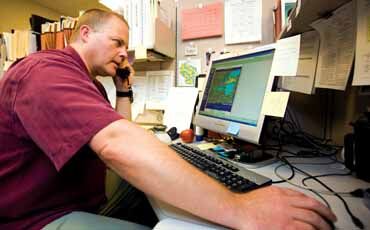
John “J.” McLellan, Population Protection Planner for the Dane County Department of Emergency Management (DEM), is paid to think about the what-ifs. What coordination will it take? Which roads or escape routes will be made accessible?
“I help identify and develop emergency response in Dane County,” he said, “and make sure that more resources are available in a more rapid and efficient fashion. Somebody has to do the alerts. That’s where emergency management comes in.” He is the coordinator, working with 61 units of local government to develop preparedness plans. And he can’t say it enough: “It’s all about preparedness.”
McLellan, 43, joined the department in 2005. He just missed the notorious 2004 Audrey Seiler debacle, (the UW student who faked her abduction, attracting national and worldwide media attention) but was very much involved in the Stoughton tornado emergency response a year later — a significant event.
“I also function as the department’s Public Information Officer,” McLellan said. “So I’m the person who gets information out to the media and deals with those calls.” The day of the Stoughton tornado, for example, he was surprised when he began receiving inquiries from TeleMundo and all major news networks. “I learned a whole lot in terms of how the regional and national media work,” he said, “and that was a driving factor for me, training-wise, as to why people and local units of government need to plan.”
Besides the human toll and property loss the areas experienced that terrible day, it was a disaster that, according to McLellan, busted the entire annual budget of the Town of Pleasant Springs in three days, and exemplified the need for a sound modus operandi.
“A large element of my work over the past five years has been the development of Dane County plans that will mirror federal and state plans,” he explained. For example, if a disaster occurs, due to weather, fire, or other unforeseen event, only first responders or elected officials — not the County — can give an order to evacuate. And if there was an act of terrorism here, McLellan said the FBI would have primary jurisdiction, but his office would be involved as well. “There needs to be that link between local, state, and federal agencies,” he said. “We wouldn’t need to insert ourselves into the issue, but we have to be prepared to bring more resources.”
Weather, especially wind and flooding, have caused the most problems, according to McLellan, but H1N1 also kept the office busy last year. “Our job was to help Public Health get the information out,” he said.
A native of Omaha, Nebraska, McLellan studied economics and history at Washington University in St. Louis. About the same time, he also started as a volunteer firefighter. “That was like a bug that bit me,” he said. He went back to school, obtained an associates degree in Fire Protection Technology from St. Louis Community College, then earned a masters degree in Public Policy Administration from the University of Missouri-St. Louis. He was employed as a firefighter with the St. Louis Fire Department when he responded to an advertisement for the Dane County position.
“Firefighting has been very valuable to me [in regards to] first response work. But what’s crucial is understanding how policy and process work with local organizations — what people do, how they work together … that’s the most critical part,” he said.
McLellan’s office is located in the secured Public Safety building in downtown Madison. If a situation is serious enough to open the county’s Emergency Operations Center (EOC), the appropriate emergency response agencies are notified. “When that call goes out, EOC representatives know ‘I’ll see you tomorrow’ is not an acceptable response,” he said. Typically, those contacted are immediately summoned to the EOC where they develop an Incident Action Plan (of attack).
When not mired in crises, McLellan is often out in the community, forging relationships and maintaining a web of contacts and agencies able to be mobilized at a moment’s notice.
In early July, he hosted a meeting of the Dane County Preparedness Council, a public-private partnership with Dane County. Attendees included representatives from Dane County Emergency Management, St. Mary’s Hospital, the VA Hospital, Monona Police, the Wisconsin Department of Transportation, the Dane County Regional Airport, and Dane County 911, among others.
A guest speaker, Captain William Tyler, the emergency preparedness coordinator for the Beloit Police Department, shared details about a large-scale apartment complex evacuation Beloit officials dealt with just days before Christmas. He explained the situation, the response, the rationale for the response, and the lessons learned.
Then McClellan encouraged attendees to share their own experiences, and Heidi Kumm, House Supervisor at Stoughton Hospital, described the hospital’s response to a bomb threat last January, which led to a full-scale evacuation. “We had a plan in place with a large facility next door, and that plan was implemented,” she said. Lessons learned that day? “There was never a Reverse 911, and wheelchair accessibility was huge.”
Learning from these real-life situations is critical when planning for the unexpected. What if, for example, Milwaukee, Minneapolis, or Chicago had a major event and had to suddenly be evacuated? “We’d be on the receiving end,” McLellan answered. How would hospitals, hotels, and roads be used? It’s all about preparedness. “The best response always starts before the emergency!”
Planning for the unexpected requires constantly reassessing the appropriateness of the county’s state of readiness. “What do we need to prepare for here? A hurricane? No. But evacuations? We have those [usually smaller in scale] all the time,” said McLellan. “Being prepared for terrorism doesn’t help you when a Katrina hits,” he said. “So all-hazards planning is critical.”
At the DEM, department managers are on-call in one-week rotations to accommodate situations that might arise. The office also maintains and operates the outdoor warning sirens — just one part of the Dane County warning system — and offers weather radios to the public at a low cost.
McLellan, meanwhile, helps develop emergency exercises that train responders and test procedures for simulated catastrophes. One such exercise, portraying a long-term power outage, will occur this month, and a full-scale operation, involving 200 people from over 15 organizations, is being planned for 2011 at the Dane County Regional Airport.
McLellan insists his role is not to “call the shots.” Rather, the office pulls everyone together to form a coordinated response.
“I’m a minor cog in all of this,” he said.
Sign up for the free IB Update — your weekly resource for local business news, analysis, voices and the names you need to know. Click here.

