
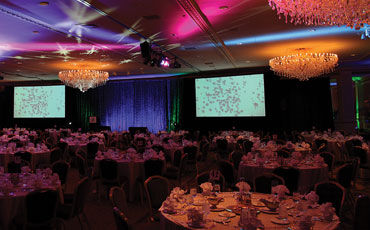

Some people are born with meeting and event planning greatness, and some have such greatness thrust upon them – whether they like it or not. If you find yourself in the latter category, as sort of an accidental meeting planner (mainly because your employer has nowhere else to turn), let not your heart be troubled. There is ample help right here in Madison.
Many accidental meeting organizers are minding their own business in small companies when they’re suddenly tasked with organizing a meeting or corporate event. The word “task” might not capture what they suddenly confront, but the term multitasking does.
In this look at meeting planning, IB spoke to a combination of professional meeting planners, venue administrators, and convention and visitor executives to offer tips on the multiple tasks that meeting planners, whether they be green or experienced, dare not neglect. In the process, we asked for a combination of basic and advanced tips, just in case the novice gets the meeting planning “bug” and decides to pursue a professional certification.
Task 1: Adjust Your Attitude
Bill Zeinemann, associate director of marketing and event services for Monona Terrace Community and Convention Center, and his staff have defined several tips for meetings that exceed expectations (some are included here). The first guiding principle is that you’re not just planning an event, you’re creating an experience, and that’s the mindset today’s planners must have.
Task 2: Lean on the CVB
Inexperienced meeting planners aren’t alone because they can rely on the local convention and visitors bureau for help with every aspect of event planning. CVBs increasingly are focused on hospitality, from welcoming people the minute they get off the airplane to the time they leave, plus they know the hotels, venues (including meeting room type and setup), local attractions, budgeting tips, and the freshest ideas.
According to Janine Wachter, a certified meeting professional and director of convention and event services for the Greater Madison Convention and Visitors Bureau, CVBs have access to incentive funding and grants to offset the cost of transportation or meeting venues, especially if a convention is coming to the same destination for three or four years consecutively.
CVBs also can help leverage local experts. In Madison, colleges and universities and institutions are a tremendous resource, which means planners don’t necessarily have to fly in expertise. “In Madison, we can use that intellectual capital to attract and plan events,” noted Janet Sperstad, program director for the meeting and event management degree program at Madison College. “It’s definitely one of Madison’s unique features.”
Task 3: Tend to Goals
Why is your group meeting? Is it to get motivated or educated, to network or socialize, or to brainstorm or strategize? Make sure you identify objectives before you make any decisions on content. Once the objective is determined, “you can start to think about the program that would serve that objective,” Zeinemann said.
Task 4: Budget Objectively
Craft your budget with the objective in mind. The first questions are: how much do you have to spend? Is it flexible or set in stone? More important, how realistic is the spending plan based on past experience?
“A budget is enough to get you started,” Zeinemann noted. “At some point, before you start planning at a detailed level, you need to have a sense of the resources available to you. It can be a chicken-and-egg conversation. Do you determine the budget based on the objectives and how you want to achieve them, or does the budget dictate the way you to pursue those objectives?”
Which does Zeinemann prefer, the chicken or the egg? “Achieving the objectives is the primary purpose, so if you don’t have an adequate budget to effectively achieve those objectives, it calls into question how effective the event can be.”
Task 5: Venue Shop
The why decision is closely followed by the where, not only the destination city, but also the most fitting venue. Novice meeting planners might want to “buy local,” especially for a corporate event, but the locale for regional and national meetings comes down to the ease and cost of travel and hospitality – airports, shuttles, taxis, and availability and affordability of hotels, especially if the lodging is attached to the eventual convention center.
Since you can’t learn everything online, preliminary phone work and site visits will be necessary. Have a checklist of needs ready for each visit, along with any remaining questions for each site’s event planning expert, whether he or she represents a hotel or a convention facility. Be prepared to share as much as possible upfront about your goals and budget, estimated attendance, a rough schedule of events, plus meal and break needs.
“We recommend a site visit, especially for events that are larger or multi-day events, and for events involving people coming from different cities,” Zeinemann advised. “The planning office of an association may be in Virginia and the individual planner may have not set foot in Madison, but their board has decided that Madison is where the convention is going to be in 2016. So it’s important that those individuals come and see the facility and talk with us because we can accomplish a lot if the individuals come and see the city and see the building.”
If a site visit cannot be arranged, a more detail-oriented approach is required. Heather Stetzer, director of sales for HotelRED, said the hotel has a long, detailed checklist for meeting planners, but it’s best to get a planner to the hotel so they can “walk through” the event. “Site visits are very important, but we don’t always have a chance to meet with someone booking a meeting from Minneapolis or Chicago,” she said. “Over the phone, you have to be a little bit more detailed about your goals and objectives.”
Task 6: Avoid Bandwidth Blues
Think of the venue not only in terms of meeting rooms and networking spaces and catering services, but also as your medium of communication. Not only do quality facilities offer the requisite space, they also have the tools to pursue your meeting objectives. In this age of smart phones, laptops, and iPads, nothing spoils the experience faster than substandard bandwidth or data-transfer speed, especially if the gathering relies on event apps and if planners want to survey attendees during the event.
“As event planners, whether we know a little or a lot, we’re having to think differently about our site visits, as well as requests for proposals, and ask people deeper questions,” Sperstad stated. “The questions are no longer about free Wi-Fi or Internet connections in the meeting rooms, it really goes far beyond that. We’re finding that because of all of these devices that people come in with, we have to ask how much data is really going to be transferred during our meeting.”
Like so much about event planning, factoring data-transfer speeds is closely tied to knowing your attendees – how do they access the Internet, and for what purposes? On its website, the Convention Industry Council has a bandwidth estimator, which asks about the number of attendees and whether they will be low- (basically checking email and Web surfing), medium- (pulling up Web applications or streaming audio), or high-bandwidth users (Web training, streaming video, and large file transfers), and whether most of them will have multiple devices.
For example, an event with 100 attendees who are high-bandwith users, where most have multiple devices, would require 21 Mb/s (megabits per second) of bandwidth.
Venues should be upfront about the bandwidth they offer, even posting maximum bandwidth on their websites. For calculating bandwidth, it’s also important to know the needs of your presenters and whether there will be other events simultaneously taking place at the same venue.
Bandwidth isn’t the only technological consideration; don’t overlook wireless coverage. “People have their 3G and 4G coverage with their smart phones, and if the providers – Verizon, U.S. Cellular, or Sprint – don’t have antennas in the building or close by, coverage can really be spotty,” Zeinemann stated.
Task 7: Audio Visioning
Tracey Bockhop, a certified meeting professional with the Preventive Cardiovascular Nurses Association, plans about 30 national events each year and has accommodated a variety of audio-visual needs – presentations and keynote speeches, music and announcements, and live video streaming. The necessary audio-visual equipment generally depends on the speaker’s needs; a standard room set would include a screen, an LCD projector, microphone, laser pointer, and laptop. Presenters who plan a video presentation will need an audio mixer that connects the sound from a laptop to the house sound system.
Nationally, the cost for A-V rental ranges from about $900 to $2,000, “depending on where you are,” stated Bockhop. While there is no getting around these costs, the use of company equipment such as laptop computers can save money. “This is always negotiated with the hotel or the convention center,” Bockhop said. “They are pretty flexible in reducing costs for a package of items.”
A-V costs are influenced by room sets. It would be a good idea to see if various speakers have the same A-V needs, which means they can be assigned the same room at different times, avoiding extra fees that come with changing the room sets and moving equipment around.
According to Wachter, some facilities have exclusive A-V policies, and some allow you to bring in your own computers. “Just confirm your speakers’ needs, making sure you’re not over-ordering,” she advised. “That can go all the way back to your request for proposal, when you are choosing a destination or venue. If you know a lot of what you need up front, having a very detailed RFP when you’re selecting a venue can really help figure out those costs.”
Task 8: Energize the Downtime
When considering a venue, remember the importance of “experience” and offer dining, entertainment, and cultural activities that give destinations a sense of place. Deb Archer, president and CEO of the GMCVB, reminds meeting planners the experience isn’t confined to programming inside the meeting venue, which is one of the reasons she wants elected officials and city planners to design local event districts so that major venues like the Alliant Energy Center are surrounded by amenities like hotels, restaurants, and retail.
“The customer experience has as much to do with the off-site experience as it does with the meeting,” Archer said. “Until now, venue surroundings have been viewed as ancillary or value-added, but now they are considered standard.”
Inside, natural lighting, ergonomic seating, public art, and opportunities for wellness are defining event spaces because they reflect the growing needs and expectations of attendees, Archer said. In addition, socially conscious attendees appreciate the selection of facilities with advanced “green” practices. If planners put out an RFP, a LEED (Leadership in Energy and Environmental Design) certification from the U.S. Green Building Council could be one of the evaluation criteria.
Task 9: Block Hotel ROOMS
When booking hotels, it’s very important to get precise numbers because event planners have to “eat” any unused rooms. Likewise, if planners exceed the number of rooms in their pre-determined hotel block, the attendee experience is affected because then planners are scrambling for alternative hotels and attendees are unhappy if they are separated from the host hotel.
Electronic registration can help nail down the number, but this is where a good working relationship with the hotel yields dividends. The hotel will need a final count anywhere from 35 to 40 days prior to the event, but there always are last-minute bookings. “I have things booked out for 2015,” Bockhop stated. “So the hotels we’re holding meetings at in 2015 have the counts that I want for guest rooms. Now at some point, we will release any unbooked rooms. Most people’s cutoff day is 30 days out, meaning at 30 days prior to the event your block is no longer available. After that, they don’t take registrations.
“In the hotel and travel world, you are going to have some last-minute bookings. It’s easier to manage just a couple than it is to manage 30, so you want to limit last-minute access.”
Wachter said planners have to account for attrition (cancellations), but knowing attendees’ booking habits is an advantage. “Depending on how registration goes, and if you have a history of your attendees registering late, it might be a negotiation piece with the hotel to say, ‘I know my attendees register within the last month, both registration and hotels,’” she noted. “Different cutoffs work for different groups.
“That is challenging for a lot of planners. You need to have open communication with the hotel you’re working with, with your sales manager, to say, ‘If my block is getting full, I want you to call me so we can add more rooms.’ I also want a schedule to indicate that we’ll release this many rooms at this date.”
Task 10: Transport Guests
Regarding transportation, here are a couple of simple pointers: If you’re flying people in, make sure the airline can handle the number of people arriving and departing, and consider partnerships with cab services to handle local transport. One pertinent question that could save money: “How would you like to be the official cab service of our event?”
Task 11: Sign On
Wayfinding signage is typically the responsibility of the destination and the venue, but meeting planners can spice up their own event and promote the company or association brand with a “gobo,” a digital sign that can be custom made (or rented from a convention facility), display your logo, and travel wherever you go. In fact, a gobo is basically an electronic logo that can be projected within the facility.
It might take a while for a custom gobo to pay for itself – indeed, a more economical banner makes more sense for a one-off event – but if you are successful enough at planning your first meeting, you might be asked to do it again. “It’s a metal disk that goes in front of a light,” Wachter explained. “It can be anywhere between $50 and $200, depending on how large it is and whether you’re producing several of them (logos) at the same time.
“The upfront cost might be a little higher, but it pays for itself in the long run. You end up with something you can keep using.”
Physical signs aren’t the only way to welcome, as Walmart has demonstrated. “There is also a human aspect of welcoming people,” Archer said, “so it’s not just all passive welcoming signs, notifications, and digital event messaging boards. We shouldn’t remove all the human aspects of making event attendees feel welcome.”
Task 12: Let There Be Light
John McDonald, the Madison manager of Studio Gear, notes that lighting has two purposes at a corporate meeting – functional and aesthetic. Functional involves face lighting on the presenter in a dimly lit room, or dim-able lighting in a room. Aesthetic illumination includes colored lighting behind the stage or around the room. “Moving fixtures can add color and motion to the room, but also adds cost,” McDonald noted.
“To get the biggest bang for your buck on aesthetic lighting, think about highlighting the area behind the presenter or architectural features of the room,” he added. “Lighting can also be used to highlight the hallway or even outside the building.”
Task 13: Cater to Their Tastes
Catering choices can help achieve the objective of the meeting. While it’s wise to understand the tastes of your audience, planners can reinforce the sense of place by showcasing local cuisine, or surprise attendees with an unexpectedly dazzling snack that can delight without busting the budget.
Catering is a big part of the budget, but there are opportunities for flexibility, including special dietary needs or allergies (all of which can be gleaned by online registration). The other advantage is that a caterer worth his or her salt can offer sage advice and ideas, and at least one meal, the evening dinner, is easy to calculate (one per attendee, per night).
According to Patty Lemke, general manager of Monona Terrace Catering, when it comes to meal planning, it’s important to make sure the budget is realistic for the venue chosen and the services desired, so don’t hesitate to involve the venue staff in the budgeting process. Here’s how Lemke breaks it down:
Breakfast: Breakfast might be a great way to start the day, but serving a full breakfast is not mandatory at the beginning of a meeting day. It’s important to at least offer coffee and tea as guests arrive. Soft drinks for non-coffee drinkers should also be a consideration. If the budget is tight, a less expensive continental style breakfast (pastries, fruit, juice, coffee, tea) can be a satisfying option for guests.
Morning Break: If the day begins with a full breakfast or a substantial continental style breakfast, the morning break can be light and consist of beverages only (heavier on the coffee than cold beverages). If the day started with beverages only, then it would be appropriate to provide a light snack such as fruit, pastry, or yogurt. If there are leftover pastries from the early service, be sure to have those available at the morning break.
Lunch: Since lunch is in the middle of the meeting day, the time allotted for lunch is a key factor in determining what type of meal to serve. “Box lunches are great for a really quick serve, or to take into workshops over the lunch hour,” Lemke said. “Buffet lunches work well if you want variety but don’t want to track individual meal choices, and if you have a few extra minutes to allow everyone to go through the buffet.”
Plated meals can be an efficient way to serve guests, especially if the salads and desserts are pre-set. They can also be more cost effective since, unlike a buffet, the portion is controlled. “It is no longer a requirement to serve dessert with lunch,” Lemke noted. “Serving dessert at the afternoon break is a great way to stretch the budget.”
Afternoon Break: If dessert was served at lunch, the afternoon break can consist of beverages only (heavier on the cold beverages than coffee) and a light snack like popcorn. If dessert was not served at lunch, then the sky’s the limit on a really great afternoon snack to keep everyone’s energy going for the rest of the day. Along with beverages, consider cupcakes, brownies/bars, cookies and milk, smoothies, ice cream, candy bars, and fruit.
Receptions: Options for bar service can vary significantly, Lemke noted. If the budget is generous, then a fully hosted bar is a great option with a “welcome drink” that is themed to the event (a carved-ice martini luge with the company logo is always a big hit). More budget-friendly options are hosted beer, wine, and soft drinks with cash spirits, or a hosted keg of beer and soft drinks with all other items on a cash basis. Anytime there are hosted alcoholic beverages, be sure to also offer soft drinks as a non-alcohol option. (Note: With our litigious society in mind, some events limit alcohol consumption with drink tickets, or make arrangements with hotels and cabs to handle sloppy imbibers.)
Ordering the right amount of hors d’oeuvres depends on when you plan to serve them:
• Pre-dinner: 2-4 portions per guest, per hour
• Late afternoon: 6-8 portions per guest
• Dinner: 12-15 portions per guest
• Post dinner: 2-3 portions per guest
Dinner: Whether serving a plated meal or buffet, be sure to have guests inform you of their special dietary needs – vegetarian, gluten free, and allergies – for all meal periods, and do so at the time of RSVP or registration. If offering multiple entrées, have a system in place to identify the guest’s meal choice at the time of service. Color-coded meal tickets are a reliable method to ensure guests receive what they ordered.
Dessert is expected at dinner. Whether you are serving individual desserts, placing a family-style tray of assorted petite desserts on each table, or offering a post-dinner dessert buffet with coffee, it is important to offer something sweet to finish the evening meal.
“Dinner buffets offer variety to guests without having to track meal choices, but they can be more expensive than a plated meal because the portion is not controlled like a plated meal,” Lemke explained. “If budget is a concern, stick with a single-plated entrée, always with a vegetarian option.”
Task 14: Turn Stage Fright Into Stage Might
Preparation is the best antidote to event-day jitters. Prep work includes having a thorough event kit and a schedule of events with room designations, and compiling contact information for key venue personnel, anticipating needs, and being prepared to troubleshoot the day of the event. Zeinemann recommends a pre-conference meeting with venue staff to make sure everyone is on the same page.
Task 15: Follow Up
After the event, follow up with thank-you notes to attendees. Contact any leads generated in the planning process or during the event, and encourage comments and share a recap for those who came. Survey attendees no later than 10 days after the event to gain feedback and insights about what went right and what can be done better. Huddle with the venue or hotel partner to discuss tweaks and improvements. To evaluate return on investment, ask one simple question: Were your meeting goals accomplished?
Sign up for the free IB Update – your weekly resource for local business news, analysis, voices, and the names you need to know. Click here. If you are not already a subscriber to In Business magazine, be sure to sign up for our monthly print edition here.

