
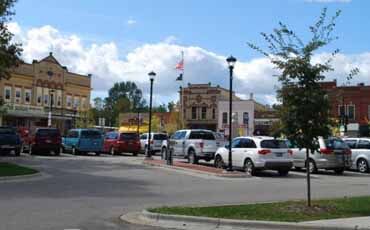

Call Oregon, Wis., a bedroom community, and Brett Frazier, the village’s indefatigable chamber of commerce director, is likely to correct you – with the sort of amiable flair you’d expect from one of this agreeable old town’s youngest leaders.
To say that Oregon is strictly a commuter town, after all, is to miss the kinetic energy that’s been building in the village lately, particularly when it comes to the business environment.
“At its core, I would say Oregon is not a bedroom community, because that indicates that there’s no commerce going on,” said Frazier, “but I would say if there’s a way to envision a community where you have a thriving industrial park, a thriving downtown, a business community right alongside all the best things of a bedroom community, that’s our goal here, and we can do it. The community is laid out perfectly for it.
“It’s a historic community. We’ve got residential certainly spread out throughout, but not necessarily bumping up against, in many cases, the industrial area, the business area. Our business is really focused in a few different core areas, but we always want to make sure that we’re not sacrificing the quality of life of Oregon, which is our biggest selling feature, for economic development’s sake. There’s a balance there, and that’s what we work with the village to find.”
The village certainly has forward momentum. Last year, it cracked CNN/Money’s top 100 list of America’s best small towns to live in, coming in at No. 99. It also landed a fairly sizable fish (for a town that boasts just 9,200 residents, anyway) when Thysse Printing Service, a company that had called Madison home for 70 years, agreed to set up shop in Oregon’s industrial park.
Add to that its highly regarded schools, proximity to Madison, and a still-charming downtown that hasn’t yet been steamrolled by the sometimes grim realities of 21st century retail, and you can see why Frazier is sanguine about the future.
Still, for all its historic charm, residential appeal, and some delightful quirkiness – a retro bowling alley straight out of a Big Lebowski fever dream peers across the street through the chamber of commerce’s upstairs windows, and a Buddhist center and monastery resides on the outskirts of town – it’s taken some time for Oregon to push its way to a place at the adults’ table.
“When I first started, I got calls about someone looking for 500 square feet of office space. … Well, now I’m getting calls from people looking for seven-acre sites to develop a 30,000-square-foot building. They’re looking for these kinds of check boxes to be checked and they’re looking in this geographic area, and they’ve called Oregon as one of the six calls they’re going to make today.” – Brett Frazier, director, Oregon Area Chamber of Commerce |
“In reality, there’s only so much commerce going on,” said Frazier. “So when you have communities like we have in the Madison area that promote themselves very aggressively and very well for those limited economic development dollars – and I’m thinking about places like Fitchburg, like Middleton, like Waunakee – we have just kind of by accident, I suppose by not being self-promoters as much as we might, we’ve sort of fallen into the background.
“You’ve got these other communities that do a very good job of self-promoting and making sure everyone is aware that they’re an option when you’re looking to invest in a business or in land. Now Oregon has become a player through [the Thysse Printing deal], and some others that we see on the horizon. More and more, Oregon is going to elevate to that level of consciousness with the business investor.”
Indeed, since early last year, when Frazier came on board as the Oregon Chamber’s executive director, he’s seen a fundamental shift in the kinds of inquiries he’s fielded.
“When I first started, I got calls about someone looking for 500 square feet of office space,” said Frazier. “Well, I know where to find that. That’s something the chamber does – we support our members. If a member is looking for new office space, we’ll let them know what’s out there, great.
“Well, now I’m getting calls from people looking for seven-acre sites to develop a 30,000-square-foot building. They’re looking for these kinds of check boxes to be checked and they’re looking in this geographic area, and they’ve called Oregon as one of the six calls they’re going to make today.
“Both calls have value,” he noted, “and both calls are something we do here at the chamber, but if we’re talking about a broad community impact, especially for a place like Oregon that’s got low-impact land and an industrial park where we can put these businesses, dealing with these bigger developments is something that’s going to benefit all of our members here at the chamber. Increasing that daytime population benefits just about every single member that we’ve got.”
Overcoming barriers
The efforts the village has made to broaden its business scope are, to some degree, an extension of some overdue changes it has made in the last decade.
Steve Peotter, the CEO of Oregon Community Bank and Trust, past president of the Oregon Chamber, and vice chair of the chamber’s Economic Development Commission, has seen some of those efforts up close.
Peotter has lived in Oregon since 2004, when he relocated his family to his wife’s childhood hometown, and he says the village really started making commitments to economic development in the mid to late 2000s.
“In 2007 and 2008, the village went through, I’ll call it a redevelopment of the historic downtown of the village, which involved making it more user-friendly, family-friendly, bike-friendly, more pedestrian-friendly, to frankly make the downtown more visually appealing and also more accessible to the residents that live here, as well as having some businesses downtown that were compelling to bring people downtown,” said Peotter. “So I think in the village at the municipal government level, that was a good discussion that happened, and then the business community and the chamber were very supportive of that change.
“Meanwhile, about that same time, the folks that came in and purchased the Bergamont neighborhood, that was kind of coming online at the same time, so there was also this spur of the big clubhouse going up, the pool house going up, and there being frankly some good excitement related to that neighborhood, which brought additional residents into the community. So those pieces played out very well together, and then recently, as things have happened, everyone is pleased that the Thysse Printing company is relocating out of Madison to be here.”
Indeed, Thysse Printing’s impending move, which will be completed at the end of May, is illustrative of both the town’s sleepy reputation and the more economically vibrant path it hopes to forge.
Even though owner Jason Thysse had called Oregon home for five years and was sold on the town as an ideal place to live, it still took a lot of convincing to get him to move his business there, and he concedes that there was initially a psychological barrier to making the move. At the time, said Thysse, the company was actively looking for real estate in Madison and communities such as McFarland and hadn’t really considered Oregon, but when Frazier and other community leaders got wind of the company’s potential move, the hard sell began.
“I think [that psychological barrier] definitely existed for me, because obviously I don’t mind living there and driving there, but there isn’t much industry in Oregon,” said Thysse. “But they helped me see that Oregon has a lot of potential, and they’re going to be very aggressive in bringing more business there.”
One of the stumbling blocks that had to be overcome was Oregon’s reputation as a relatively far-flung community outside the Beltline’s hustle and bustle. But Thysse said that with the rise of the Internet, he became convinced that proximity to clients wasn’t nearly as important as it was 10 or 15 years ago. At the same time, he saw many advantages to moving.
“The lot we looked at was a full three-acre lot, which was a lot bigger than any of the buildings we were looking to purchase,” said Thysse. “So what that does is give us room to almost triple our square footage from the original building that we’re putting up. So I like the fact that we hopefully should never have to move again, because moving the shop is not going to be easy the first time.
“Secondly, just what [Frazier] went through to help recruit us, working with the village, shows me they’re serious about bringing in not just us but other businesses as well, which would only strengthen our position in the area.”
Small-town life, big-city benefits
Any new businesses that care to call Oregon home will join a small but important nucleus of companies that have served as reliable local economic drivers for decades.
Among these is Trachte, Inc., a manufacturer of pre-assembled design flexible steel buildings that has been in business for more than 90 years.
Two other local companies, Wisco Industries, Inc., a metal stamping firm, and All-Color Powder Coating, have combined to contribute to one of the UW’s most recognizable “landmarks” – the colorful chairs at the Memorial Union.
Indeed, you could say that those chairs have their own colorful history.
“The UW had to replace some chairs, and when they went to buy them from the place they had bought the chairs from originally, they discovered that that company had gone out of business, all of the dies or stamps had been sold or melted down for scrap,” said Frazier. “So they contacted Wisco, which was able to duplicate the chairs, create them, so those are the chairs you’ve been seeing. And in more recent years, All-Color has started doing the powder coating there. There’s a lot of synergy between those two companies.”
But while Oregon may have ties to its far bigger and more famous neighbor, at its heart it’s a small town, and city-minded folk might still be reluctant to set up shop there.
What, after all, is there to do in a little town like Oregon? If you’re not into kids’ sports, golf, block parties, socializing at the local coffeehouse – or even Buddhist meditation – the options may seem fairly sparse compared to what you’ll find in Madison. Still, it’s not like it’s a ghost town. As Frazier notes, “It’s true we don’t have a movie theater, we don’t have a hotel, there’s lots of things that currently we don’t have, but I never hear the complaint that there’s nothing to do in Oregon. There’s always something happening.”
And if the local community calendar is not to your liking, Madison is not far away.
“I think you can have a village that feels somewhat small-town in a positive community way, but also happens to be very close to a vibrant urban environment,” said Peotter. “And a lot of the people we talk to who choose to live here, that’s what they talk about. In 16 minutes, you can be from your house to Monona Terrace, or in 16 minutes, you can make it to the Memorial Union. And there’s a lot of Wisconsin graduates who live in this village, and there’s a lot of excitement to be able to live that close.”
Down the road
While Fitchburg’s own expansion efforts have created some excitement among Oregon residents, and have created a situation where, in Peotter’s words, the big city is for all intents and purposes “moving three miles closer to Oregon,” the village does not seem content to sit on its hands. For his part, Frazier is looking well into the future.
“As we get this momentum going, at some point unfortunately we’re going to run out of land in that industrial park,” said Frazier. “We need to make plans as a community. Where do we go after that? There’s an obvious one that everyone talks about, which is east of Highway 14 at the 138/14 interchange. It makes a ton of sense. The landowners out there are interested in annexation. That makes all the sense in the world.
“There’s also the potential that we could expand that industrial park down there by other land acquisition. As the momentum gets going, I think it makes a lot of sense to do both. The mechanics of that are something that the village would have to look at from a financial perspective, but there’s a potential for significant growth in both locations during the recovery economy, especially when things finally come roaring back, which of course they will.”
Sign up for the free IB Update – your weekly resource for local business news, analysis, voices, and the names you need to know. Click here.

