
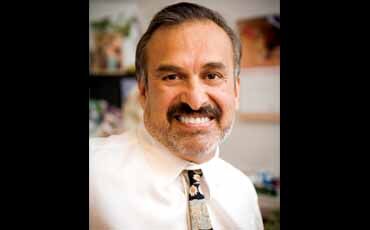

Oscar Mireles, executive director/principal of Omega School in Madison, an alternative, adult basic education and diploma completion program, is a man of many personas: There is the family man from Racine, Wis., one of 11 children of a migrant worker mother and factory-worker father. A man whose older brother once flunked out of kindergarten because he didn’t speak English.
There is the former 98-pound varsity wrestler on the Racine Horlick High School team who credits the sport for teaching him self-discipline and instilling self-esteem, who now teaches wrestling at Edgewood High School. In fact, many of Mireles’ life lessons are honed from his wrestling experience.
There is the artistic man, a published writer and poet — intuitive, observant, and always listening. “I am way more sensitive than I should be,” he admits, saying writing is one of the few things he does for himself. His words reflect on specific Latino experiences, and help explore his own identity.
There is the proud Mexican-American, the father of four who learned his native tongue later in life and has developed an interest in Salsa and Zumba dancing, but whose wrangle with the Tango was cut when a bum knee (replaced last month) sidelined his cha-cha-cha.
And there is the compassionate man, taking pride and interest in each of Omega School’s students. The man who claims to know each of the its 2,500 graduates by name. The photographer, whose framed photos of past graduates line the school’s hallways and office walls.
“What you put on the wall is what you value,” he said. “For us, it’s graduates. They [walk in] and the message is: You’ll have success here.” This from a man who admits it took 19 years to complete his sociology degree after leaving UW-Oshkosh with just eight credits to go: “Perhaps that helps me better relate to students.”
Mireles, 55, has run Omega School for 16 years. The school prepares students who missed out on a high school diploma a chance to earn their GED through its alternative, one-on-one approach to learning that is a critical yet-often-criticized technique. “Some think you can’t do one-to-one instruction, or that you need more time,” he said, referring to the six to 12 weeks it might take a student to prepare for and pass all five GED tests, which are administered at Madison College. Twice a year, Mireles provides caps, gowns, and holds graduation ceremonies celebrating those who succeed.
Support from United Way, the City of Madison, and other school districts and funders, allows students to attend free sessions twice a week in two-hour blocks. Five paid instructors and dozens of volunteers and tutors provide individualized learning, but it takes a commitment on both sides.
“These are students who may have failed in a classroom setting. Life got in the way — perhaps drugs, perhaps pregnancy,” Mireles said, adding that half of the students are under 20 years old, and 80% are under 30.
“[To many], learning is kind of a mystery — something only smart people do. They can’t grasp it. We separate the students so they can learn on their own. We teach them to focus in — there are no headphones, no cell phones allowed. Here they can prove they’re smart enough.”
The school provides babysitting twice a week, and has offered meals on occasion. “We try to remove any obstacles,” he said, yet he knows success — and the drive for it — resonates differently in each person. It’s all about focus and discipline. Just like wrestling.
Of about 250 students that commit to at least 20 hours in Omega’s GED program each year, about 80% will take at least one GED exam, and 40% of those will graduate in a calendar year. Is Mireles happy with those numbers? “Given the population, the people we get here have typically failed everywhere else. This is a last resort. So yes, I am pleased. We try to do everything we can.”
Sign up for the free IB Update — your weekly resource for local business news, analysis, voices and the names you need to know. Click here.

