
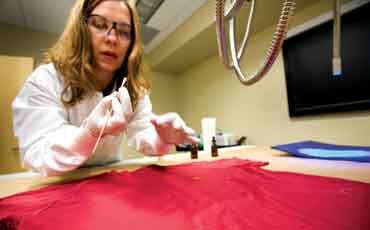

In a dark room at a large, square table, Jennifer Zawacki, DNA analyst with the state crime lab, examines a red shirt under a special blue light, searching for hidden clues to a crime. Under regular lighting, the shirt appears normal, but illuminated in blue, stains eerily luminesce. Zawacki dips a cotton swab into a clear solution, and dabs the stain. It turns pink, a positive indicator for blood. If there is blood, there will be DNA belonging to a specific individual.
Though this particular test is for demonstration purposes only, it illustrates some of the crime-solving tactics used at the crime lab, and for a few minutes, we feel like we’re actors in a dramatic TV show. But many of the similarities to prime time end there.
Zawacki laughs. “I wish I could drive a Hummer and go to work in leather pants,” the 32-year old says, comparing the reality of her job with television’s glamorized depictions. On the contrary, when called out on a crime scene, she usually wears jeans and T-shirts that she doesn’t mind getting dirty.
“We see a lot of nasty things.”
DNA analysts are state employees paid on an hourly basis, and their jobs require a lot of paperwork and report-filing. Unlike TV, they don’t work on one case exclusively. “We might have between three and eight cases going at a time, in various stages,” Zawacki says, and though they would love to wrap everything up in one hour, reality isn’t so cut and dried (no pun intended).
Typical cases may take between one and three weeks to complete, with homicide cases lasting a month or more, she says, adding that the Madison lab tends to receive more sexual assault cases than homicides. They rarely attend autopsies: “We examine evidence, not dead bodies.”
Wisconsin’s Department of Justice operates two full-service crime labs. The Milwaukee lab employs 22 DNA analysts focusing on a nine-county area surrounding the state’s largest city. Madison’s lab, with about 33 analysts, covers the rest of the state. Several years ago, Wisconsin’s crime labs had a well-publicized nine-month backlog of cases. Since then, support from Attorney General J.B. Van Hollen and the Legislature resulted in the hiring of 30 additional analysts in 2007.
Federal grants cover analyst training, lab supplies, and the acquisition of new technology, such as the three “robots” in the Madison lab (two in Milwaukee), each of which can analyze 80 liquid DNA samples at once, 10 times the capabilities of a single analyst.
So what drives a person to choose a career analyzing blood and semen samples, or documenting gruesome crime scenes rife with unimaginable odors? “You want to help the victim,” Zawacki says. “I know that people have been convicted because of my work, and I’ve also eliminated suspects from evidence. But nobody looks forward to examining dirty sheets.”
Zawacki, who joined the crime lab in 2005, graduated from UW-Madison in 1999 with degrees in molecular biology and biochemistry. She then earned a master’s degree in forensic science from John Jay College of Criminal Justice in New York.
Because she has additional training as a crime-scene photographer and videographer, she also volunteers on the CSI unit, which visits a crime scene or attends an autopsy only when it is invited to do so — usually by a municipality lacking similar resources. (Agencies such as the Madison Police Department, for example, have their own CSI units.)
In a murder situation, Zawacki says emergency responders (police, fire) will be present, as will the Coroner and often a CSI unit to document the scene. “We usually send two people,” she says, and despite the flurry of activity, analysts try to limit their interactions with the police in an effort to eliminate any bias. “We don’t want to know what they’re thinking.”
Back in the lab, analysts examine a finite number of data from DNA evidence and draw conclusions. Assignments are doled-out based on experience, and each analyst has a roomy set-up, including a desk and laboratory space complete with a microscope and other diagnostic tools of the trade.
There are five steps to analyzing DNA, Zawacki explains. First, the DNA must be extracted from the evidence, and the amount of DNA present must be determined. Then, the analysts make billions of copies of specific areas of the DNA for study. Zawacki likens this process to having a 100-page book chocked full of information. “We will always study pages 5, 27 and 60, for example, and we need as much DNA [from those specific sections] as we can get.” So rather than collect many different samples, only a few, small samples are taken, and then multiplied.
The detection stage creates DNA profiles that identify specific markers unique to each individual. [Interestingly enough, identical twins will exhibit identical DNA markers.]
Finally, results are interpreted. If a positive identification is made, the DNA goes through a statistical analysis, which can be used in a jury trial. “We can identify someone if the source of the frequency (of their genetic makeup) is rarer than one in six trillion,” she said, which happens to be 1,000 times the world’s population.
The resulting DNA profile is entered into CODIS (the Combined DNA Index System), a national DNA database that registers DNA from convicted offenders, forensic profiles (gained from evidence), and missing persons. Profiles of victims are never put in the database, Zawacki says, and in cases of missing children, parents are the best resource.
Human DNA collection usually involves a cheek swab, whereas blood is collected from a dead body. Currently, all felons submit DNA samples, though there is discussion of expanding that to all arrestees in the future. Zawacki says blood, saliva, and hair are ideal for DNA collection, and just a dime-sized sample will provide enough evidence for study. Skin cells, white blood cells, and semen are also excellent tattlers.
Aiding the search for DNA is the lingering effect of some evidence. Semen (on a bed sheet, for example), lasts a long time, regardless of washings; and blood that might have been washed off walls or clothing in an attempt to hide evidence can reappear using a product called Luminol, one of many tricks of the trade — yes, just like on TV.
Zawacki cautions that a positive DNA match does not necessarily prove that a person is guilty, because tests cannot determine when the DNA was left at a crime scene. And while DNA cannot be extracted from everything, Zawacki says a new technology called Touch DNA is allowing for collections from inanimate objects, such as doorknobs and weapons. “Some people just shed more DNA,” she says, through sweat, for example.
Knowing what she knows, and seeing what she sees on a daily basis, does Zawacki ever really feel clean?
“Laundry is never really clean,” she admits, though she refuses to obsess about it. She is very mindful, however, to wash her hands often and avoid touching doorknobs whenever possible.
Of her job, Zawacki says, “I do this for the greater good, to help victims get justice, but we’re really just tools in the process.” Then she adds, “I can see myself doing this until I’m old and gray. It’s a really good career.”
Mean wage estimate: about $26/hour.
Sign up for the free IB Update — your weekly resource for local business news, analysis, voices and the names you need to know. Click here.

