
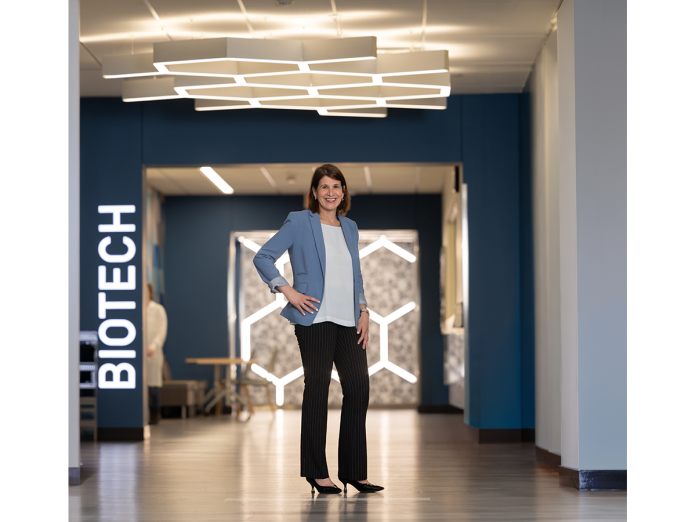
When Jennifer Berne became president of Madison College last July, she took on a job she said is essentially impossible, but nonetheless critical: to help create a system that reaches all students.
It’s a tall order for an institution that spans 12 counties. Madison College has seven campuses, including three in Madison, as well as locations in Fort Atkinson, Portage, Reedsburg and Watertown.
Each campus and its surrounding community comes with a unique set of needs: Students face different barriers that can make school attendance a challenge; educators are tasked with preparing them for a rapidly shifting career landscape; and local employers face labor shortages while, at the same time, demand for workers in new industries grows.
Over the course of her career, Berne has taught both students and teachers, assessed and advocated for the needs of technical colleges and employers and repeatedly challenged herself to continue her own education.
All of this, she said, is in service of “clearing a pathway” for students, allowing them to take charge of their lives and enrich their communities.
While Berne acknowledges that “no system reaches all students,” that isn’t stopping her from pushing for changes that accommodate students and fulfill workforce demands.
What made you gravitate toward a career in higher education?
I’ve done a lot of different things, but all in support of teaching and learning for adult students. I started at a community college, very much like Madison College in another state, and I taught English and ESL and adult basic education.
I taught the students who had very low literacy levels but wanted to improve their lives. I was very young, and I really didn’t know what I was doing. I was trying hard, but I felt that I could do better for them. So I went back to school to learn about how you teach, how adults learn, and in doing so, I got very interested in another kind of adult — teachers.
I went to a four-year (college), and I became a professor of teacher education, so I taught adults who were teachers how to teach reading and writing to students.
But I was also a mom, and my students were practicing teachers and had to go to school at night. So I was teaching at night while my kids were home, and I was home during the day while my kids were at school. It was kind of a mismatch, so I went into administration, thinking I would be in there for a short time while my kids grew up, and then go back to a faculty role.
Very quickly, I realized that my heart was actually in the two-year college.
So it has evolved a little bit … but the roots are the same: How do you provide opportunities for people to activate their own lives?
How do you prepare students for a changing workforce or for areas of high demand?
I feel an enormous responsibility to the community to make sure that we provide high quality health care and public safety, so we train police, fire, EMS, nurses, dental hygienists, respiratory therapists — many health care disciplines.
We also feel responsible to the manufacturing community to make sure that we are putting out graduates that know about the technology, but also the practical skills.
I feel very responsible to our students to give them a clear pathway to get to their goals. We see the obstacles they have: child care, transportation, time, taking care of parents, all sorts of things. Each student has a particular array of responsibilities and needs, and we’re trying to meet those so that they can do what they came here to do.
So it’s sort of a dual responsibility: It’s a responsibility to the students who come here to make sure that we give them a high quality education with as few barriers as possible, and then we have a responsibility to the workforce to make sure that those students move from Madison College into those jobs.
In the Wisconsin Technical College System, 93% of our graduates stay in Wisconsin, and almost 70% of our graduates stay in the region that the technical college resides in. That’s probably even more for Madison College.
We’re actually providing a direct route to community vibrancy.
What are the hardest parts of your job?
It’s been a challenge to me to understand that you can create a system that reaches many students, but no system reaches all students.
We have 28,000 students, and 22,000 degree-seeking students. We can create systems, and those systems will help many students, but it’s our obligation to help all students. That’s a frustration that I’m trying to overcome, and the way that I manage that is by listening to the students.
I mean, it didn’t occur to us 10 years ago that community college students might be food insecure. We weren’t thinking that that might be interfering with their ability to succeed.
Nationally, the community college infrastructure has seen that and is now responding. We have a food pantry. We have many, many community partners who we refer students to for food insecurity, because we know that it’s not just about them eating that day. It’s about knowing that they can eat this month and through the semester.
I’ve learned what it takes to (make room in) somebody’s life in order to succeed in a program. … Being a student is a lifestyle. It’s not something some people have the luxury of stepping into and stepping out of. Most students have to really commit to it, and because of that, we have to commit to them.
On the flip side, what have been your proudest moments?
As a very adult student, I went back to school. This was 20 years after my doctorate, to get an MBA, to learn about change management and accounting and marketing and AI and all of the skills that I thought (I should know).
A big part (of my career) is teaching and learning, but it’s also a business, right? I’m really proud that I was able to do that. It was the hardest thing I ever did. It was so much to juggle, and a different way of thinking.
The best thing we can teach our students is how to learn what they want to know, so they can go out into the world with whatever they’ve acquired here and learn the next thing as a transfer student, as an employee, as a parent, as a community member.
I run marathons. That’s a big part of my life. I’ve done it for 30 years, and I do one each year, but I run all year to be prepared.
People say, “Oh my gosh, I could never run 26 miles,” and I say, “You could if you wanted to.” … I believe our students have the tools in the reserves to learn what they want to succeed.
What brings you joy in your job?
When I see students walking across the stage at a technical college graduation, it’s like their lives change in that moment.
A student who gets a nursing degree has now really provided a path for many people around her, in her family, in her community, to see success. The most rewarding part of my job is seeing students finish what they started, become what they want to become … and know there’s life ahead of them as well.
I have great hope and great expectation that the people that we’re educating today are going to be our leaders and are going to take great care of our democracy and ourselves.

