

When it comes to choosing between grains and grapes, Wisconsinites’ creative ferment has traditionally been focused on the former, with beer holding an almost sacred place in our state’s economic history.
But as the nation’s beverage choices change, Wisconsin is changing, too, and the biggest indication of this shift is the number of wineries that have opened in the past decade.
In 2000, the state was barely a blip on the map for oenophiles, but in a little more than a decade, interest in winemaking here has exploded, with more than 80 wineries now calling Wisconsin home.
| “It seems like now every two or three years there’s another two or three great varietals that are released to the vineyards that are available that weren’t available before.” — Alwyn Fitzgerald, Fisher King Winery |
“If you look at the trend, it loped along with just slight increases all the way through the ’60s, ’70s, ’80s, ’90s, and I think it was 12 or 13 wineries in 2000, and now within the past decade it’s gone right up,” said Alwyn Fitzgerald, owner and founder of Mount Horeb’s Fisher King Winery.
Fitzgerald can proudly say that he’s not just part of the trend, but a significant contributor. In 2011, after years of preparation, he launched Fisher King Winery. Prior to that, when he was still doing the significant legwork required to get his dream off the ground, he helped found the Wisconsin Grape Growers Association, which in just five years has already attracted around 400 members.
“Prior to 2008, Wisconsin was just about the only state in the union that didn’t have its own grape growers association, which shows that Wisconsin was kind of lagging behind in this area,” said Fitzgerald. “So if you poll people across the country or internationally, they wouldn’t pick Wisconsin near the top of the list of grape-growing regions or wine regions. That is changing now.”
Wine’s ascendance
|
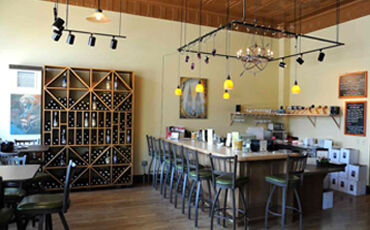
Fisher King Winery opened in Mount Horeb in 2011. |
You could say winemakers’ prospects are changing everywhere, not just in Wisconsin. From 2001-11, wine consumption increased nationwide by 20%. At the same time, beer consumption decreased by around 10%, and even coffee consumption ticked down somewhat, despite the omnipresence of Starbucks and other coffee shops.
But Fitzgerald wasn’t just following a trend when he decided to leave his corporate job to open a winery — he was pursuing a long-dormant dream.
For around 35 years, Fitzgerald worked in marketing with large science supply, instrumentation, and biotech companies. He earned a good living doing meaningful work, but his interest in wine and winemaking kept gnawing away at the velvet handcuffs that were keeping him from pursuing his passion.
“I finally just realized — it’s kind of like that old song, ‘Is that all there is my friend?’” said Fitzgerald. “I mean, I wasn’t getting fulfilled. It wasn’t feeding my soul. Working in the corporate world and marketing products and services is fine, but you kind of have to build up your enthusiasm to do it. So the so-called latter part of my career, I said, ‘I better pursue something that’s a passion, because especially now that I’m in my 50s, if I don’t do it now, it’s just not going to happen.’ Because it would be a heck of a lot harder to do in my 60s, and it’s not going to happen in my 70s.”
But while Fitzgerald was determined to make a go of it on his own, like most successful entrepreneurs, he dove into his passion with eyes wide open. He spent a year and a half putting together a business plan, took courses at the UW’s Small Business Development Center (an indispensable resource, he says), and meticulously scouted out locations, finally settling on Mount Horeb because of its proximity to Madison, its active chamber of commerce, its busy main street, and its visitor-oriented environment.
And while he has an MBA, he found having the input of reliable bean counters (aka good accountants) was instrumental in achieving his more starry-eyed goals.
“Marketing guys are always possibility thinkers, and we see opportunities,” said Fitzgerald, “and somebody needs to hold your feet down to the ground a little bit and say, ‘You might be able to achieve some of these things, and you think you can get some of these sales or profit numbers generated, but let’s look at a few different scenarios. Maybe it isn’t going to come out that way, and if it doesn’t, how does that affect everything?’”
Great grapes
But while due diligence is vital to the success of any business, riding the crest of a wave can’t hurt either. Not only have Wisconsin wineries benefited from consumer trends, they’ve also seen a surge in opportunities.
That goes back to the grape, and a Wisconsinite whom Fitzgerald calls “the Gregor Mendel of the vineyard.”
According to Fitzgerald, the work of Elmer Swenson, a legendary grape breeder who died in 2004 at the age of 91, has helped revolutionize the Wisconsin wine industry.
“He lived up sort of toward Eau Claire, and he had a larger vineyard, and he spent many, many of his years cross-pollinating and cross-breeding different grapes from wild grapes crossed with vinifera [the classic European grapes used to make widely consumed wines such as cabernet, pinot noir, chardonnay, Riesling, and more],” said Fitzgerald. “He created probably three dozen different hybrid varietals that can withstand our cold winter and actually make decent wine.”
(Continued)
Eventually, Swenson took his talents to the University of Minnesota, which used them to help establish its respected viticultural research program. Along with the contributions of several other viticultural programs around the country, this has expanded the horizons of wineries like Fisher King tremendously.
“It seems like now every two or three years there’s another two or three great varietals that are released to the vineyards that are available that weren’t available before that have been developed at theses viticultural research institutes,” said Fitzgerald. “They’re getting planted in our cold-climate northern vineyards, and they flourish in our cold winters, and they are producing a greater variety of wine, wine options, and wine possibilities.”
|
Workers show off some of the grapes that will be used to make Fisher King wine. |
Of course, one might think that selling wine to the grains-and-hops fans in the Badger State presents a marketing challenge in and of itself. But demographic trends as well as Fisher King’s own accomplishments bode well for his winery, says Fitzgerald. For one thing, Fitzgerald says he is witnessing a shift among consumers in general, but Millennials in particular, who have bought into the buy-local movement and have more adventurous tastes than previous generations. These are likely future craft beer drinkers, and Fitzgerald also sees them as the “next big wave of wine drinkers.”
In addition, Wisconsin wineries are quickly catching the notice of wine drinkers across the country, slowly but surely rebranding the state as a wine-friendly region. For instance, in 2012, Wollersheim, Wisconsin’s largest winery, was named Winery of the Year at the San Diego International Wine Competition, and Fisher King has made some of its own inroads, winning a gold medal at this year’s International Eastern Wine Competition.
“So here we are, we’re a 2-year-old winery, and we entered a wine that we made from grapes grown right here in Wisconsin in an international wine competition, and we won a gold medal,” said Fitzgerald.
But while accolades and awards will surely further the fortunes of Wisconsin’s wineries, ultimately it all has to come down to the drinkability of its wines.
“I am absolutely convinced as a winemaker that we can make well-balanced, technically well made, absolutely delicious and drinkable wines from locally grown Wisconsin grapes,” said Fitzgerald. “I can market this place until I’m blue in the face, but wine quality is paramount, and that’s what’s going to keep building a reputation and having people seek out my wine. That’s what we’re all about, and we’re trying to make as much as we can from local Wisconsin grapes.”
Click here to sign up for the free IB ezine – your twice-weekly resource for local business news, analysis, voices, and the names you need to know. If you are not already a subscriber to In Business magazine, be sure to sign up for our monthly print edition here.

