
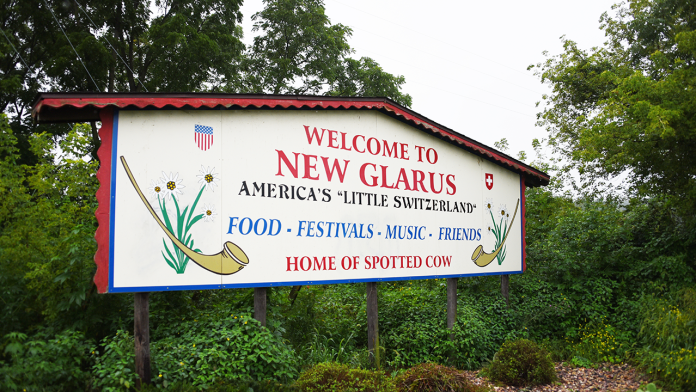
NEW GLARUS — Matt Streiff’s ancestors would likely be proud of his recent investment.
Streiff is one of 25 investors — a majority of them local residents — in the 173-year-old New Glarus Hotel, which is undergoing a facelift in the Green County village about 30 miles from Madison. The hotel was established before the town was officially founded, and many of the contributors have fond memories of the longtime building.
“I’ve had 16 ancestors who immigrated to New Glarus from Switzerland,” Streiff said. “I think about those ancestors of mine coming into town, and I wonder how many of them spent their first nights in the New Glarus Hotel when they arrived.”
The hotel is finding new life thanks to Dan and Leah Roe, Christina Bleifuss and the team of investors. The New Glarus Hotel Group LLC, which Bleifuss and Dan Roe are leading, bought the rundown property in February 2024. The hotel shut down in the 1980s and its restaurant closed in 2020.
“It was at the verge of disrepair,” Bleifuss said. Growing up on a farm in nearby Monticello, she learned how to polka at the hotel with her grandpa. Now living in New Glarus with her family for the past six years, the possibilities had piqued her interest.
“When you drive by an eyesore in the heart of your downtown, you can envision what it could look like,” she said. “That’s why… I reached out to be a part of the project, and here I am.”
New Glarus Hotel & Yodel Room, as it will be called, is one of three businesses forming a trio of new or expanded ventures leading the area’s growth and bolstering its status as a tourist destination — all while staying true to its Swiss roots. In addition to the renovated hotel, which is set to debut in November at 100 6th Ave., is the fine dining restaurant Canter Inn nearby. At the same time, New Glarus Brewing is expanding its “Hilltop” brewery, opening next summer.
Leaning into its Swiss heritage, especially with festivals and events, has led to New Glarus bringing in over 100,000 visitors each year. The annual Oktoberfest and a Christmas market with Swiss chalets are successful. The village also provides grants to downtown businesses to help them provide Swiss facades, keeping the magic of the town’s origins alive.
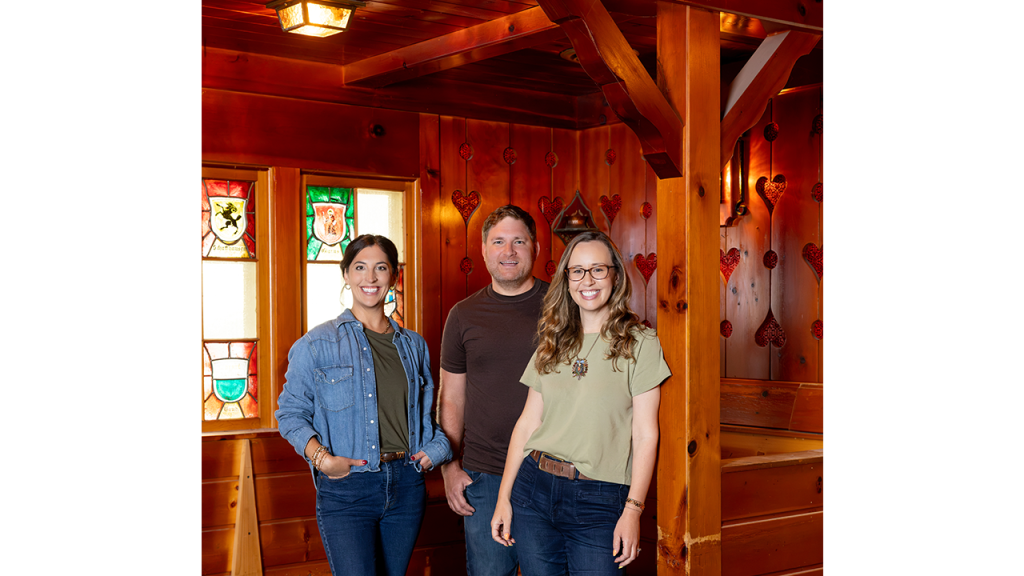
Photo: Sharon Vanorny
EARLY SWISS BEGINNINGS
New Glarus was formed in 1845 as a colony when people immigrated to the area from the canton of Glarus, Switzerland, according to the New Glarus Historical Society. The New Glarus Hotel, then known as the New Glarus Haus, was built in 1853 as the town’s first hotel and a public center to gather. The village of New Glarus would not be incorporated until 1901.
And long before tourism and New Glarus beer, the town was known for another drink: evaporated milk.
The Helvetia Milk Co. from Highland, Illinois, another Swiss community, opened a condensing plant in the village, using local farmers’ milk. The Pet Milk plant was the largest employer in New Glarus before closing in 1962.
It was around that time that the town decided to bolster its tourism business, all tied to the original New Glarus Hotel, in a way.
Robbie Schneider purchased the hotel in 1960. He was a recent Swiss immigrant to New Glarus, moving to work with the town’s yodel group. With the closing of the Pet Milk plant, the community decided to lean into its identity and tourism, according to the Wisconsin Historical Society.
Schneider was one of the leaders to push forward with tourism, turning the New Glarus Hotel “into a center for Swiss food and entertainment,” the historical society said on its website, when detailing the hotel’s history.
Fast forward to the COVID era, when Leah Roe walked by the hotel and a kernel of an idea was born.
It was 2020, the Roes’ daughter was 18 months old, and they were running the Perk, a leadership training business. Overnight, however, the Perk went from making money to making zero dollars as the world shut down.
“The first thing everyone was cutting from their budgets was in-person leadership training and development,” Leah Roe said.
Like many with a new baby, the Roes needed to get outside somewhere. So they’d head to New Glarus.
“It was a cute little downtown to walk around, we felt safe being outside,” she said. “We walked by the hotel and it was for sale, and I said to Dan, ‘What if we just shut down the Perk… (and) buy this hotel? What if this is our life now? We run a boutique hotel?’”
The family toured the building, talked to a bank, rented an apartment in downtown New Glarus and then found out Leah was pregnant with their second daughter.
“I was like, ‘Can’t do it. I can’t do the hotel.’ So we always talked about it as a dream that just wasn’t right for us.”
But a few years later, Nic Mink, the owner of nearby Paoli’s Inn at Seven Acre, who had been asked by New Glarus about pursuing the hotel project, called and mentioned a LinkedIn post Leah had written about a boutique hotel, how it was her dream.
“I said to Dan, ‘If he is talking about the New Glarus Hotel I’m gonna lose my mind,’ because we’ve been thinking about this hotel for years. And it was.”
The Roes eventually connected with Bleifuss to form the hotel group. Dan Roe and Bleifuss are the managing members of the LLC and running the development. (Mink is a consultant to the project and on the hotel ownership group’s board.)
Since then, it’s been a whirlwind as they near the November reopening.
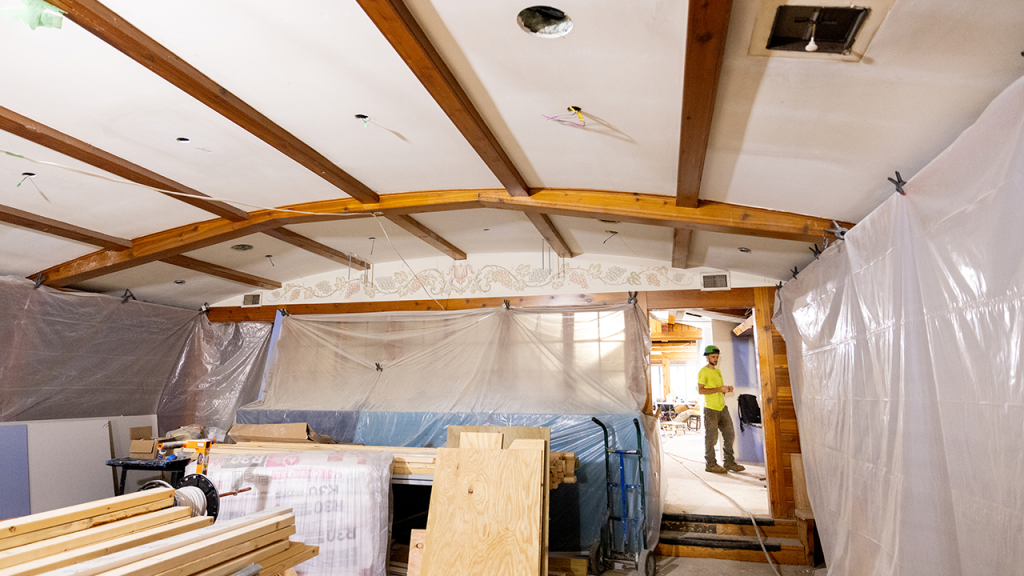
Photo: Sharon Vanorny
SUPPORTING POLKA, OLD FASHIONEDS AND ALPINE MACARONI
Last year, the New Glarus Hotel was admitted to the National Register of Historic Places, which Bleifuss pursued with the hotel group. The designation helps with acquiring funding, among other benefits.
Getting the building back up to code cost over a million dollars alone, proprietors said. The hotel will cost a total of $8 million when it finally reopens. Of that, $1 million has come from TIF funding from the village of New Glarus. The developers also secured a $250,000 grant from the Wisconsin Economic Development Corp. and a $200,000 Green County development loan.
In addition to that funding are the contributions from the New Glarus residents or people who grew up in the town and believe in the vision. They have helped cover a $1.75 million gap.
They “ended up being 25 of the nicest people I’ve ever met, who all have amazing stories at this property,” Dan Roe said. “All they want to do is walk back in there and have another Old Fashioned and another rösti and see it back up and running.”
The hotel prompts fond memories of polka, traditional Swiss comfort food like Alpine macaroni, dinners, weddings and parties — so many of the anchors of a small town community.
The hotel will also have a bar, restaurant and event space called the Yodel Room.
Historic parts of the building like the facade, a sunken bar and music stage will all be kept. The upstairs has eight rooms, a housekeeping room and a communal coffee/tea bar. It originally featured about a dozen boarding rooms with a shared bathroom.
The Keller, located on the lower level of the New Glarus Hotel, will be used for the Roes’ business, the Perk.
“Sometimes Dan and I look at each other and we’re like, ‘What the heck did we get ourselves into? What did we say yes to?’” Bleifuss said. “Because it evolved so much from when we both were brought on board for this.”
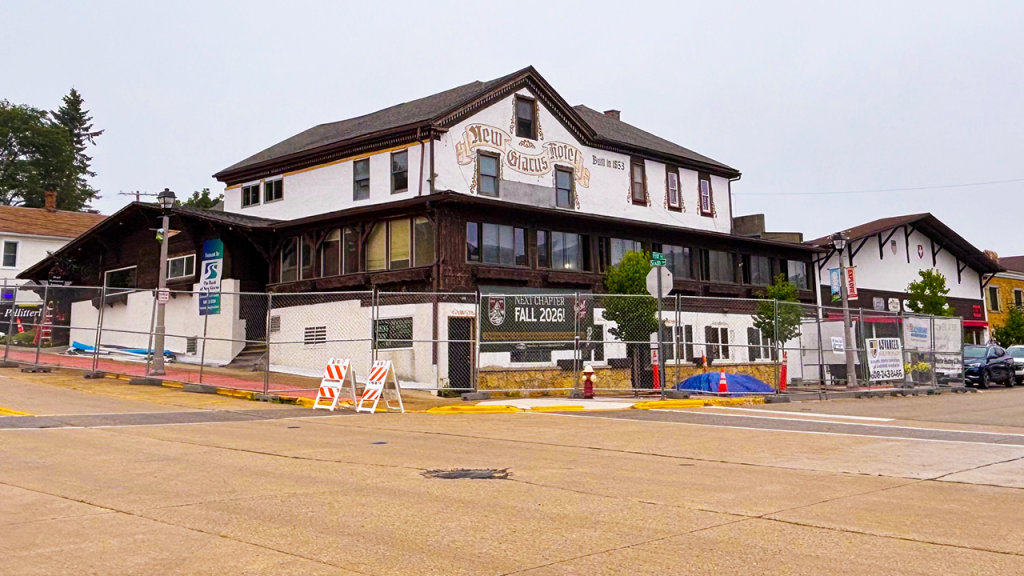
Photo: Jess Carter
BUILDING ON THE SWISS-THEMED TOURISM
The town supports its Switzerland-inspired tourism in several ways.
Businesses like the fine dining restaurant Canter Inn, located at 119 5th Ave., can use matching grants to freshen up their exteriors. The village of New Glarus’ Facade Improvement Grant program is part of a tax incremental district which allows business owners to apply for a 50% matching grant up to $6,000.
Canter Inn used it to restore its original Queen Anne Victorian porch.
“There was a lot of work that needed to be restored from… neglect over the years,” said Jon Nodler, who owns the restaurant with his wife Sam Kincaid. The porch “had been carpeted with some outdoor carpeting at one point, so a lot of structure had rotted out.”
Nodler said the grant was very helpful: “We really wanted to not only retain the front porch, but… bring it back to what we thought it might have looked like originally.”
About two blocks away, at 618 Railroad St., home goods store Alpenhaus Market boasts a Swiss facade and used the same grant.
“They covered a huge portion of my signage for my building, which is also a big, scary cost starting a new business,” owner Abby Breseman said. “It was really important to me to have good signage and branding.”
These may seem like little details, but it all forms an identity, and helps new businesses keep costs down.
When New Glarus introduced its Christkindli Market, a holiday market now in its sixth year, Deb Carey, founder and president of New Glarus Brewing Co., brought forth the concept and purchased the chalet market stalls used to create a Swiss winter wonderland. The business also brews an event-only wassail stout for the occasion.
It’s one of four main festivals the village hosts to bring in tourists.
“Based on the festival numbers we have, we see well over about 100,000 or so people throughout the year,” said Annie O’Connor, director of the New Glarus Chamber of Commerce, citing Placer.ai data from 2024.
The village hosts the Beer, Bacon & Cheese Festival and Polkafest, two fests that happen simultaneously (and O’Connor counts as one) in June, the Blues, Brews & Food Truck Festival in July, Oktoberfest in the fall and the Christkindli Market in December.
Also bolstering businesses is the recent establishment of the New Glarus Merchant Association. Breseman is the vice president and the group “went full swing” this year.
“We are working to highlight New Glarus as a premier shopping destination, and specifically, kind of for the Madison crowd who may not realize that New Glarus is a really a quick day trip away,” Breseman said.
“Some people just think New Glarus is this mystical, magical beer land that doesn’t actually exist, but it’s a real town, so you should come and see us,” she said.
Breseman used to work in corporate marketing before opening her store. She led a video holiday campaign last year that ran on the Shop New Glarus Facebook and Instagram pages. The association created the 12 days of shopping, showing how New Glarus can be a one-stop spot for gifts.
The association plans on doing it again this year, and also showing the people behind the businesses.
“We’re not Amazon; this is a little mom and pop shop,” Breseman said. “Everything is locally owned in (downtown) New Glarus.”
Canter Inn, which opened in fall 2025, has seen a mix of locals, Madison residents and even some from Milwaukee and Chicago.
Nodler said it’s a new “rhythm” of business compared to Madison or Philadelphia, where he and his wife worked before. Growth has been a bit slow, which they expected.
“We didn’t open the things that, A, you’re seeing a lot of in these small towns, but B, you’re kind of seeing a resurgence of around Madison,” Nodler said. “We wanted to offer something that was more contemporary that could be in line with more of a destination restaurant that you’d find in a larger market because that’s what we’re very passionate about.”
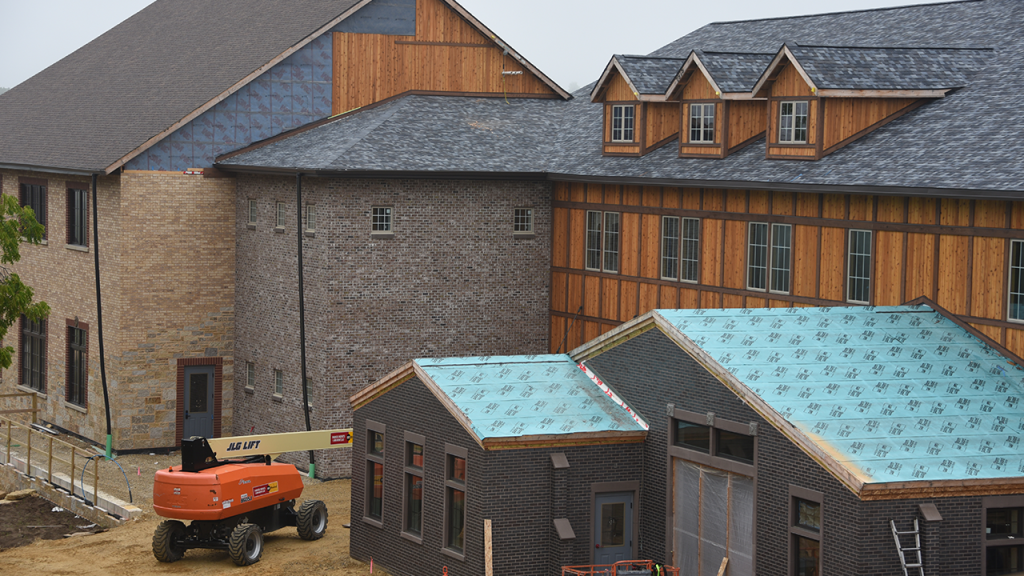
Photo: Louis Livingston-Garcia
BEER TEMPLE ON A HILL
Also luring tourists is the New Glarus Brewing Company, the home of farmhouse ale Spotted Cow.
“People come to see the brewery and then they discover this amazing, quaint little town with all these cool shops,” Breseman said. “I could do zero marketing, and I feel like I would still have a successful business.”
On Aug. 7, the day before Madison hosted its Great Taste of the Midwest beer festival — one of the most popular in the nation — this pilgrimage to, and exploration of, the town was in full effect. New Glarus Brewing holds a beer release each year before the fest, bringing in hundreds of visitors.
The brewery released a kriek beer, a sour beer with Door County cherries, and a line had formed hours before the release at the brewery’s gift shop. People stopped at spots like Fat Cat Coffee, and some ordered Sugar River Pizza while tasting samples of kriek and other New Glarus beers.
“They discover how charming America’s Little Switzerland is, and then they walk around,” Breseman said of the visitors. “We have over 17 different unique shops with four walkable blocks, and I just think that’s a really unique selling point.”
And this in spite of New Glarus’ popular Hilltop brewery being temporarily closed for construction. It only opens its old brewery site, Riverside, and sour beer production site to visitors.
New Glarus began selling its beer in 1993. Its success is largely thanks to Spotted Cow, which launched in 1997. But it has also created numerous award-winning beers.
The brewery’s success led to the company’s Hilltop campus. The Swiss-inspired project was finished in 2006, costing around $21 million.
It’s where most of the beer has been made since, drawing 250,000 visitors each year, sometimes up to 10,000 on a weekend, until the brewery closed during COVID and for its expansion.
The Hilltop addition is set to open next summer, adding a new tasting room, expanded gift and beer shop, brewhall expansion, distillery, museum space and more.
The expansion is built along the hillside and somewhat within it, connecting the brewery to open space at the bottom of the hill. It will be a 65,000 square-foot addition. A larger parking lot will be included. Four copper kettles will be added to the brewery’s operations, and the beer depot, which sells New Glarus beer, will be expanded and have a grass roof.
The grass roof actually has a Norwegian tilt to it, nodding to Carey’s ancestry. It helps keep heat in and also provides space for critters like the coyote mom and the many deer it’s already hosted. A geothermal energy system is also part of the expansion.
Distilled spirits will be sold onsite, making the destination even more special for visitors who trek up the hill.
Carey said the project is on time and on budget, coming in at $55 million. She also said it was needed for numerous reasons like dwindling office space. She was tired of having an office in a filing room and having people so close together.
And the beer depot and gift shop could become packed quickly. Parking on busier weekends meant Carey was often directing traffic.
“We desperately needed to be able to accommodate visitors,” Carey said. “All of our teams… everybody’s in little desks, squashed next to each other. Which is fine temporarily, but when it gets to be 10, 15 years of it, it gets a little old.”
And while Carey said she doesn’t have data on the economic effect the brewery has on the village or state, one can only imagine it is vast. In addition to bringing in a quarter of a million visitors yearly, the brewery produces 235,000 barrels of beer annually. In 2024, the Brewers Association, which represents small and independent craft brewers, ranked New Glarus at 12th in the nation for beer sales — not a small feat when it only distributes beer in its home state of Wisconsin.
And those beers bring money to the state in other industries, too. New Glarus prints its labels in La Crosse, uses cans from Ball Corporation in Fort Atkinson, buys its paper from Menasha, and uses fruits like cherries and cranberries from around the state.
“I just figure I’m doing the best we can, and wherever it takes us is where it takes us,” Carey said.
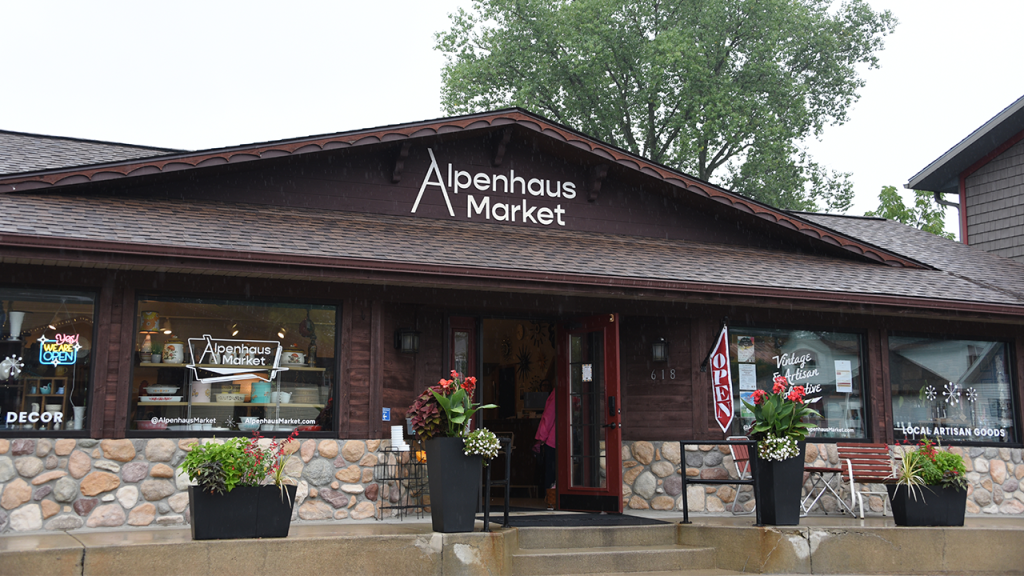
Photo: Louis Livingston-Garcia
GROWING PAINS AND CREATIVE SOLUTIONS
Yet all of the development in the area has not been without some challenges.
The visitors are still showing up, but the temporary closure of the brewery’s Hilltop campus has diminished traffic to the village. Construction on Highway 69 has also been a factor.
“We don’t have a lot of metrics or historicals to work off of, (but) from what we gathered from other businesses,” Canter Inn’s Nodler said, “I think it’s safe to say tourism is down right now.”
The restaurant, which is open for dinner Tuesday through Saturday, briefly offered lunch on the weekends but discontinued it citing the “transitional time” for the town, according to an Instagram post.
“We’re hoping we can be a destination on our own, and then when the New Glarus Hotel opens up in our backyard, that we can capture some of their guests that are staying there,” Nodler said. “And when the brewery opens back up, we’re poised to put our best face on for (people who) are ultimately coming through for that experience.”
The hotel owners expect weekend guests but are also mindful of how to keep business going during the week. For those times, the Roes are looking to the Perk.
“This is going to be an absolutely beautiful property,” Leah Roe said of the hotel, so why not integrate the Perk into it?
The Roes envision using the space for the Perk’s leadership training and executive retreats.
“We’re really excited to… have a place where we can invite our clients (from) all over the country,” she said.
It’s a piece of an exciting reversal for the business which faced real trouble during the pandemic.
With one employee during COVID, Leah Roe said, “we were going down, and we were going down fast.”
A PPP loan kept that employee for a few months. The Roes then made a list of dream clients and worked the phones, because, “If we’re gonna go down, let’s go down swinging.”
It worked. Leah Roe changed the business to scale to remote environments. Since then it’s included in-person trainings again and will start a new chapter as part of the New Glarus Hotel’s offerings.
Though a small village, New Glarus is still doing big things.
When Streiff, one of the local investors, held a sendoff party to the New Glarus Hotel in its restaurant in 2020, he wasn’t sure it would be a part of the village any longer.
He and 70 people toasted the hotel with Appenzeller Alpenbitter Swiss liquor from a giant 4-liter bottle. Growing up, he’d see the bottle in different bars around town.
The possibilities that accompany the renewed hotel made the choice to invest an easy one for Streiff.
“I invested because I was interested in seeing the New Glarus Hotel succeed and hold the place in the community that it had
pretty much for all of my life,” he said.

