
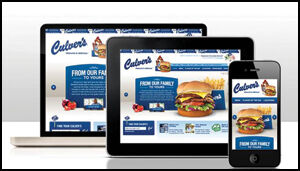

Is the mobile march passing your business by? It’s a question worth pondering, because not only are consumers increasingly mobile, moving from desktops to smart phones at a blistering pace, they also expect businesses they patronize to be equally nimble.
The business case for mobile starts with the fact that, globally, there will be more mobile users on the Internet than desktop users sometime in 2014. In the United States, that is expected to occur in 2015; in countries like India, this threshold has already been crossed.
“That’s kind of the Rubicon, when your Internet population is higher for mobile than desktop,” said Ponara Eng, digital director for Hiebing.
Further proof is offered by Facebook, which recently disclosed that nearly one out of every three dollars it produces now comes from advertising on smart phones and tablets. About 680 million of Facebook’s 1.06 billion users are mobile, and of those 1 billion users, 157 million are mobile-only (not just mobile-preferred).
David Stidham, vice president of marketing for Culver Franchising System, said smart phones, with all the personal and professional data they contain, have become more coveted than wallets. “If you were to poll 100 people right now, I guarantee more people would prefer to lose their wallet before losing their cell phone,” he said.
Many industries can benefit from mobility and the organizational enablement it creates. Retailers can provide an in-store mobile experience or learn more about their customers’ buying habits; food companies can inspect their inventories for spoilage at each point of distribution.
Efficacy depends on a number of factors, particularly application performance, but mobility isn’t about an application or a device, it’s about an extension of the enterprise and new forms of connection. With that in mind, IB offers a half-dozen tips to begin your own mobile march.
1. Make the business case
Part of the business case is the mobile march, and part of it pertains to the way mobile can address business problems. Even though there are many examples of organizations implementing mobile, don’t just jump on the bandwagon for jumping’s sake, or because a competitor has beaten you to the punch. There must be a business rationale, such as making more money, saving more money, or building brand loyalty.
American companies have made this mistake before. In the 1990s, the mantra was “Web first.” With hundreds of digital solutions on the market, organizations will be tempted to repeat that mistake with a “mobile first” approach. “A lot of companies bought into that and spent a lot of money investing in Web architectures without taking a step back and saying, ‘what is the business problem I’m trying to solve?’” noted Matthew David, a program director for Compuware Corp. in Milwaukee.
2. Map technology to business process
Like any information technology deployment, mobile adoption provides an opportunity to review your business processes – something you should do before those processes are mapped to technology. One reason IT installation projects fail is they are linked to a faulty business process. If there is nothing inherently wrong with an existing business process, the real-time advantages of mobile can make the process more efficient.
Consider the hypothetical example of a retailer that wants to make sure its stores are presenting a merchandising promotion the way the marketing department intended. Rather than record individual store evaluations as part of a lengthy paper process, the retailer can gather data with a custom-built smart phone app (or on a tablet), the coveted data points can be available in real time, and any corrective action can be taken much sooner.
According to David, in this case “you are taking an existing infrastructure that’s already in play, and instead of changing the whole business process, you are providing a technology that fits the work being done. It becomes a way to augment the work as you’re doing it.”
3. Optimize for mobile
Mobile adoption is not just a matter of adding an app, it’s about optimizing your website for handheld computing devices. “When we talk about optimizing for mobile, we’re not talking about taking your website and shrinking it to the size of a smart phone screen because that makes it so tough to read and to process,” Eng said. “It’s about making it optimal for that specific size, to simplify it so that it’s well presented on a 4-inch screen.”
Hence the term “responsive Web design.” If a website has not been designed in the past two years, it’s probably not mobile-friendly, according to Ben Seigel, principal with Versa Studio, a Madison Web design and development business. Given the complexity of website images and video and animation, and the fragmentation of the device market, the mobile optimization process emphasizes simplicity because of the requirement for easy navigation.
Needless to say, failing to optimize for a wide range of devices can be a competitive disadvantage, resulting in poor customer engagement and lost sales. “The thing about websites, and this has been true since people started getting on the Web, is that people will stay with a difficult site if it’s something they really want,” Seigel explained. “If they are tech-savvy, they will stay longer because they know how to get around and refresh content. If not, they get frustrated and leave.”
(Continued)
4. Build momentum
Since mobility can affect all facets of a business – sales management, product development, employee relations, and customer and supplier interactions – there are ample opportunities to make a business case. So if you’re in IT, what’s the best way to make the case for mobile? Start with a small, manageable project and build from there.
The first business case for mobile is considered especially important because a successful project, one that solves a business problem, can convince skeptical higher-ups to do even more with mobile. “As an enterprise leader, you want a solution in place that can be put forward as a poster child solution for success,” David said. “Put something in place that is meaningful to whoever your customer is, whether that’s your employees, your business partners, or customers that are actually paying you money.”
Then measure everything, because it’s very difficult to define success without measurements in place. Understand the business problem you are trying to address, and measure against today’s baseline.
Once you’ve built that first mobile app and have successfully demonstrated its value, pitching additional mobile solutions gets a bit easier. To make it easier still, it helps if other business units claim a piece of ownership through the formation of a governance group “instead of this being owned by IT or owned by marketing,” David advised.
5. Leverage data
Mobile sponsors should take the long view of business value, which includes analyzing the data beyond the initial data capture. Enhancing the organization’s analytical capabilities to the point where data can be mined in greater detail will require additional investment in business intelligence solutions, but getting your arms around increasing amounts of data produced by mobile technology and other business systems can be very revealing.
Think about it. Your mobile architecture is being built on top of an infrastructure of databases that already are in place. As long as more data is being collected, why not try to see what kinds of secrets it can unlock?
“We’re starting to work with a number of Wisconsin-based companies on analyzing business intelligence because there is so much information out there that you can become swamped by the data,” David said.
6. Don’t wait too long
While it’s important to establish a business case, it’s also important to get a move on. American Greeting Cards could have become a dinosaur among greeting card companies after digital upstarts like JibJab, an online greeting card service, became popular with 18- to 20-year-olds. The 100-year-old company stopped the bleeding with an app called justWink, having realized that younger consumers continually find new ways to connect in a mobile way.
This suggests that for many companies, particularly retailers and any other entity that connects with younger consumers, mobile adoption is a matter of survival.
The Culver’s Experience
For David Stidham, vice president of marketing for Culver Franchising System, the business case for mobile was about experience and numbers. As of October 2011, when Culver’s was planning for 2012, mobile traffic to culvers.com was approaching 25%, but these guests were getting the desktop experience, which was not properly optimized for the mobile technology that consumers were using to access the site.
It was hardly the handcrafted online experience Culver’s promised, so the company went to work on optimizing its website for smart phones and tablet computers. Culver’s “responsive” website was launched in July of 2012, and its hunch was correct. In the past several months, mobile usage of Culvers.com has outpaced desktop usage; in the last month alone, mobile (51.3%) and tablet (9.4%) usage combined for over 60% of total site visits.
What’s more, its iPhone and Android apps have a combined total of 185,127 downloads. Both apps enable guests to get Fresh Frozen Custard flavor alerts, find the nearest Culver’s, or browse the menu. In November 2010, Culver’s also created a text club, which has grown to 292,809 members who receive weekly special offers and news.
Not just young people have been served. “We obviously believe it’s a great conduit to younger consumers, but it’s not limited to younger consumers,” Stidham noted. “The adoption rate of smart phone technology is climbing 10% to 15% higher than projected annually, so we believe it’s a viable method of communication, not only for young folks but all demographics.”
For a deployment investment of about $50,000 and additional iPhone and Android support fees of between $12,000 and $15,000, Culver’s has seen mobile traffic increase 114.2% and tablet traffic rise 141.6% in one year. In all, 2.1 million total mobile program users (unique mobile Web + text + apps) have visited since the responsive website launched.
While streamlined, the mobile experience allows guests to take advantage of every feature they would have access to on the desktop: nutritional information, the menu builder, and promotions. More mobile evaluation is to come, including testing for mobile payment, tied to a loyalty program, right at the cash register.
“We truly believe part of our success in our business model is that one-on-one engagement,” Stidham said. “We always make that a priority because hospitality is a key ingredient to our success.”
Click here to sign up for the free IB ezine – your twice-weekly resource for local business news, analysis, voices, and the names you need to know. If you are not already a subscriber to In Business magazine, be sure to sign up for our monthly print edition here.

