
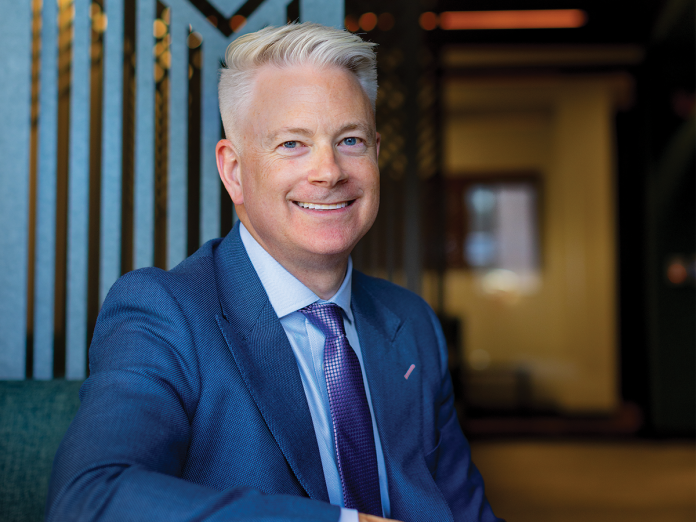
When John Miller took the helm of the Wisconsin Economic Development Corp. in December 2025, he came from a diverse career background he said carried one consistent theme: a focus on job creation in Wisconsin.
Before Gov. Tony Evers appointed him the agency’s secretary and CEO, Miller worked as an organizer for the 1996 Clinton-Gore campaign in close proximity to congressman Jerry Kleczka, who would become an influential mentor.
Miller later took over and ultimately sold Miller-St. Nazianz Inc., the business that had been in his family for five generations, and founded Arenberg Holdings, a Milwaukee venture capital fund, to invest in early-stage Midwest companies.
Miller said his business background has lent credibility in his work on policy and economic development, providing insights to Wisconsin’s hallmark industries and promising up-and-comers. It’s also helped him recognize opportunities in “every single nook and cranny” of the state.
How have your earlier career aspirations evolved and informed your later choices?
I’m a Wisconsinite, born and raised, and my family had always been fairly politically active, so I knew that I wanted to be engaged in some sort of political/policy role.
I shared an office with a congressional campaign (for) Jerry Kleczka, and he was a member of Congress representing Milwaukee. Over the course of the campaign, we got to be close to each other, and he offered me a job in his Washington, D.C. office.
I started at the lowest rung and worked my way up through the office. (Kleczka) was on the Ways and Means Committee — which is a fairly powerful committee that has jurisdiction over tax and trade and all sorts of other important things — and I was his staff person on that.
I decided to also go to graduate school at night and on the weekend. I got a master’s degree from Georgetown while I was there. It was a great way to spend my 20s, learning all sorts of policy issues with … a consistency of really keeping Wisconsin at the forefront.
(When) I was about 30, I decided to come back to Wisconsin, and I went to the UW Law School, which was a great experience. But one of the things that I learned was that being a traditional lawyer in a law firm wasn’t for me.
Halfway through law school, my father pitched me on joining the family company. At that time, our family company was a farm equipment manufacturer. … The number of family farms was decreasing every year pretty rapidly, so our customers were decreasing. We needed to change the equipment that we made, so we pivoted and decided to make a very different product.
I took over as the CEO right before the Great Recession, so I learned how to manage through that.
Eventually (CNH Industrial) bought the company. It was really a growth strategy for me. It was a way to keep (going) in a world that was condensing.
I went off to start my next chapter. I got into working with venture companies — companies that are in the startup mode — and … I tried to learn that frame of mind. It’s a very different way to do business.
At my height, (the fund, Areberg Holdings LLC) had 45 different holdings, and 43 of them had a nexus to Wisconsin.
This position opened up when my predecessor left for greener pastures … so I thought this would be a great opportunity to get back into serving the public.
How have you drawn on these skills or experiences in your role with WEDC?
I spend most of my time traveling around the state, visiting and talking to businesses, and I think that there’s a level of credibility that I have with businesspeople. When I go to visit them, I explain my background and say that I was responsible for payroll, and responsible for a balance sheet, and I was an employer, and I had to make decisions that impacted real people, and I had to do it during some pretty tough times.
The other thing is, because of the early part of my career, I really have an understanding of how policy interacts with the public. When I was working in Congress, we did a great deal of work on how trade relations impact local manufacturers. We did a lot of work to try to mitigate it — just like the environment we’re in right now — with cheaper products offshore, or now we have tariffs.
I can sort of identify with some of these trade issues because if we don’t have a fair system, then our U.S. manufacturers can’t sell their products abroad, and the U.S. manufacturers employ U.S. workers to make products that end up overseas.
And that’s a pretty robust part of the economy in Wisconsin, whether you’re talking about Oshkosh Truck (Oshkosh Corp.) or any of these other companies that build products that wind up outside the U.S.
What kind of economic development opportunities are you seeing for Wisconsin in the short- and long-term?
I spent a number of years on the UW Board of Regents, and one of the things that really sunk in during that time was the Wisconsin Idea, and how important that is not only to how the university should function, but … government as a whole — that we should reach out and touch every single nook and cranny of the state in a way to benefit everyone.
That’s not always possible. When there’s population centers, larger businesses obviously need to locate there for workers. But we need to make sure we are not forgetting about Main Street in Ashland and Minocqua and all these places. … They need attention, too.
At the WEDC, we can focus on small grants to small companies — mom and pop, Main Street — to mid-sized companies that want to either expand their workforce through a capital acquisition, new equipment or worker training … all the way up to very, very large projects that we do with billion dollar enterprises that want to build massive factories here. Eli Lilly is going to build a $4 billion factory (in Pleasant Prairie) to employ thousands of people, and we’re able to incent that.
It’s really an interesting job, and we have to listen … and work with all of those different entities of different sizes all at once, (and) think about what’s next or what’s on the horizon. We are a manufacturing mecca. I use that term with great pride because manufacturing is not just … a factory with welders and sparks flying and metal being cut. That’s all happening, but we also have a lot of biohealth manufacturing. We have fusion, which is also manufacturing, because we’re actually creating a machine to create power. We have a really robust food and beverage industry here that is growing and growing.
There are lots of industries that I want to promote. Other states might have to go far and wide, but Wisconsin has been such a robust manufacturer.

