

When it comes to preventing the H1N1 virus from catching and spreading within the walls of a business, perhaps no type of enterprise outside the health care realm has a more important role in being vigilant than grocery stores. We all need to eat, and the handling of food and packages containing food by those infected — employees and customers, alike — is one possible explanation as to how the virus spreads so quickly.
In this look at how one area business is trying to prevent H1N1-related disruptions, we spoke to Tim Metcalfe, president of Metcalfe Sentry stores in Madison’s Hilldale Mall and the Milwaukee suburb of Wauwatosa. Those who enter either store will quickly notice that the basics of flu prevention extend to both employees and customers.
Metcalfe said the company’s strategy largely has been directed by the Food Marketing Institute by way of advice from the Centers for Disease Control. The initial step was to educate employees on the proper health habits, which include sneezing into one’s upper sleeve rather than the hands, for controlling the spread of H1N1.
“The first thing we did is have meetings with every staff member,” Metcalfe said. “We’ve got a little over 400 people that work for us, and we had them all come in as part of a mandatory meeting, just to go over the symptoms and the signs of the virus so they are aware of what the disease is and how to prevent it.”
Perhaps just as important, Metcalfe said the training included the following message: “If you’re not feeling well, don’t come to work and get other people sick.”
The conversation then turned to things that could be done around the store to protect employees and customers. That’s why basic health measures were put in place, including hand sanitizers, wipes, and cleansing sprays.
The hand-sanitizing liquid of choice is Purell, and dispensers are positioned throughout the store in hand-sanitizer stations so that customers can continually clean their hands while they shop. “They are touching things all over the store, from freezer doors to dairy doors to picking up products that are on the shelf, including a can of something that they may put back on the shelf,” Metcalfe noted.
The other thing placed throughout the stores is “Sani Cart” wipes, a sanitizer used to wipe off the handles of doors in the frozen foods or dairy departments, or to clean the handles and other sections of shopping carts. Those wipes have been placed at the entrance of the store and throughout the aisles for customer use.
The third product, “Sani Guard,” is an aerosol spray used to kill any germs on keyboards and cash registers and workstations which are shared by multiple employees. The spray kills anything on those surfaces without applying a damaging liquid to the equipment.
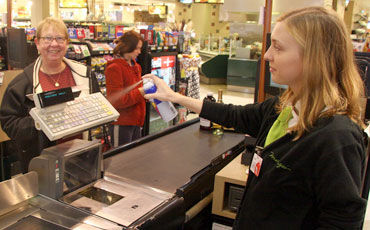
Hand sanitizers also have been placed at the checkouts for both customers and employees. Every time the store changes a cashier, it will sanitize the register.
The organization’s strategy also includes hourly bathroom cleanings, where various handles are sanitized, the hourly sanitizing of cooler doors and freezer doors, and hourly cleanings of the customer service counter because, as Metcalfe notes, “These are all areas that people use or it’s where people congregate and place their hands, so if something does happen there, we can hopefully prevent it from getting too far.”
In anticipation of shortage, Metcalfe has stocked up on supplies of Kleenex, hand sanitizer, and other flu-fighting products. The store’s preparation might even extend to something that is not really necessary — the supplying of masks. [One local public health worker informed IB that mask use for uninfected people is ineffective, and that the only role for masks is for sick people who are coughing and/or sneezing and need to visit their health care provider.]
Metcalfe isn’t sure what the store would use the masks for, but added, “We are aware that other companies” preventive measures do include those. We don’t really think it’s going to go that far; we just want to have a supply should there be a need to hand them out to people.”
New HR Flexibility
With all the focus on protecting customers and employees from contracting the HIN1 virus, human resource considerations have not been ignored. Metcalfe Sentry has changed its sick-time policy to offer employees more flexibility. The policy used to forbid the use of vacation time as sick time, and vice versa. Now if an employee gets sick and they want to use vacation time, they can.
The store also has relaxed its rules in terms of employee dependents. “Let’s say mom has to stay at home with a sick child; we’ve made our staff aware that we understand those issues will be out there, and we’re going to be more open to allowing people to have time off if they need to be with a sick child or someone they need to care for,” Metcalfe explained.
“The other thing we’re doing with prevention is that our medical insurance pays for flu shots, so we’re telling all employees to go out and get their immunizations.”
When Metcalfe employees come to work, a supervisor will check them for signs of the flu and send them right home if necessary. Tim Metcalfe’s reading of CDC guidelines is that an infected employee would be off for about three. “Our understanding from the CDC is that once you have gotten H1N1, it takes two days for it to run its course,” he explained. “After that, what we’re looking for is employees to have at least 24 hours of no symptoms, and then we are asking them to come back to work.”
What happens if a lot of employees get sick? “We would probably just have to go on a mass hiring to staff the stores,” he said, noting that would require Metcalfe Sentry to educate and train a new batch of workers in H1N1 preparedness. “The store would not shut down and can’t shut down. Our customers depend on us.”
One potentially mitigating factor is the time already spent on cross-training employees. For example, people that work in the seafood department can cross over to deli and vice versa. “We already do a lot of that stuff,” Metcalfe said, “but one of the suggestions of the CDC is to really work on cross training in order to be prepared.”

