

“I’ve worked long and hard to work long and hard,” said Melissa Simon, 28, chief medical resident at UW Health’s Belleville Clinic location. In her third and final year of residency, Simon, who says her resident-salary is $50,000, already has a job lined up in Prairie du Chien, Wis. next fall.
In the cubicle next to her, second-year resident Meaghan Combs (earning about $40,000), is engaged at her computer. Simon and Combs are two of six family physician residents that will work at the clinic this year, and two of over 1,000 family physicians to graduate from the UW Family Medicine program since its inception in 1970. Two-thirds of those general practitioners still practice in Wisconsin.
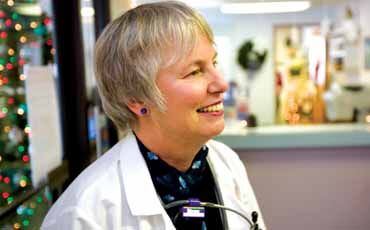
Those are numbers that make Department of Family Medicine Professor and Chair Dr. Valerie Gilchrist, 58, proud. But there’s a problem: Given the move toward health care reform, which will require more doctors, there simply aren’t enough Simons and Combs to go around.
“We don’t have enough primary care physicians (PCPs), and it’s easy to understand why,” she says. “PCPs get paid the lowest salaries for long hours, complex patients, and for paperwork that ought not go to physicians.”
Gilchrist, board certified in Family Medicine, calls family medicine an integrative specialty and believes all physicians should be capable of providing birth-to-grave care — obstetrics (OB) through geriatrics and even some hospice (palliative) care.
In her mind, attracting more PCPs could better be accomplished if physicians were paid more comparably in relation to specialists; if their jobs were more patient-centered, with less paperwork and computer time; and if their hours were better regulated.
“Being a PCP should afford a manageable lifestyle,” Gilchrist says, suggesting that working in teams might be a solution to what often results in round-the-clock care.
“There is a saying in the medical profession,” she quips: “If you like the patient more than the disease, go into primary care. If you like the disease or procedure more than the patients, go into specialty care.”
A native Canadian, Gilchrist moved to Madison with her family two years ago after chairing the Family Medicine departments at both East Carolina University, and Northeastern Ohio University before that.
For 25 years, she practiced low-risk OB, and at one point was the only female delivering babies in Youngstown Ohio. Needless to say, her practice thrived.
So, is the Canadian health care model better?
“During my first 10 years here, I was always defending the Canadian plan,” she says. “I really thought the Americans would get it right, but we’re not there yet.
“Is it better in Canada? It depends on who you talk to. The vast majority of patients would probably say, yes. But if you have a breast lump and want an immediate MRI, you will most likely have to wait.”
While Gilchrist agrees the U.S. health care system needs work, she insists that what is being pushed through in Washington isn’t health care reform, it’s payment reform. The difference, she explains, is that health care reform would focus more on primary care, and less on specialty care.
“[In the U.S.],” she says, “we fund huge amounts in specialty care but not primary care, which has better outcomes, costs less, and has higher satisfaction. We’re so concerned with freedom of choice that the rhetoric can’t get beyond that.”
Physicians, she explains, are largely paid based on billing codes which favor procedures, such as removing a mole, rather than time spent assessing and discussing with a patient how best to manage their high blood pressure, or high cholesterol, for example. New technologies are assigned new billing codes, and one unintended consequence of the new, specialty-related technologies is that, for decades, the discrepancy between specialty and generalist compensation has been widening.
A peek at Gilchrist’s daily calendar reveals endless meetings and scheduled on-call time in support of hospital staff. But Tuesdays, for the most part, are her days to breathe. That’s when she heads south to the Belleville Clinic, dons her physicians’ coat, and does what she most loves to do — take care of patients.
“I have a very small practice now,” she says. “I continue because I like it, and it gives me legitimacy with my peers so I can relate to their concerns.”
As a state employee in the UW Department of Family Medicine, a Chair position at UW earns around $277,000 on average. The $88 million department Gilchrist manages includes nine teaching sites, 11 clinical practice sites, over 800 employees, and 211 faculty members. Gilchrist now reports to Robert Golden, Dean of the UW School of Medicine and Public Health.
Gilchrist says her career path was fairly typical. “All clinical chairs are MDs,” she explains. “Most have gone through the heirarchy, from clinician to academic clinician, and possibly other leadership roles.” In addition, they might have served as director of a medical school division within a department, and worked their way up to vice chair.
Beyond running the department, which naturally takes the bulk of her time, two other components to her position are academic (research) and educational (supervising residencies) in nature. There’s also an occasional lecture, but clearly, the main focus of Gilchrist’s job is to maintain, sustain, and hopefully grow primary care in the future. “It’s a tremendously exciting time,” she says.
Quoting a colleague, she adds, “We’ve got to stop doing things to patients, and start doing things for patients.”
Sign up for the free IB Update — your weekly resource for local business news, analysis, voices and the names you need to know. Click here.

