

When it comes to ethical conduct, Edgewood College professor Denis Collins appreciates the idealism of undergraduate students. But like the first bloom of love, he knows their knee-jerk ethics likely won’t last forever. Collins, author of Essentials of Business Ethics: Creating an Organization of High Integrity and Superior Performance, said undergraduate students are always a lot of fun, in part because they haven’t seen as much questionable corporate behavior as upper classmen.
“They are really go-getters, they really want to do well, and they really want to help out,” said Collins, who now is adapting his book into a textbook for undergraduate students. “It’s the older students who have been through the process already, who have already worked for a corporation and have worked for a boss, who have really seen people skimming, who have seen people lying, who have seen people misuse their power — they tend to be more jaded.”
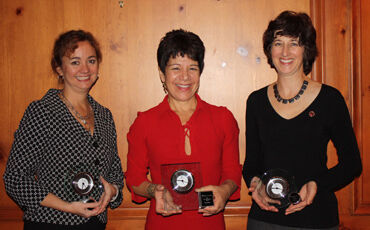
That students approaching graduation have already gotten a close-up view of various corporate capers speaks poorly of the business world’s progress in building ethical cultures. So in this look at business ethics, IB spoke to Collins and three graduates of Edgewood College who recently were honored during the college’s 3rd annual MBA Distinguished Alumni Awards ceremony: Pamela Bean, executive director of research at Rogers Memorial Hospital in Oconomowoc; Beth Curley, private banking manager in M&I Bank’s wealth management division; and Mary Linton, director of enterprise solutions for Promega Corp.
Beth Curley’s Vantage Point
Curley manages the private banking group for M&I Bank’s southwest Wisconsin region. In serving high net worth individuals, ethical considerations are intertwined with issues such as privacy, confidentiality, and understanding risk tolerance and comfort level with various investments. Her organization is audited both internally and externally for the proper handling of wires and transfers and adherence to the multiple identification requirements of the USA Patriot Act.
Some moral failings are more damaging than others, but from Curley’s vantage point, building an ethical business culture begins when interviewing job candidates; it’s not only important to find the right skill set, but the best cultural fit. “The ethical culture has to start from the top, and then you have to add the people who are going to be a good fit for that culture,” she said. “It’s adding people who want to work hard for the clients and do what’s best for the client and for the bank.”
That would come as music to Collins’ ears, as he advises organizations to screen for ethical inclinations when considering new hires — combing resumes, reference checks, and background checks for behavioral information — and then using employee orientation to expose new workers to Codes of Ethics and Conduct, and teach them to be true to the organization’s ethical decision-making process.
Pamela Bean on Industry Values
Different industries have different ethical danger zones. Bean (Rogers Memorial Hospital) — who also serves as the main partner for Millennium Strategies, a biotech business consulting firm — said data analysis in biotech can lend itself to challenging situations, especially when it comes to interpretation.
“Researchers need to make sure they show self-control when it comes to interpreting the data as they want to see it, rather than what it represents in terms of valid empirical evidence,” she explained. “This self-control indicates a respect for scientific knowledge and results in an organization that is more than the researchers’ self-interest. This aim becomes easier if you attempt to identify a personal purpose that matches your company’s missions.”
Bean said building ethical behaviors requires re-examining core values related to integrity. In an ideal business, she opined that leaders and workers would always ask themselves if their behavior comports with established best practices.
“Driving ethical behavior with values and attitudes requires alignment between values, attitudes, and behavior,” Bean stated. “Make a habit of recognizing and encouraging others for their contributions and administering the rules fairly to all people.”
Mary Linton on Company Values
That last point is an area of emphasis at Promega Corp., where the same expectations apply to people at all levels of the organization. Mary Linton said the company’s values are emphasized to employees via training, performance reviews, and a company Intranet, and preferred behaviors are reinforced through recognition and reward. The company wants to promote a culture of creativity and innovation and transparency, especially transparency. The company’s financials and real-world impact are shared at quarterly meetings.
“The CFO goes through our financials with employees,” she said of the quarterly meetings. “We’ve done that during all 16 years that I’ve been here.”
Curley pointed to the importance of checks and balances to nip misconduct in the bud, including the encouragement of whistle blowers. “For whistle blowers, it’s about making sure there aren’t negative ramifications against people that do come forward and bring things to people’s attention,” she said. “I don’t understand how the whole [Bernie] Madoff thing got that far. People had to have known about it.”
The BBB’s Torch Awards
Employee culture is one of four areas of emphasis for the Wisconsin Better Business Bureau’s Torch Awards for business ethics and integrity. Madison’s H.E. Stark Agency received an honorable mention from a panel of judges largely because of the way it approaches the sensitive issue of debt collection.
Given the business relationships that are at stake in the debt collection process, especially in a struggling economy, H.E. Stark spokeswoman Nancy Richardson said the company looks for people with certain skill sets. “We ask about skill sets as it relates to the collection position, skills that fit into a culture of respect,” she explained.
Community at Large
Curley, who is personally involved in a number of philanthropic interests, said ethics extends to what the Better Business Bureau calls the “community experience.”
She noted that banks are evaluated in part by the Community Reinvestment Act, which was a reaction to the days of redlining, when banks would curtail mortgage lending in economically disadvantaged neighborhoods. Whether that’s direct financial sponsorship of worthy causes or community events, or encouraging employee involvement through rewards and incentives, companies gain by contributing more than jobs and tax base.
“We’re frequently contacted by nonprofits looking for volunteers for different things,” Curley said, “and we spread that information out to employees.”
Sign up for the free IB Update — your weekly resource for local business news, analysis, voices and the names you need to know. Click here.

