

Electronic mail once was viewed as a wondrous business application. The send button was pressed and e-letters flashed across the universe in no time, and at a fraction of the cost of a postage stamp. And then came spam, an electronic buzz killer for the ages, and the once positive moniker attached to e-mail, “killer app,” became a pejorative term.
Print customers have used e-mail as marketing tool, but with non-existent returns, people now view it as a scattershot approach. Even with spam filters, the messages that you want to receive get filtered out, and occasional rejects get through. Like every other technological tool, the more we took e-mail out for a spin, the more we learned about its best uses and limitations.
Nowhere is that truer than in the printing industry, where e-mail is more narrowly and more effectively used than it once was, and bulk mail has made a comeback as part of precision marketing. “I get to the point where I don’t trust what I get e-mail-wise, and I’m always worried about getting some type of virus,” said Gene Davis, president-owner of Badger Graphic Systems in Sun Prairie. “We get used to just clicking through it all and ignoring it.”
It’s one of several established or emerging print industry trends that small businesses should be aware of, and be ready to exploit. In this look at printing, IB spoke to Greater Madison print executives who are increasingly able to tailor their services to the needs of small business clients.
Beyond Ink on Paper
Ten years ago, printers were simply companies that put ink on paper, preferably with a fast turn around, at the right price. With the introduction of digital presses, they became designers, marketers, and cross-media practitioners. For printers, this has implications for staff composition. People with marketing, writing, and design expertise are valued employees, and cross-training is conducted on both offset and digital presses.
Printers always will be interested in putting ink on paper, especially with their considerable investment in capital equipment. But Todd Tiefenthaler, president of Kramer Printing, said marketing skills have become especially applicable, from a print services perspective, in recent years. Today’s printers are capable of procuring accurate or “clean” databases for clients (complete with opt-ins that provide relevance to the receiver), profiling their best customers, and literally drawing increased eye appeal to direct mail prices through design — in effect becoming both database manager and marketing services provider. In turn, print customers are looking for help not only with print and direct-mail pieces, but to improve their Facebook page, or make their direct mail work in conjunction with e-mail.
In some cases, clients have inquired about giving their customers the ability to order everything on the Internet. In response, printers have set up Web sites that allow the client’s customers to do all of their online ordering. Badger Graphics serves businesses that have offices throughout the Midwest, and it can set up a Web-based ordering system, maintain the entire inventory here, and handle shipping.
The bottom line is that the Internet allows printers to be innovative and serve clients in a very deep way. “If the office in Omaha needs a dozen golf balls, they just go online and order that directly from our Web site, we ship it to them, and bill the company direct,” Davis explained. “So the client company does not get involved in all the purchasing procedures, and the inventory running out of things. That is our job.
“It’s much more service-oriented, and not as price-oriented.”
When it comes to the traditional aspects of marketing, such as focus groups and the development of advertising campaigns, there is no substitute for advertising agencies or market research firms. But small businesses usually cannot afford those business services, so commercial printers have stepped into the breach by offering improved return on investment with targeted direct mail that is guided by one simple question: Who is your ideal customer?
With that, they have been able to talk customers out of ineffective “spray-and-pray” campaigns that flood the postal system with large volumes of mail — without much rhyme or reason. More importantly, they can use technology to measure the results of targeted campaigns. “We have devised ways for measurement, especially in direct mail,” Tiefenthaler said. “Whereas the typical direct mail campaign, the spray-and-pray, would have a 1.0% or 1.5% return, we’re looking at measured results in some cases of 28% to 30%, in some cases even more than that. The cost per mail piece might be a little higher, but the cost of acquisition comes down when you target it, when you focus it narrowly.”
As companies learn how to best employ the Internet and e-mail, they find that e-mail, together with direct mail, can be effective, particularly when soliciting funds to a targeted group of people. “I don’t think e-mail is bad in itself,” said said Liz Tiefenthaler, vice president of marketing for Kramer Printing. “I think that if done correctly, to an opt-in list, it works really well, particularly when you do it with direct mail. Otherwise, it’s just e-mail sent out there, spray-and-pray.”
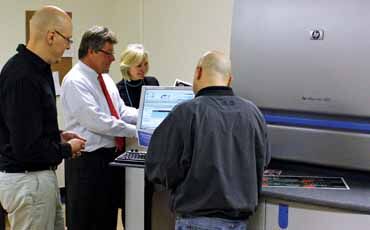
The more targeted campaigns are a reason why printers have invested in smaller, more versatile digital presses to complement the large-run, offset presses that have been staples of the industry for years. Print customers now have the option of personalizing mailers, which is made possible by digital presses like the HP Indigo and the Xerox iGen4. Some of them look like glorified copiers, but they enable print customers to send relevant mailers with offers and text to address their customer’s needs.
Another factor in favor of digital presses is the movement to print-on-demand. “In the past, people would need huge runs and warehouse what was not immediately needed,” explained Liz Tiefenthaler. “Any change meant the piece became obsolete.”
“The world is just becoming a faster place and businesses need to be responsive,” she added. “As a part of that equation, their sales materials need to be easily adapted for change. Add to that the green movement, where people are trying to eliminate waste, and the time is right for digital.”
Davis agrees with that assessment. “With the economy, everyone is trying not to have much on the back shelf tying up their capital,” he said. “A lot of people have gone to ordering very small quantities of full-color materials. They may only want to run 100 of a brochure. In the old days, only 10 years ago, you had to order an awful lot of those. You probably had to use a large press that would have a minimum of 10,000 or 15,000 of something.”
There is still a place for offset presses, but the long-term trend clearly is with the digital variety. “There still is a need for very large runs and we’ll obviously do those runs, but we have more people ordering as they need it, and not inventorying more in back,” Davis said. “Of course, there is a big risk to big runs because if something changes, it hits the dumpster. ThatÃÂÂÂs not a very green thing, either, and it’s not very good for businesses to use outdated materials.”
The smaller-is-better trend also impacts printers who don’t sell directly to the end-user. John Shannon, president of Madison Forms in McFarland, provides business documents via the distributor sales channel. Shannon, one of the first forms manufacturers to use direct computer-to-plate technology, closely follows advances in press equipment. He’s seen aggressive investments in technologies that no longer exist, but he’s also had to adjust to smaller orders.
“We’ve also been cautious with new equipment in that we’ve moved more toward variable sized presses where I can offer different sizes with one piece of equipment, rather than have three or four,” said Shannon, who relies on his distributors for advice on new product investments, which in turn influence his capital investments. “It’s an evolutionary process. Advances in electronics and the integration of software have come so far in the past decade.”
Cross Purposes
The digital presses also enable printers to offer variable imaging. Davis explains: “You’ve probably seen some of the postcards that you get at home, and it’s got your name on the front, and you can’t figure out how we did that. We’re basically just taking the data from a mailing list and moving that data to print, independently, copying that variable image on every one of the postcards that goes out. It allows a customer to really personalize marketing campaigns.
“That’s a real trend and one of the reasons we’ve been able to survive the last couple of years. We’ve had less business but more customers, and that’s a good sign for the future.”
In the view of Liz Tiefenthaler, it’s critical for small business owners to have a cross-media approach. One method uses the Internet, via a personalized URL and direct mail, to drive a two-way conversation. A direct-mail postcard will go out, directing the recipient to a personalized Web page. When the mail recipient visits the page, it will have a message that simply says, “Hello Joe, welcome! Here’s an offer for you.”
“It allows a two-way conversation with the customer, and that’s what people are looking for today,” she said. “They are looking for a way to talk back to you.”
Sign up for the free IB Update — your weekly resource for local business news, analysis, voices and the names you need to know. Click here.

