

Everyone’s had a bad retail experience, and most of us have gathered one or two choice anecdotes about customer service gone horribly awry. But in the annals of bad-retailer stories, Joe Scanlin’s is a classic – and if all goes well, it could one day make him as rich as Stephen King.
It all started when Scanlin entered a department store and, five minutes into his shopping excursion, still hadn’t been helped. He took his business to a competitor, and that’s when the wheels of invention really got set in motion.
“I went home and I calculated how much money they lost from me as a consumer for about six years,” said Scanlin. “And I saw that number, and I saw the other things that I took note about my shopping, and I thought there needed to be a product that provided organically true data about how I was moving through that space and how they could most effectively use it to engage me.”
| “A lot of people think that Internet shopping is ubiquitous, but it’s still a fact that over 76% of shopping decisions are made in the physical world.” – Joe Scanlin, founder and CEO, Scanalytics |
The product Scanlin had in mind was an intelligent mat device that could record foot traffic, compiling consumers’ engagement level and tendencies so that retailers could get a better handle on how their customers behaved. So like a true innovator, instead of just wishing that something like that existed, Scanlin immediately got on task.
“I actually went home after that and … I started building my first intelligent mat device,” said Scanlin. “I built a prototype. I taught myself how to do it in about three days, and it worked, and I saw how I could scale it and started looking at different materials, and then I basically started engineering what we have today.”
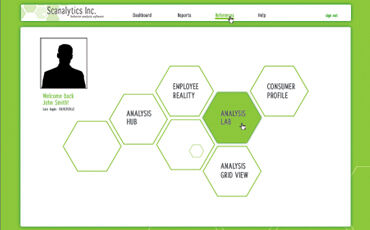
What the start-up has today is a system that starts with a recording device and then provides tools that allow retailers to analyze the data and attain goals such as increasing engagement times with products.
Indeed, the way the company itself describes its system is no doubt tantalizing to any retail establishment: “Our algorithms automatically report data based on the decisions you make, and outline the ones that produce the best results. There are a lot of decisions made every day. Understanding the impact of those decisions on your bottom line will help you stay lean and increase your profitability.”
“So [retailers] can understand different things like tipping points; they can understand different things like how long someone takes to make a decision to pick something up, and they can leverage that to be able to basically provide them with the information at the right time instead of just sending over a sales clerk to see someone,” said Scanlin. “They’ll understand how people respond organically to different stimuli. Some things could be as easy as adding a light or adding a smell that might change how people react to certain things, but they don’t know that through looking at receipts. Receipts aren’t telling them how many people just walked past a display, and if they added something, how did that change the capture rate for something?”
Landing big fish
Despite being a fledging company, Scanalytics is already catching the notice of some big players, which have signed on as clients – though Scanlin is still bound by agreement to keep those names out of print.
“I would say that we have some of the biggest retail names as far as stores are concerned, and we have two of the world’s largest trade show operations companies,” said Scanlin. “We have a good spectrum.”
The company also has its sights set on tackling one of the most vexing problems facing retailers today – so-called “showrooming,” in which customers scope out products at brick-and-mortar stores and then purchase them for less online. While the conventional wisdom is that online shopping is on the rise and traditional shopping is on its way to obsolescence, Scanlin is saying “not so fast.”
“A lot of people think that Internet shopping is ubiquitous, but it’s still a fact that over 76% of shopping decisions are made in the physical world,” said Scanlin. “A lot of shopping online happens, but [people in the industry] have told us that the physical world is still going to be that major medium, so that’s the lifeblood of a lot of big corporations, and even small ones. So that’s why we’re creating this environment that could help replicate online or at least bring some of those elements of online shopping back to the physical.”
(Continued)
For example, Scanlin imagines a system in which a customer can be prompted to purchase a pair of jeans that might go perfectly with a shirt he or she is looking at in the store.
“Those elements are actually not as complex as people might think, and so if we can provide that and we are kind of providing that vehicle to be able to bring those comforts of shopping online into the physical world, then we can kind of revive the life of the physical shopping world,” said Scanlin.
Forward momentum
So far, the company – led by Scanlin and VP of Business Development Matt McCoy – has grabbed the attention of more than just retailers. Last year, the company won the People’s Choice Award at the Early Stage Symposium’s Elevator Pitch Olympics, as well as first place in the BizStarts Collegiate Business Plan Competition. It also got a big boost through its affiliation with gener8tor, a local technology accelerator.
“Gener8tor allowed us to reach people that we wouldn’t [otherwise] be able to reach, and the community they provided and the network they provided were absolutely pertinent to our success and were a crucial element to our growth,” said Scanlin.
That growth seems like it very well could be on an upward trajectory. Scanlin and his team are not focused only on attracting big retailers as clients. The system is designed to be used by everyone from small retailers to big-box stores to big brands, and it’s also been crafted to emphasize ease of use.
“We built it so that anybody can put [the mat] on the ground and plug it in and basically start getting data from it,” said Scanlin. “It’s actually very simple.”
Of course, the technology is also potentially a boon to larger chains, which can use it to measure the tendencies of different populations, instead of trying to find one-size-fits-all solutions.
“What we’re trying to present is a world where extrapolating data and then just multiplying it across every store isn’t the solution anymore,” said Scanlin. “It can be something that’s very specific to every store, because even if you own a retail store on one side of Milwaukee or Madison and then you have another one on the other side, those two can have completely different shoppers and those shoppers can have completely different responses to different stimuli and are telling you a lot of different things that you can’t just multiply across the stores.”
Right now, the funding Scanalytics has secured through the help of gener8tor and through other sources is going toward R&D, manufacturing to satisfy purchase orders, and growing the company’s team.
Scanlin says that five or 10 years down the line, he’d like to see his company involved in helping out more industries.
“We’ll be able to do some analysis on people in all sorts of different industries, and really understand consumers’ behavior and leverage that to create an environment that’s beneficial to everyone involved,” said Scanlin. “We’re doing some very interesting things in the medical field right now, where we can start to understand things that people are doing organically and start preventing costs that are involved in the medical field.”
Click here to sign up for the free IB ezine – your twice-weekly resource for local business news, analysis, voices, and the names you need to know. If you are not already a subscriber to In Business magazine, be sure to sign up for our monthly print edition here.

