

When the Charles Darwin Foundation approached Madison’s Bell Laboratories in 2008 for help in restoring the famous Galapagos Islands to their former ecological glory, it may have seemed an odd fit. After all, Bell Laboratories is known for eliminating rodents, not saving tortoises and finches.
But three years later, as a result of Bell’s efforts on behalf of the island’s indigenous fauna and flora, the company has received a Business Friend of the Environment Award from the Wisconsin Environmental Working Group, an affiliate of Wisconsin Manufacturers & Commerce.
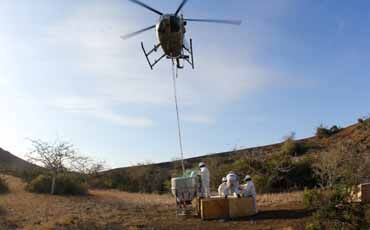
According to the Charles Darwin Foundation, Norway rats, black rats, and house mice, which were originally introduced to the islands by humans, have had a devastating effect on native tortoises, iguanas, and birds. In January, helicopters dropped bait that was developed and donated by Bell Laboratories in an effort to eliminate the invasive rodents and give those other animals a fighting chance.
“I didn’t realize this, but when the head of the Charles Darwin Foundation came here to visit us a couple of years ago, he told us that there have been no giant tortoises born in the wild that have survived in the wild for over 30 years now, because the rats will either eat the eggs or the babies,” said Craig Riekena, director of Bell’s Island Restoration Project. “So every time they find one out there now, they bring it into captivity, raise it up until it’s 5 years old – at which time it’s big enough to take care of itself – and then they re-release it into the wild. In fact, if it wasn’t for these tortoises having such a long life span, they probably would have been wiped out by now.”
Bell has actually worked on similar projects before. It has been participating in the removal of invasive animals in island environments since 1997, and has lent its expertise to efforts targeting Tahiti, the Bahamas, and islands near Scotland and California. The baits used on the Galapagos Islands were based on the formula for baits used elsewhere, with a few added tweaks. But the basics of those formulations remain the same wherever they’re used.
“I didn’t realize this, but when the head of the Charles Darwin Foundation came here to visit us a couple of years ago, he told us that there have been no giant tortoises born in the wild that have survived in the wild for over 30 years now, because the rats will either eat the eggs or the babies.” – Craig Riekena, director of Bell’s Island Restoration Project |
“Most of the applications [of baits] are aerial drops, via helicopter, and they fly over in these GPS-based grid patterns and they drop it on the entire island,” said Riekena. “You have to kill 100 percent of the rats – anything else is a failure. So you have to make a bait that’s going to be hard enough to survive the impact of falling a couple of hundred feet onto a rocky surface, so it’s got to be strong. It’s got to be large enough or in other ways designed so it will be attractive to the rats and can be consumed by the rats but not other things that are on the island, because you don’t want birds eating it, you don’t want the reptiles eating it – you want to kill the rats exclusively. You want it to survive the impact, but once it gets there, you want it to be either consumed or to break down quickly.”
According to Bell, results of the rat eradication program have been encouraging, though the company noted that it takes two years of monitoring to determine if it has succeeded in eliminating the animals.
Bell Laboratories was one of nine companies to receive 2011 Business Friend of the Environment Awards, and the only Madison-area company to win. It won in the Environmental Innovation (Medium) category. Winners were chosen by an independent panel of judges who represented industry, an environmental group, the DNR, and academia.
According to Scott Manley, director of environmental policy for the WMC, the Galapagos Islands’ notoriety and historical importance likely played a large role in Bell’s selection.
“Partnering with the Darwin Foundation and the way the company went about doing this, I think the judges were very impressed with it,” said Manley. “But also, the Galapagos Islands are just so well known for being a unique ecosystem, and having a Wisconsin-based company playing a role in bringing that ecosystem back into balance was something I think the judges felt was very worthy of recognition.”
Telling the whole story
The 22nd annual Business Friend of the Environment Awards program was held on May 12 in Waukesha. According to Manley, the awards were originally created in order to recognize the good that many businesses are doing and dispel myths about the business community’s impact on the environment.
“We felt it was necessary to bring attention to the fact that there are many businesses in Wisconsin that are going, we would say, above and beyond the call of duty in terms of environmental compliance, and really exceeding what the law requires in doing even more,” said Manley. “And our feeling was that so often in the media when there’s a story about the environment and businesses, it’s often because there’s an oil spill somewhere or a pipeline spill or some isolated instance of a company being a bad actor, and it’s our very strong belief that that doesn’t give an accurate picture of the environmental commitment of the business community.
“And the second reason, which is equally important, is that it’s our belief that many of the unique projects and innovative technologies and innovative processes can serve as a blueprint for best practices that other Wisconsin businesses might emulate. For example, one company’s waste reduction technique may be able to be replicated at another business, and so to the extent that we can bring awareness to other businesses of these strategies that award-winning companies have implemented, we might see those same strategies reproduced and have even better environmental outcomes.”
Sign up for the free IB Update – your weekly resource for local business news, analysis, voices, and the names you need to know. Click here.

