
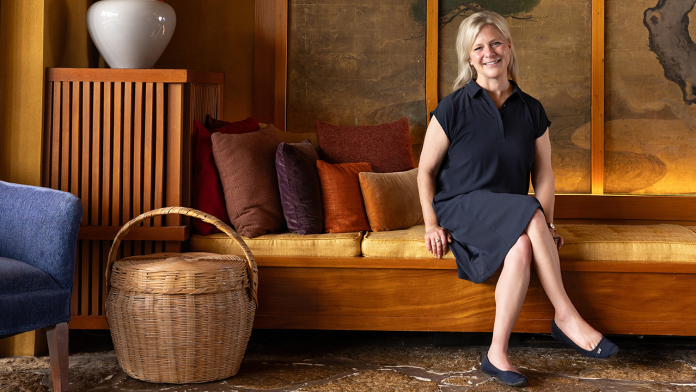
SPRING GREEN — Carrie Rodamaker said she just “fell into” her role as executive director of Taliesin Preservation, the nonprofit steward of Frank Lloyd Wright’s historic estate here. But after 24 years with the organization — working her way from gift shop assistant manager to the top spot — the famed property has become something of a home to her.
Taliesin, meaning “shining brow” in a nod to Wright’s Welsh heritage, is the famed architect’s 800-acre estate.
Rodamaker grew up not far from Spring Green, outside of Cross Plains, and shifted from a nearly decade-long medical career in Madison to work closer to her roots. Over her tenure, the Taliesin property has seen a substantial tourism increase and, in 2019, joined seven other Frank Lloyd Wright locations on the list of UNESCO World Heritage sites. The group of Wright properties is among just 26 such designees in the United States.
Visitors at Taliesin can tour Wright’s 37,000-square-foot home, school and studio — with structures from nearly every decade of the architect’s career from 1890-1950. There is also a gift shop and restaurant, and weekend workshops on photography, painting and design. Taliesin also hosts lectures and events at its theater.
While Rodamaker is proud of the public awareness growing around Taliesin and the steps being taken to restore the property, she said there is plenty more on her to-do list to ensure the estate is well cared for, grows its number of visitors and its history is preserved.
What drove your career change and drew you to work for Taliesin Preservation?
My history here goes way back. My mom actually grew up just a quarter of a mile away, so growing up, we were always coming out here to see my grandma and be with the family.
Of course, that meant driving by Taliesin all the time. As a kid, I didn’t really know what it was, but I remember always looking at it and saying, “Oh my gosh, what is that?”
We grew up outside of Cross Plains, and my mom worked at a bank. My dad worked at a telephone company — Wisconsin Bell, AT&T, it went through a number of names — but they always volunteered. They were always involved in (organizations) like Telephone Pioneers (of America), Ronald McDonald House.
Seeing all of that, seeing them build a career but then give back, was always an inspiration for me too.
I worked eight years in the clinical side of pediatrics for UW Medical Foundation. During that time, I met my husband, and my husband grew up out in this area, and he was a business owner. So I knew we were going to live out here ultimately.
We bought a piece of property just right down the road from Taliesin, and it was cool to me not only because this was such a beautiful place, but also because … my family’s roots were in this area.
Taliesin Preservation was looking for a gift shop assistant manager or gift shop role … and an ultimate manager once the current manager left.
Wright’s philosophy was learning by doing, so (I thought), I’m going to just apply. I went in for my interview, and I ended up getting the position, and I did the gift shop manager role for about five years or so.
We (later) decided that we really needed an operational department so all of these retail aspects could fall under one department, so then I transitioned into the director of operations. I did that for — my math is a little off — seven to 10 years or so, and then the executive director at the time for Taliesin Preservation, she left.
I had gotten to know our treasurer, who was Sen. Howard Marklein (R-Spring Green). Over the years, I’d gotten to know him because he was on our board. Knowing that they were looking for an executive director and not having any aspirations of wanting to do it myself — I really didn’t — I was still concerned about some things.
(I said), “Here’s what we could use in a leader, here’s what we need as an organization.” And he’s like, “Well, what do you want me to do about it? … Carrie, put your hat in the ring.”
And so I did.
What about the work that happens here is so important to you?
It’s about what this place is, what it can offer people. I’m passionate about history. There are so many stories to tell here, and it’s just getting more people to know what this is, and to have them experience it in some way, shape or form.
That’s my driving force. I love it here.
What was your vision for Taliesin as you stepped into the executive director role?
We always thought about this place as, we’re here, we do our thing, but we weren’t shouting it from the rooftop.
If you don’t have the money, you can’t look beyond your nose to see a greater vision, and so that was a hurdle. We had a few really good years behind our back that allowed us to save some of that money, and invest it wisely to allow us to grow, and … look to the future.
We do not own these buildings here. They’re owned by the Frank Lloyd Wright Foundation, which is based in Scottsdale, Arizona.
We work with them. We’ve had an up and down relationship throughout the years, but we’ve really come to a great place — a true partnership — in how we can elevate this place and what we can do.
Taliesin is now inscribed as part of a UNESCO World Heritage site. That just blows your mind. It expands the horizon and pushes you to think, what do we want to do collectively to share part of a UNESCO World Heritage site, which is the only public one in Wisconsin, and one of 26 in the country?
You talk about the Great Wall of China, the Great Pyramids of Giza and Taliesin all in the same sentence. It’s a huge platform to be on. It is, and goldarn it, we better start acting like it!
What we’re doing now is working to grow visitorship. We want to grow ways of bringing different audiences in — finding new programs and definitely working on the ones that are successful, the ones that are continuing to bring people here.
Do you have a sense of how much tourism has grown during your tenure?
These buildings have significant challenges that we’re working to address with our partners — real critical preservation. A lot of great stuff has been done, but more needs to happen.
Part of what we’re doing now is really looking at a 20-year preservation plan aligned with a 20-year programming plan, and where we want to go.
We’ve gone from 25,000 visitors, pretty consistently over the years, to now about 35,000, and we want to eventually get to 100,000 visitors.
We know it’s not a sprint — it’s a marathon. Working on really developing those plans and all of this outreach … that all helps. It’s all about awareness.
Percentage-wise, I would say I think we’re looking at about a 4%-5% increase, kind of steadily over the years.
What fulfills you beyond your nonprofit role?
I can be so extroverted at work that usually, for me, decompression means going home, being in my house, gardening. I love my gardens. I have a few goats and chickens and a dog. I’m just the average person that goes home and enjoys reading, gardening, learning.
And my family — I love spending time with them. I’ve got my husband, a stepson, and he’s married — they’ve got four kids — my parents within 15 minutes from here, my sister, her husband, and they’ve got three boys.

