
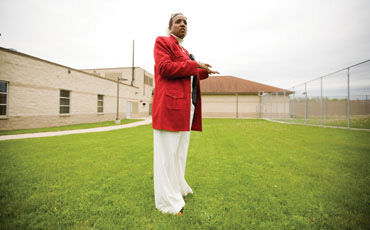

On a sunny, spring morning, Deirdre Morgan, 46, has already stopped at MillerÃÂÂÂs Market for her daily egg breakfast fix. “I’m a protein girl,” she laughs. Good thing. She’ll need all she can muster as Warden of the all-male Oakhill Correctional Institution in Oregon.
The life she leaves behind most days is normal by Madison standards. A graduate of Madison East High and then UW-Whitewater, Morgan has been a wife for 19 years, and is mother to two teenagers. At her Verona home, she is “a nurturer and a hugger”; however, that sweet mother bird nature changes when she leaves the nest.
Morgan has held the position of Warden since 2004, but has worked with the Department of Corrections intermittently since she was 23 years old. IB meets her to shadow her on thejob and learn about her industry.
In the parking lot, two dozen men and women dressed in black with “ERU” emblazoned on their shirts (Emergency Response Unit), grunt and chant as they practice militaristic maneuvers under the direction of their leader. They will spend eight hours training this day, honing skills they hopefully will never have to use.
In addition to the safety and security of the inmates, Morgan is charged with supervising more than 250 staff, including the ERUs, who work as uniformed guards any other day of the week.
“This is a 24/7 institution,” she notes, and though most days officially start at 8 a.m. for her, the Warden’s responsibilities don’t end. She is always looking over her shoulder. She doesn’t forget that the serene, “Tara” like driveway to the minimum security facility is facade. Behind the gnarled, twisted “stun” fences encapsulating the institute’s main entrance, almost 700 inmates are serving time.
Visitors to the institution must present a photo ID, sign in to a register book, and submit to a metal detector. Cell phones are off limits entirely, bags are checked, and staff recommends that car keys be locked in lockers in the front waiting area.
Entrance to the inner sanctum is gained through a series of locked doors, opened electronically by a uniformed guard who greets and visually identifies all who pass through. We enter a locked conference room. This morning, Capt. Michael Buettner informs her of the day’s status: There are 680 inmates. Thirty-one will be working on the farm, three will be on work-release, and another three will go to UW to receive chemotherapy. Another inmate blew out his knee playing basketball and also will require special care.
Then there is another issue: There has been a water main break involving a steam line located just outside the maximum security, or “segregation” building. Such a repair is complicated by the fact that a portion of the institute’s stun fencing will ave to come down in order to get a backhoe in to repair the damage. Simple solutions are never simple in this secure environment.
The segregation building averages 45 inmates per day in its 48 cells. It also has two observation units, often used for suicide prevention. “It’s like a ‘time-out'” for inmates with behavioral issues, Morgan explains.
She turns back toward the unit with seeming disdain: “That building looks and feels like a prison.” Yes it does… compared to the rest of the 100-acre facility, that is.
A tour of Oakhill, with its 15 housing units (many built in 1931), farm, gardens, and pastoral setting, could rival the postcard-quality of any college campus. A 10,000-sq.-ft. health care facility offers everything from medical and dental care to triage. The government pays for inmate health care, but typically there is a $7.50 co-pay on their first visit. “The minute you hit the door [at the medical clinic], you’re no longer an inmate, you’re a patient,” says Morgan.
Oakhill also has an arrangement with UW Hospital for inmates requiring more critical care, including chemotherapy.
In addition to a food services building currently under construction, inmates can take advantage of a music room, an art and hobby room, weight room (no free weights allowed), a gym and a library — but only when a schedule allows.
Oakhill is also one of only six Wisconsin institutions with a chapel on the grounds — something Morgan helped refurbish and is particularly proud of. Next to the chapel stands sweat lodge for Native American inmates.
The average length of a stay at Oakhill is seven months. Inmates — ranging in age from 18 to 84 — are there for any number of reasons, from construction fraud, to drug charges, to failure to provide child support, to first-degree murder.
“Most of the murderers we see have been in the system for 20 or 30 years already,” Morgan says. Some inmates are eligible for parole, and others are under “determinate sentencing,” where the period of incarceration and extended supervision is dictated by a judge.
In each housing unit, one uniformed officer typically oversees between 42 and 46 inmates. Every 90 minutes, the officer takes a casual count verifying that everyone is accounted for. Three times a day, a page goes out to all, and the entire facility conducts a standing count of every prisoner. Those numbers are reported to the control center.
On any given day, between 45 and 65 inmates leave the institution, Morgan says, but none leave without her approval. She knows who are the sickest, who are out working in the community, and who has a court date.
“I think people are surprised by how much a Warden needs to know,” she said. “I am the policeman, the mayor … my fingers are in everything.”
Inmates can and are encouraged to “earn a living” during their incarceration. The best behaved can make between 12 cents and $2 per hour working at the facility, attending school, learning a vocation, or participating in other self-help programming.
This engagement serves two purposes: First, it provides inmates with money to purchase personal care and food items, and second, it keeps the men from sitting idle. “You get out what you put in here,” Morgan said.
Staff-recommended, highly screened inmates can apply for more coveted positions, such as work-release or working on the Center’s farm.
Last year, the farm yielded 46,000 pounds of food for the prison’s food service facility. Morgan noted that 10% of all the food harvested gets donated to area food banks.
Morgan herself has very little contact with prisoners: “I have to let staff do that.” It was an important lesson learned early on. Nor does she allow anyone to use her first name. “I have always believed there is a first line of defense on boundaries,” she said. “First, it’s what you wear. Second, it’s what they call you. I am Warden Morgan.”
A couple times a week, Warden Morgan likes to stroll through the grounds on a marked trail. Only then can an inmate approach her to discuss an issue, but she makes it clear that no decisions will be made at that time.
“Sometimes you have to let the cake bake,” she says, meaning decisions follow due process. A formal complaint system also provides inmates with some feedback. “They don’t have to like my answer,” she said, “but they have to get an answer.”
Like any manager, Morgan struggles with budget issues and says her biggest challenges include getting good personnel, holding personnel accountable, and providing resources for inmates.
“We work very hard to treat people the way I’d like to be treated,” she says. “We want to make sure our facility is safe and that everyone is afforded dignity and respect.”
And her pride is evident: she said with conviction, “Wisconsin has one of the safest prison systems in the nation.”
Asked if she’s ever felt threatened, Morgan shakes her head. “No, but I do get angry,” she says, recalling some specific instances when inmates took advantage of situations, such as a middle-of-the-night power outage.
“But overall,” she says, “Raising children is the most difficult thing I’ve ever done. That’s hard!”

