
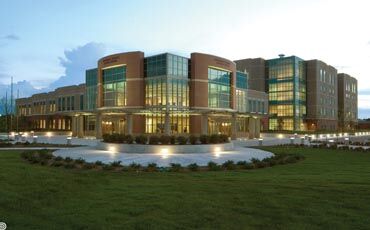

Designing a prison is like creating a small city, according to Ashraf Sadek, managing principal of the Madison office for Bray Architects. “People think the majority of prisons are cells, but that’s incorrect. You need a medical center, a school and a library, a chapel, an exercise room — all the things that you do on the outside.”
Sadek, who is certified as a professional engineer, has been involved in designing prisons and jails for many years working with the State of Wisconsin, Department of Corrections and in the private sector. Before that he worked on palaces for the royal family in Saudi Arabia, which, he said, are actually quite similar in design to prisons. “A royal family is often confined in a compound of buildings,” he added. “And the level of security needs to be maintained.”
This however, is where the similarity ends. Sadek does not want to give the impression that prisons are opulent mini-cities. “There is no luxury at all in those cells. They are concrete walls and floors and there are no finishes.”
This said, Sadek does find an aesthetic appeal in prison design. “The beauty of design is not just what a building looks like, but how it functions, and the form has a shorter life than the function.”
The function of a prison is, indeed, the key part of its design. There are many things that must be taken into account and numerous codes to follow.
Several local firms are involved in “justice” design or construction, and it’s an industry that likely won’t slow down anytime soon. The United States has more people behind bars than any other country in the world. As of 2007, there were 2.3 million people incarcerated in local and state jails and federal prisons, according to a study by the nonpartisan Pew Center on the States, and inmate populations are expected to increase by 25 percent or more between 2006 and 2011.
IB talked to several area firms, to find out what it takes to design a prison or jail, and what guidelines must be followed.
Security Considerations
All aspects of a prisoners’ cell are geared toward preventing both escape and bodily harm, both to oneself and to other prisoners and guards.
Wisconsin Administrative Code requires jail cells have a floor area of at least 54 square feet. The code also states that the distance between the floor and ceiling may not be less than eight feet and the distance between opposite walls may not be less than six feet.
Daily natural light is another requirement for prisons. Sadek explained that this is the standard because an absence of natural light has been known to negatively affect an inmates’ behavior. “Inmates can get mean without it.”
Any windows are either barred or less than five inches in width. Prisoners have been known to squeeze through anything larger.
One option is to design an outer corridor with windows, which allows daylight to filter through any interior cell windows. This is called “borrowed light” and also meets the American Correctional Association (ACA) standards. The Milwaukee Secure Detention Center, designed by Durrant, has this feature.
Wisconsin Administrative Code specifies that windows “shall be of detention strength and manufactured, sold and installed by firms that specialize in jail and prison equipment.” Basically, there will be no breaking out or squeezing through.
Wisconsin code also requires that each cell has a “rigidly constructed metal bed” with the frame either bracketed to the wall or bolted to the floor.
A “wet cell” will include a wash basin and toilet, both of detention strength metal. Jerry Olson, director of architecture for Durrant, explained that the toilets have no moving parts, “So they can’t be busted and used as a weapon.”
A “dry cell,” on the other hand, has no running water, and is not as beneficial for managing inmates, according to Sadek, because it increases interaction between inmates and guards (requiring travel outside of the cell to the toilet and shower).
Sadek currently is involved in remodeling a prison in Prairie du Chien, where Bray is converting a music hall into high security segregation units. The walls in these units are concrete reinforced with horizontal and vertical metal bars at every three layers of masonry.
The ceilings are made of heavy gauged metal and there are no holes where anything can be inserted. “So no contraband can be hidden and no one can kill themselves,” said Sadek, who’s heard of cases where inmates have collected and hidden toothpaste in the wall until it hardens, then fashioned it into a weapon.
Other cell standards include a detention strength, metal mirror that cannot be removed, and either lights that have a dimming capability, or a night light “to allow for comfortable sleeping,” according to the Wisconsin code.
At the former Boscobel Supermax prison, now called the Wisconsin Secure Program Facility in Boscobel, a lawsuit was filed by inmates — in part over bright lights that burned in cells 24 hours a day.
Judge Barbara Crabb ruled the practice unacceptable in 2002, and the prison subsequently reduced nocturnal lighting by 60 percent.
Sprinkler heads are also required for code, but have proved dangerous as a place to hang a sheet for suicide.The problem is solved by either putting the sprinkler heads in the hallway, or the head is surrounded by a cone so you can’t wrap anything around it. Another preventative measure is the use of clothes hooks, according to Olson, that are structured to bounce down if too much weight is applied. “Everything we put in a facility is vandal resistant,” he added.
Electronic security is an important aspect of modern prisons and jails. Olson said the security cameras used today are much clearer, allowing everything going on to be observed. Typically cameras are installed in both community areas and hallways.
The perimeter of high security prisons are enclosed by some type of fence. Fences topped by razor wire are the common image that comes to mind, but other options include high voltage fences, shaker fences or shaker collapse fences. Sadek explained that a shaker fence has low voltage and a shaker collapse fence has this voltage as well as a collapsing top that doesn’t allow prisoners to climb over.
The Wisconsin Secure Program Facility in Boscobel has a fence with lethal voltage.
Camouflaged as an Office
Location is a major factor when designing a prison, and Olson (Durrant) said each project has its own challenges. The Dane County Jail on Doty Street, for example, had complicated site constraints. “The street elevation was so tall on the back side we had to excavate really far down there.” The building also was constructed to blend in with its surrounding environment and not look like a jail.
This is a common challenge for prisons or jails located in downtown or urban areas. Corey Brumbaugh, vice president of business development for Miron Construction, a local company that has worked on several large prison projects nationwide, explained that if the detention facilities are located near people and buildings, an attempt is usually made to have it blend in with the surrounding architecture. “Alternatively if the prison is in a rural area, it can be more functional, and generally has a much more institutional design.”
Durrant designed the Milwaukee Secure Detention Center with the intention of making it look like an ordinary office building, since it sits in a prominent position on Highway 43. This was achieved by moving the cells inside and creating the outer maintenance corridor. “Once you do that, you can really do anything you want on the outside walls,” said Olson.
Potter Lawson just completed two county jails in downtown areas of Racine and LaCrosse, and CEO and president Eric Lawson said, “They look just like office buildings. You wouldn’t recognize them as jails.”
Olson said the Winnebago County Jail in Rockford, Ill. created a different kind of challenge because “it was in an area of the city that had seen its better days, and the city wanted the jail to be a sparkplug for revitalization.”
It’s still too soon, according to Olson, to determine whether or not the $140 million dollar project will indeed help to reinvigorate that area of Rockford.
Cost-Saving Design
According to Olson, “You can design the most cost effective prison or jail but staffing is the biggest long term cost, so anything we can do to reduce the amount of staffing is always a positive.”
Durrant has a staffing expert at its Phoenix office who studies this aspect of prison design exclusively.
One way prison staff can be reduced, explained Olson, is to make sure two people don’t have to man “the observation pod” during the third shift. “During the first and second shifts, there is always one guard in the pod and one on the floor, but it’s critical to eliminate the need for two at night. If you put a restroom in the pod, for example, that can help.”
Costs can be saved by other aspects of design as well. Sadek pointed out that a straight hallway doesn’t need as many cameras, for example, as a curvy one.
Sustainable design is another method firms are using to promote long-term savings, according to Lawson.
He noted a solar hot water system that was installed in the LaCrosse jail, and a geothermal heating system for an institution in Green Lake. “The water system can pay back very quickly,” he said. “because these institutions use a lot of water.”
Is Privatization the Answer?
Another crucial debate in the business of prison design and construction, is whether or not prisons should be owned and operated by private corporations. Private prisons are not allowed in many states, including Wisconsin. The Wisconsin Statute states “A private company may build a private incarceration facility without enabling legislation, but it cannot be operated by a private company.”
The Stanley Correctional Institution in Stanley, Wisconsin was built by a private company that purchased land and built the prison on speculation, due to a need for prison space in the state. Several years later. the state of Wisconsin did buy it.
The privatization of prisons is nothing new. In fact, the practice dates back to the contracting out of prisoners during the American Revolution. The first for-profit prison in the U.S. was built in 1852 in San Quentin, California. The institution was eventually turned over to the state due to mismanagement.
Private prisons surfaced again in the 1980s when the inmate population rose sharply, causing overcrowding and a need for more prison space. In 1984, the modern era of prison privatization was born when the Corrections Corporation of America (CCA) was awarded a contract to take over a facility in Hamilton County, Tennessee. This marked the first time that any government in the country had contracted out the complete operation of a jail to a private operator.
Miron Construction, in conjunction with Performa Incorporated in DePere, Wis., has built large private prisons in Georgia, Oklahoma and, most recently, Colorado.
Brumbaugh, of Miron, thinks these private projects make sense. “The need for prisons is increasing but state procurement procedures and funding availability can often take too long, so it’s easier to lease a bed per day [from a private prison operator] much like you would a hotel room,” he said.
The 1,250-bed, $80 million dollar prison Miron currently has under construction in Hudson, Colorado would take four or five years for a state to build, according to Brumbaugh. “Under a expedited delivery process, we can do it in two years at a cost effective solution.”
Sadek argued the other side of this debate, noting that the privately built prison in Stanley had a lot of problems with it after the fact. “The cheapest way is not always the best way, and I am personally on the side of the state.”
Some studies have shown that private prisons do decrease costs, but other studies show this is not the case. A 1999 evaluation of 24 different studies on cost-effectiveness printed in the journal Crime & Delinquency revealed that, at best, results of the question are inconclusive and, at worst, there is no difference in cost-effectiveness.
There are other criticisms of private prisons. A 2001 study by the Bureau of Justice Assistance found that inmate assaults on guards were 49 percent higher at private institutions due to lower staff levels and training.
Regardless of this long-time debate, private prisons appear to be on the rise. Corrections Corp., the largest private prison operator in the U.S., built two prisons last year and plans to finish two more in 2009, bringing its grand total to 66 prisons.
Private or public, with a rising population of inmates, much continued thought and consideration will need to go into the design of these institutions.

