
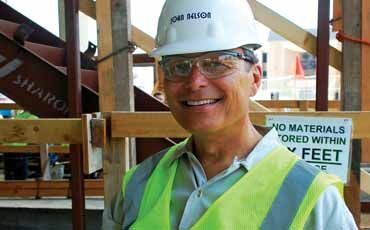

In our August 2010 magazine and in last week’s Web feature, we got a different take on sustainability from UW-Madison adjunct professor John Nelson, who believes the sustainability movement would benefit from less hype and more objectivity. We now present Part II of our recent interview with him in question-and-answer form, and he addresses the ambitious expectations of the sustainability movement and what he really thinks about LEED.
IB: What’s your take on Cap-and-Trade legislation?
Nelson: Here is an important metric. If you study underlying science of the Climate Change legislation working its way through Congress, whether you agree with it or not. I’m not rendering an opinion about it. I’m just simply saying that if you study the underlying science, it traces back to a couple of people at Princeton, and they developed something called stabilization wedges. And the stabilization wedges talk about reducing the rate at which we put carbon into the environment through 2050, and then plateau the total carbon in the environment at 2050 at a prescribed level. That is the science underneath the Waxman-Markey climate change legislation and a good deal of the policy that has been discussed in the U.S. If you believe that to be a reasonable goal, then our equivalent miles per gallon for energy in our buildings in the United states needs to go down by 80% between how and 2050.
IB: How do we do that when carbon capture and storage technology hasn’t been developed yet?
Nelson: We have to make the buildings vastly better.
IB: It just seems unrealistic to expect that.
Nelson: It’s really ambitious, and you may be right. It may be unrealistic. So far, the discussion about the energy-related issues our civilization is facing has been more about finding supplies, different supplies, alternate supplies, or mitigating the harmful impacts of using the supplies we have. The discussion has been mostly on the supply side, and that’s pretty limited. Supplies are limited by physical resource constraints and by technology.
The demand side, to me, appears to be the place we where we really have to focus a lot of energy and effort. I’ll give you an example. In my opinion, the energy challenge that we face bears similarity to the financial crisis we’ve just been through, where we, in my opinion, we became over-leveraged on debt, and then synthetic instruments no longer worked, and there was a collapse. It’s far more complicated than that, and it’s not my discipline, and I’m just doing it shorthand there, but I think we’ve done the same thing with respect to energy. We’ve set up a demand system to that calibrates to a standard of living that is not supportable with the resource base and the population we have, and the longer we focus on finding alternate supplies or technologies, the target is going to be a point of inflection.
There is an analyst in New York City; his name is Howard Davidowitz, a really smart guy. He studies retail, the retail-financial market, and I’ve followed him for years. In about 2005, he did a calculation in which he said that in the United States, there was roughly 20 square feet per person of retail shopping space. And he was smart enough to know how much revenue each square foot of shopping space needed to generate. He also knew ho much disposable income the average American had to spend, and he calibrated those two and he said Americans can only afford 10 square feet of retail shopping space. The other 10 stays in business because Americans are over borrowing, using second mortgages on their homes, and so forth.
And his prediction in 2005 was the economy was going to take a big hit in the retail space, that there will be a lot of vacant and empty retail space. So I’ve listened to him since them. He was obviously proven correct by the events that transpired. If you pay attention, there is an awful lot of office space and retail space empty right now. A lot of vacancy, especially in the retail sector. There are shopping centers sitting empty in this country when I travel around.
I think we have a similar situation with energy. We’ve set up a demand expectation. How big our buildings are. How many square feet per person? Houses have gotten bigger in the last 20 or 30 years. Cars have gotten bigger. Mileage driven has gone up. And personally, when I look at the fundamentals, I don’t think there is something out there that will invisibly slide in, cost effectively, to allow all that consumption to continue at the current level.
IB: Is there any part of the Cap-and-Trade bill that addresses that in a meaningful way?
Nelson: No. The greenest building is the building is the unnecessary building that is not built. I really think going forward, people who figure out how to repurpose buildings with more effective use of space, people who figure out how to … let me stake a step back. Just as when you are in debt, you can’t spend your way out of a problem, or when you’re overweight, you can’t eat your way to slim, you cannot build your way to green. The existing inventory is so big and the cycle time in buildings is long.
IB: So what you’re telling me is there is going to be more investment in retrofitting than in new buildings in the coming years.
Nelson: Well, when you think about it, that is the green argument. But when you also think about the capital constraints we have right now, where is the capital going to come from for the big, new projects? The government is out of money. The developers have some money, but they need tenants and there aren’t a whole lot of businesses that are out doing things. So, yeah, I think that when you look at the financial circumstances and when you look at the green circumstances, we really need to spend a lot more time looking at our existing inventory. That’s Howard Davidowitz’s model. I think we just have to figure out a way to do the same. I’m going to sound like Jimmy Carter, here, do the same with less footprint. We have to reduce our footprint.
IB: Well, President Carter obviously had a troubled presidency, but if we had listened to him about renewables, we’d be much further along in being energy independent.
Nelson: We would be if we had listened to Jimmy Carter.
IB: But OPEC was feuding in the 1980s, the oil prices came down per barrel, and the crisis was over and renewable production stopped.
Nelson: Right. Had we just listened to him (Carter) about fleet economy and the vehicles, we would not be importing oil right now — just improve the economy of our vehicle fleet.
IB: Companies like Johnson Controls can continue to innovate and improve building systems, but and as long as we have a deep thirst for energy, is that the best we can do?
Nelson: I don’t think there is any way to innovate our way out of this. I think we need to figure out a way to use less.
IB: I can’t see even a U.S. Senator in the Midwest supporting Cap-and-Trade in its current form, given the way Midwestern rate payers would be treated, especially when the coasts have more nuclear power than we do.
Nelson: Maybe, but you might be interested in knowing that the state with the highest percentage of nuclear electricity generation is Illinois. There are a bunch of nuclear reactors in Illinois.
IB: Yes, and there is a giant energy company down there pushing for this.
Nelson: Exelon. The Chairman of the Board [John W. Rowe] is UW alum. Your point is well taken. I don’t think Cap-and-Trade is going to pass, either. I don’t think carbon regulation is going to pass in the United States. I’m not optimistic about that. I’m not planning on it.
IB: What do you think of LEED (Leadership in Energy and Environmental Design) as a guide, and programs like Energy Star and Focus on Energy?
Nelson: I have very mixed emotions about LEED. Proponents of LEED will argue that it got the dialogue started, and that’s true. But it’s a very complicated system. It’s expensive. It’s something that only institutions or large companies can afford to do, and they do it principally for public relations, not necessarily because it improves their ecological footprint. And it’s not very good with energy. Energy is where the savings really are. It’s where the challenge really is. The science shows that LEED certification does not correlate to energy reduction.
And so while I give LEED credit for starting a dialogue, the thing I’m most concerned about with respect to LEED is that people think it’s the destination. “I’ve got my LEED plaque on the wall. I’m now as good as I ever need to be,” and they are not. There is still a long way to go, and I’m really concerned that, increasingly, our culture looks for easy solutions to complex problems, and LEED is an easy solution to a very complex problem. And it allows the really difficult dialogue to be overlooked.
IB: What about Energy Star and Focus on Energy?
Nelson: Energy Star is fine. Focus on Energy is a great program, just a great program staffed by great people. The challenge though, of making my appliance more efficient is that if I get twice as big an appliance, I still use more energy. The challenge with Energy Star is that it’s about efficiency. It’s about rate of consumption. It’s not really about total consumption.
Some friends of ours lived in a town house, 800 square feet, and it had leaky walls and cheap appliances, so they built a new home, 5,000 square feet, two furnaces, big refrigerators, and they bought high insulating windows, the highest efficiency furnace, and refrigerators and washers and dryers and so on, and their energy use went way up. So there is a case where just by simply improving the quality of the components, you don’t necessarily improve the footprint.
IB: On the Wisconsin Institutes for Discovery, you think that building is the real deal in terms of sustainability. Why?
Nelson: I think it’s a step in the right direction.
IB: It uses a lot of glass, but perhaps you approve of the way it uses glass?
Nelson: In that building, the really energy-intensive functions are nested inside the building behind three levels of glass. That is the inverse of most glass buildings, where all of the people and functions are put on the outside edge, so you have to condition that outside edge very carefully, and that takes a lot of energy. As opposed to in the WID, the really high conditioned space is inside three layers of glass. My point in this example was that glass isn’t necessary good or bad, but if one takes the perspective that they have big building, they need a lot of glass to get light in the building, then they organize the building accordingly so that you don’t pay a penalty for having all that glass. That is the example.
Sign up for the free IB Update — your weekly resource for local business news, analysis, voices and the names you need to know. Click here.

