
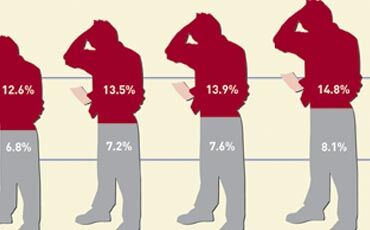

The Federal Government somewhat euphemistically refers to it as “Alternative Measures of Labor Underutilization,” a watered-down term for “unemployed” and “underemployed.” It is the title of Table A-12 on the monthly release of national unemployment statistics by the Bureau of Labor Statistics. While the information is publicly available, the total percentage of unemployed and underemployed workers (under a measure known as U-6), is not the most widely disseminated figure.
That would be U-3, the total unemployed as a percentage of the civilian labor force, which now stands at 12.5 million workers, or 8.1% of the workforce.
If the government used the U-6 measure as its official unemployment rate, the percentage that now would be ingrained in the public consciousness would be 14.8%.
Yes, 14.8% — and perhaps rising.
U-6 measures every component of this underutilized labor: people unemployed 15 weeks or longer, job losers and people who have completed temporary jobs, the “total” unemployed (U-3), discouraged workers, marginally attached workers, and part-timers who desire full-time work. The latter category is not part of the official unemployment rate, but their ranks swelled by 787,000, to 8.6 million, in February.
The proper way to measure unemployment has been debated in past recessions. In 1991, the late Douglas Fraser, former leader of the United Auto Workers, told Time magazine that by undercounting the unemployed, “the jobless problem is being disguised.” That’s not a consensus view even today, but it is one that IB has decided to re-examine during the U.S. economy’s worst performance since the early 1980s.
To gauge economic sentiment about the appropriate labor utilization measure, we talked to Phil Neuenfeldt, secretary-treasurer, Wisconsin State AFL-CIO; Dennis Winters, director, Office of Economic Advisors, Wisconsin Department of Workforce Development; and Jim Glassman, an economist with Chase. To explore what unemployed professionals are doing to remain players in the job market, and what state government is doing to help workers improve their marketability to employers, we spoke to Holly Dary, regional vice president, Robert Half International, and to State Sen. Julie Lassa, respectively.
How do U rate?
The various unemployment classifications measure different components of the underused labor population:
- U-1: People who have been unemployed 15 weeks or longer.
- U-2: Job losers and people who have completed temporary jobs.
- U-3: The total unemployed, the most commonly reported measure, counts unemployed and actively looking for work, but excludes part-time workers and people that have run out of unemployment insurance benefits.
- U-4: The total unemployed plus discouraged workers, who are unemployed people who have given a job market-related reason for not actively looking for work. This measure does not include the homeless.
- U-5: The total unemployed plus discouraged workers and marginally attached workers, who are unemployed people who are not looking for work but are available to work if an opportunity presents itself.
- U-6: The total unemployed plus all marginally attached workers, plus the total employed part-time for economic reasons but available for full-time work. Many underemployed workers supplement their part-time employment with other part-time work until they are able to find the ideal permanent position.
In all, the economy has shed more than 4.4 million jobs since December of 2007. More than half of them have been lost in the past four months, including 651,000 in February and 655,000 in January, job-loss numbers not seen since October of 1949.
As the recession has deepened and as the official unemployment rate has risen, the gap between the U-3 and U-6 measures has progressively widened.
Glassman and his colleagues at Chase have predicted that the unemployment rate could rise to 9% or 9.5% during the second quarter of 2009. “If we’re lucky, the economy begins to stabilize by summer and then begins to turn,” Glassman said, adding the prediction is based on the thorny issue of shedding toxic debt and unlocking the flow of credit.
If unemployment reaches those levels and the existing trend lines hold, the U-6 rate could approach 17%. At that rate, some believe the public’s perception of labor underutilization, and its sense of urgency about addressing it, would be fundamentally transformed.
Labor Perspective
In the mid 1990s, before the information technology revolution sparked a robust period of job creation, a working-class man was asked for his reaction to President Clinton’s assertion that the economy was starting to create new jobs. “I’m glad the President is creating so many new jobs,” he said. “I’ve got four of them.”
Such is the lament of those holding multiple part-time jobs to make ends meet, but it is indicative of the debate over the use of job measures. Labor leaders have traditionally advocated a broader view of the jobs picture, and Neuenfeldt agreed that the U-6 measure would be a much truer measure of the labor underutilization issue.
Neuenfeldt illustrated this belief by noting that people whose unemployment compensation has expired are no longer included in the U-3 figure, and by noting that jobless statistics in general don’t factor the people who are working for considerably less than they used to. In labor’s view, that’s partly a result of jobs moving overseas to lower-cost labor; others fault federal initiatives like H-IB visa program, which allows American companies to hire a specified number of foreign workers who are provided visas to work here — often at lower wages.
But it is the failure to count people whose unemployment insurance has expired that most concerns Neuenfeldt. “The [official] unemployment rate does not take into account the entire picture,” he said, “because there is a time frame for receiving unemployment insurance.”
Neuenfeldt believes that if the public was more aware of the complete unemployment picture, more people probably would demand action on matters that organized labor believes can address rising unemployment and the higher levels of depression and anxiety it causes. This includes key aspects of organized labor’s agenda, including:
- Health care reform that reduces costs for both employers and workers, and establishes universal insurance coverage.
- The creation of environmentally friendly ÃÂÂ’greenÔ jobs to reduce carbon emissions and enhance economic and national security through energy independence.
- The negotiation of fairer trade deals to address job-killing trade deficits and enforce international worker rights laws.
With a more complete picture of how many people are in trouble, more attention also would be paid to basic safety net issues of food and shelter, he added.
Neuenfeldt cited recent television coverage of long lines at job fairs, long enough for people to be turned away from a hotel where one fair was held. “There is a message there,” he said, noting that a similar message would be sent if the government was emphasizing the whole unemployment story.
Economist’s View
Since the official national unemployment rate (now 8.1%) is the highest since 1983, and because it has risen dramatically since the onset of the recession, Winters and Glassman don’t believe the use of the U-3 measure has dampened the public’s sense of alarm.
“We know that if the U-3, the total unemployment rate, is going up, it’s highly correlated with the U-6 number and vice versa,” Winters said.
(He noted that U-6 is a national statistic that is not replicated at the state level because there is not enough power in the survey estimates. Wisconsin’s unemployment rate stands at 8.8%, while Dane County has a jobless rate of 5.5%.)
Winters is unsure whether a U-6 standard would impact how the public views the scale of the unemployment problem and therefore influence state and federal government strategies on employment policy and programs, including job training for various populations of unemployed workers.
“That kind of depends on what [number] they were used to,” he said. “If we had been reporting the U-6 unemployment all along, then we would look at something like 8% as the [full-employment] standard, as opposed to 4% for the U-3. If you were to shift all of the sudden from 4% to 8%, people would have to recalibrate how they look at things.”
According to Winters, each of the different unemployment measurers has a value that helps economists understand what’s happening with unemployment and the broader economy. Most of the DWD’s economic models are based on the total unemployment rate, Winters said, “and then the things we can look at in the other measures are things like: is the spread between the U-3 and the U-6 widening? Is the U-1 number, the number of people unemployed for a certain period, increasing and essentially elongating? That means the number of people out of work for longer than 15 weeks is growing, so it’s harder to find jobs.
“We look at it singularly and in combination. I think you have to take them as a package to see if they are all moving in the same direction, to know whether there are some differences that tell you where you might be in the [business] cycle, or what’s being affected or what’s not.”
In the current economic environment, Winters does not necessarily believe that one measure is more telling than the others. “Again, I think you have to take them in combination,” he said. “I think the unemployment rate is increasing. A year ago, it was 5.4% and now it’s 8%, so we see that number going up almost three points.
“We see the U-6 numbers up, for example, almost five percentage points. So it’s in combination with other measures, and as we look at the number of people that are on the unemployment rolls longer, it kind of fits together.”
Glassman concurred that an increase in each measure spells bad employment news, and he also doubts that emphasizing a different measure would compel the public to demand more government intervention.
“I wouldn’t get hung up about the different measures,” he advised. “Going to the U-6 or whatever measure is like going from Fahrenheit to Centigrade. They are all paralleling each other, and it’s not as though it’s not bad enough under the U-3 measure.”
To Glassman, unemployment is the most important economic indicator because it tells economists how the economy is doing relative to full employment, now considered to be 4% unemployment (at one time, a 6% unemployment rate was considered full employment). No matter which measure is emphasized, trends are the key thing that economists focus on, he added.
“What we’re interested in as economists is how are things progressing over time? Pick your measure and stick to it,” he advised.
Investing in Workers
The Department of Workforce Development receives federal dollars to administer a variety of job training programs. Winters said the department is doing everything it can to train people, not only to get them jobs but to get them better jobs and climb career ladders. Among the bevy of job training programs are initiatives for youth apprenticeship, incumbent workers, dislocated workers, and working adults.
“The problem we’re having right now is that this economy has fallen so far, so fast, that we’re having trouble keeping up with demand,” Winters said.
In the long run, Winters said the department is trying to raise everybody’s skill level because there is an increasing demand for high-skilled workers in the workforce. Failing that, “we have to raise productivity to raise people’s earnings,” he said.
The “right” job skills are the focus of Gov. Jim Doyle’s new strategic workforce initiative, which would allocate $5.9 million to change the state’s approach to job training. Under the plan, federal resources would be realigned to train low-skill workers for jobs in high-growth industries, especially Wisconsin strong suits like advanced manufacturing, biotechnology, and health care.
The initiative would invest $175,000 for skills assessment and work readiness certification, and standards would be developed to assess the skills of job seekers and certify them as “job ready.”
Neuenfeldt (Wisconsin AFL-CIO) said the state does a pretty good job with its job training programs and has a good technical college system to help people make themselves more marketable to employers. However, stressing the importance of job creation strategies that are integrated with skill building, he added that these programs do little good unless there are jobs to fill. “There still needs to be a job,” he noted, “to train someone for.”
Short-Term Employment
One option for unemployed and underemployed professionals is temporary contract work, which is similar to temp-to-hire arrangements in that it can lead to permanent employment. Dary (Robert Half International) said project work can be a very good way for otherwise unemployed professionals to earn a paycheck, make new professional contacts, and enhance their marketability during an extended job search.
Dary cited the example of an accountant during the tax season. Since many employers really can’t predict their long-term staffing needs in a turbulent economy, she said they may not know whether they will need another full-time accountant for the year, but they do know that they have an immediate need during the tax season.
“In this case, a project professional is the ideal solution,” she said. “It’s a great solution for the company, but it’s also a great solution for the project professional because he or she will have an opportunity to get exposure to a company for the time when the company may, in fact, have a full-time position available.”
Among the “project” skill positions most in demand, even in a recessionary economy, are credit collection specialists, general accounting clerks, staff and senior staff accountants, and mortgage specialists.
On the administrative side, Robert Half is seeing an increased demand for customer service representatives, data entry specialists, and administrative assistants, among others.
“Those are the skill sets that we’re seeing demand for right now,” Dary said. “Locally, what is interesting about that is there might be people on an extended job search that have these skills, including transferrable skills. They may not be the best positions for them in the long term, but they may have developed some very strong data-entry skills or some very strong customer-service skills that they can use on a project basis while they continue to look for full-time employment.”
Don’t Forget the Employed
The 85% of the workforce that is gainfully employed (using the U-6 measure) has not escaped the notice of policy makers. Two bills in the Wisconsin Legislature would provide tax credits to employers that invest in their worker’s post-secondary education, with the goal of increasing the number of workers in Wisconsin with bachelor’s degrees.
One bill co-sponsored by State Sen. Julie Lassa, D-Stevens Point, would provide a 25 percent post-secondary education tax credit to Wisconsin employers that pay tuition on behalf of a person enrolled at a Wisconsin-based public or private university, college, or technical college.
As an incentive to help labor-starved occupations like nursing, the credit increases to 30 percent for tuition aid for degrees that can be used in occupations that are projected to have worker shortages. Those industries would be identified by local workforce development boards.
A similar bill, co-sponsored by State Sen. Alberta Darling, R-River Hills, and State Rep. Rich Zipperer, R-Pewaukee, would create an income tax credit for businesses equal to 50 percent of the tuition paid by businesses for an individual to attend school.
It also would provide an income tax credit equal to 75% of the tuition paid by businesses for any person that has a taxable income of not more than 185% of the federal poverty line.
Skill-building is not only an employment issue, it is partly a tax-base issue because Wisconsin’s medium family income of $55,700 ranks only 35th nationally, and simply raising the state’s bachelor’s degree population to the national average — requiring 150,000 more college graduates by 2020 — would add an estimated $7 billion to the state’s tax base.
Neighboring Minnesota has a medium family income of $62,500, which is partly attributable to its relatively high national ranking (12th) in this key education metric.
“Minnesota enjoys a higher median family income than Wisconsin does,” Lassa said, “and they tie that to the fact that Minnesota has a higher percentage of people with bachelor’s degrees.”

