

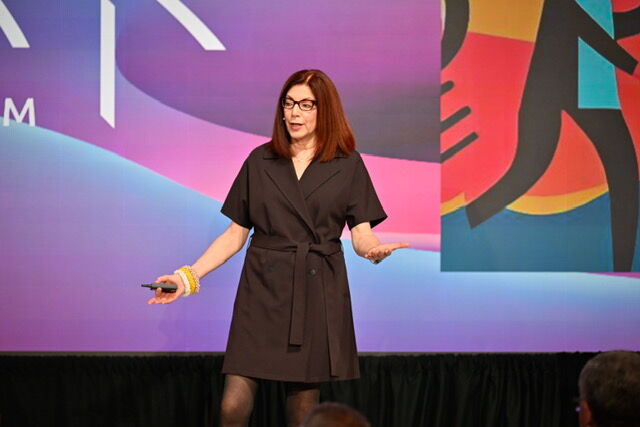
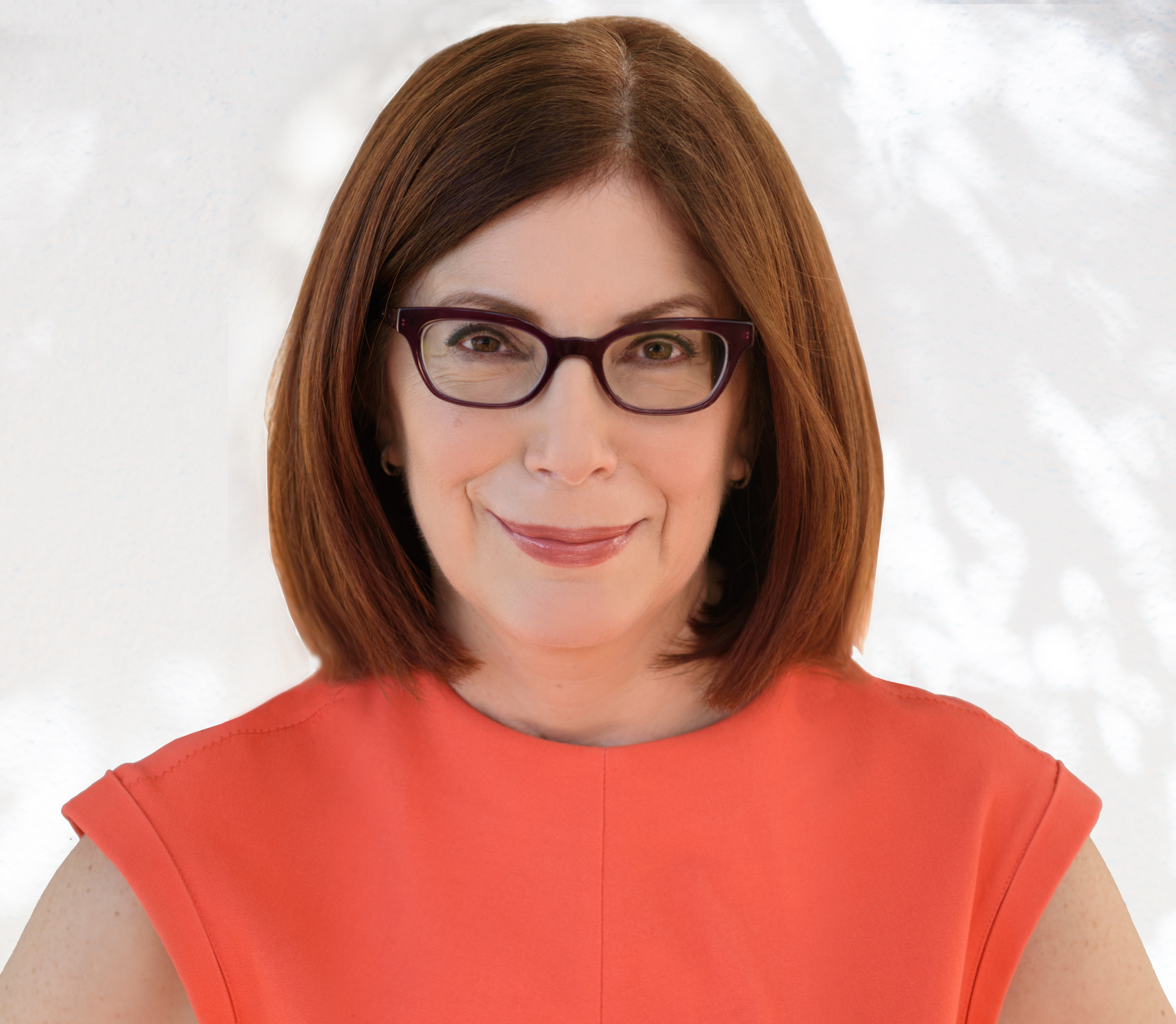
Futurist Anat Baron knows a thing or two about science-fiction movies because as a former Hollywood executive and producer, she’s helped create some, but she rejects the plotlines of sci-fi flicks that present artificial intelligence (AI) and robots as parts of a dystopian nightmare where machines make humans irrelevant. Baron, the keynote speaker at IB’s Nov. 6 Future of Business Summit, is now a CEO who says businesses should embrace generative AI because of its time-saving and productivity benefits. In anticipation of her keynote presentation, we recently spoke with her in this Take Five interview.
Why do you reject the dystopian scenario that often accompanies talk about artificial intelligence?
“There are two ways to look at life, right? There’s the dystopian version, which I actually and sadly, when I worked in Hollywood, helped make some of those movies, which is really a fear-based future. And then, there’s the completely other side, which I always like to show and talk about, The Jetsons future, which was from the early ‘60s when everything was optimistic and people thought about how to make humanity better.
“When you look at AI and the possibility of AI, it could be either. It could be the greatest thing that ever happened to humanity because it does the one thing that we’re not talking enough about, which is we give up all the tasks that a computer or an algorithm or a robot can do, and it gives us back the one thing that we all complain that we don’t have enough of, which is time. That’s the utopian version of it.
“Or, it could do what Yuval Noah Harare and others believe. It could become an alien, literally an alien intelligence and a God-like thing, because it is a thing, and just take over. I’m sure everyone has heard, it’s a pretty famous dystopian story that if you teach it [AI] everything that that the internet knows about humanity, and then you ask it how to fix climate change, the easy answer is just to kill all the humans because if you actually study all the posts and all the literature about climate change, it’s basically that humans are responsible for it.
“So, that’s the other way to look at it. With AI, we basically give up all thought and we give the AI the power to take over, or it just does it by itself. Now, we can’t do that now because a lot of the AI systems aren’t connected to each other, and also because we haven’t really, even though people talk about neural networks, we haven’t really taught them how to think like humans. But I guess that’s possible.
“But as I always like to think, we still have agency, right? So that’s why I don’t think it’s going to be, at least in the near future, dystopian. But you know, humans have done crazy things before, and the other example I will give you … but I think it’s a good one, is nuclear energy. Nuclear energy obviously could be dystopian and used for ill because we’ve seen it and we’re close to the anniversary right now of what happened back in World War II, but it could also be used for good. And so, what happened after the dystopian part of it was the nuclear proliferation agreements, and I would hope that if we as humans are smart, even though we agree on nothing between nations and we live in a really scary time in the world, that the one place we could potentially come together is to work together so that AI does not go the wrong way.”
“Every new technology has brought with it tremendous amounts of fear, and sometimes maybe we should have listened, like with social media, which is an example of an industry that is almost dystopian in some ways because it was never regulated and people just didn’t understand it, especially lawmakers at the very beginning. And so, sometimes it goes off the rails, but I think overall social media has still — net, net — been good for the world because it has allowed us to connect with people that we never would have connected with. And imagine, for example, going through COVID without social media. So, I just don’t see the dystopian argument and I don’t really understand this fear, and we haven’t even gotten to really big use cases of AI or generative AI.”
Why are some people so worried?
“When people talk about dystopia when it comes to AI, they’re talking about AGI, which is artificial general intelligence, which is kind of scary, which is the next phase. It’s basically when a computer will have the same ability as the human brain to process information. Right now, it’s basically a predictive machine. It takes in lots of different information, mostly the internet, everything that’s ever been published. For example, Google’s Gemini also takes in everything from YouTube. So, it’s got all this information. It’s not validated necessarily, and it may not even be true, but it takes in all this information.
“And when I type a prompt and ask it a question, it’s trying to predict what the answer is based on the algorithms that it’s been fed. And so, that’s all it can do today. If you think about it, it’s almost like what we did when we wrote a term paper in college. We went out. We did all the research, and we answered whatever the question was. It’s just able to do it much faster and it has access to more information. When you get to AGI — that’s been a dystopian part — is if we allow computers and machines to have similar intelligence to us, could things get bad? Yes.”
You’re a CEO and you’ve worked in various businesses. How best can generative AI help a small business?
“Right now, the use cases are still being formed. There are not a ton of use cases and I think right now AI is best used for productivity. So, it’s about everything from recording the call that you’re on, and using the AI to record the call and give you notes and then put it into your calendar. It’s everything from of course customer service … that’s where it’s going to be the biggest and it’s already, people are already using it and having great success because what happens is with AI, you have to look at everything as tasks, right? What generative AI is really good at is A, B, C, D, E. Nothing complicated, just something simple that I have to achieve.
“For most small businesses, if they’re in the consumer space and they’re dealing with customers, I’d say 90% of the questions are the same and 90% of the questions have similar responses, and so that is all programmatic and you don’t need a human. Where humans are going to be necessary is for the stuff that’s not obvious and that the computer and the machine cannot solve. We’re going to kind of bifurcate where you have to look at your business and say, what is going to help my people be more productive? Maybe cut costs, maybe boost productivity because what happens in so many people’s jobs right now, especially in a small company, is that task-oriented stuff like filling out Excel spreadsheets — whatever it is — all of that today can be done by an AI.”
Do you have any favorite AI tools right now?
“I use five LLMs [large language models] because they’re all different and they’re all trained on different data. Not only are they trained on different data … the people who are training them how to answer the questions are different for each one.
“So interestingly, if anybody wants to ever experiment by taking a prompt and cut and paste it into five different LLMs, it’s fascinating to me that they’re all different answers. Some are shorter, some are longer, some contradict each other. Some have actual resources because for me, I like to know where the information comes from, especially if I’m about to give a talk or if I’m using it for my business. So, my very favorite for research is Perplexity. That would be No. 1 if you’re doing research, especially if you’re just trying to get information. It gives you sources, which is amazing, and it also gives you follow-up questions, which is genius because it’s almost inside your head before you can even get to the next question.
“My second favorite is Claude, which is from Anthropic, which is funded mostly by Amazon and which was created by the co-founders who left OpenAI. So, they say [it is] more ethical, more built on values than OpenAI. I find it really good.
“And then, I use Gemini copilot and I still pay for some crazy reason the $20 for ChatGPT … and then I also create a lot of images for my presentation, and I guess people will see that in November in my decks. So, I use different tools for that as well. But I use actually Dolly, which is Open AI and ChatGPT, and I also use Microsoft Designer most, but those are the two that I use the most from the ‘free ones.’”
If you want your audience in Madison to come away with one key takeaway from your talk, what would it be?
“The takeaway should be that generative AI is here, and it’s here to stay, and it’s part of our lives. So, instead of being afraid of it, or thinking it’s going to go away, or not wanting to jump in, hopefully I can encourage everyone to start using it, whether it’s in their work life or just their life in general, and not to be so fearful and just incorporate into their lives because I guarantee you once you start using it, you’ll find uses for it.
“I will actually demonstrate some of those, so when you leave, that takeaway should be, ‘Wow, this stuff is really cool. It’s not going to take my job, and it’s time for me to get engaged with it because the future is really about humans and machines working together.’
“And if you reject it, you’re going to be left behind.”

