
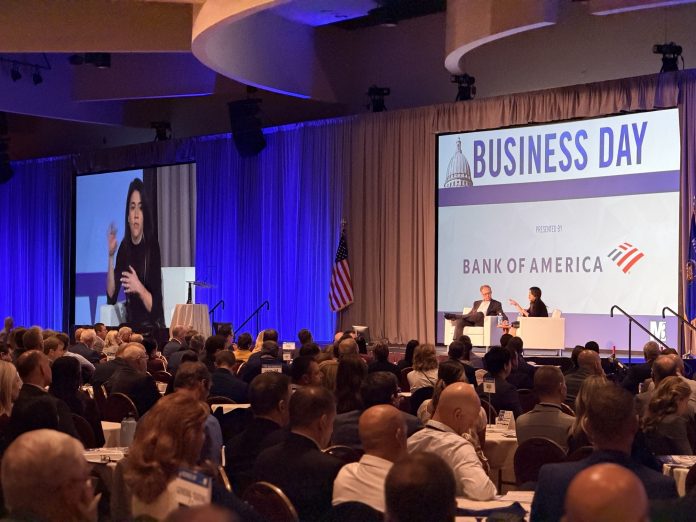

Bank of America’s Joe Quinlan pondered the title of his talk at WMC’s Business Day on Oct. 23 — “Head Spinning Headlines and the North American Outlook” — and decided it was fitting.
Quinlan, managing director and head of market strategy for Bank of America, believes the year of disruption might actually portend good things in 2026 and beyond.
It did not always seem that way, as he cited President Donald Trump’s inaugural address, when he declared the last 80 years of open trade, open investment and cross-border globalization was done; February’s news about DeepSeek, a Chinese AI company that rattled global markets when it launched lower-cost large language models than American tech giants offer; and Trump’s tariff increases on “Liberation Day,” April 2, which resulted in a 20% correction in the S&P 500.
The stock markets have recovered to approach record highs, as most trading partners came to the table to renegotiate trade deals, but the process of rebalancing global trade remains unfinished as Trump continues to bicker with Canada and plans to meet this week with Chinese President Xi Jinping following news of a possible trade breakthrough with China.
Quinlan, who was joined by Lauren Sanfilippo, director and senior investment strategy analyst for Bank of America, said after April 2, clients worried about a 1930s trade war and economic depression narrative, so it’s somewhat remarkable that only one country — China — pushed back.
“Remember for the last 50 years, 50 years straight, the United States has run a merchandise trade deficit with the rest of the world,” Quinlan said. “It’s not because we don’t have the products, the goods and services. It’s because we’ve been too nice to the rest of the world when it comes to playing fair. We played fair, relatively speaking. The rest of the world didn’t.”
With the exception of China, the rest of the world conceded the point and globalization is being reconfigured. “We’ve settled in now with a blended tariff rate around 17%, but that’s up from 3% at the beginning of the year, a massive move off when it comes to how the United States plays the game of trade,” Quinlan said.
As a result, he said U.S. executives he has talked to are more excited about operating with a level playing field and having a chance to grow their business in South Korea, Japan and Europe.
Negotiating a trade deal with China is more complex, he said, “but what this administration did with trade, honestly, it’s bullish for the U.S. economy overall,” he said.
That view was not universally shared by all Business Day speakers — geopolitical strategist Peter Zeihan talked about the disruptive effects of tariffs on global supply chains.
One area of disagreement between Quinlan and the Trump administration is immigration policy. Quinlan said 2025 is on track to be the first year in decades in which the U.S. will have net negative migration with more people leaving the country than coming in.
“That’s important when you realize that for most of this decade, and we’re 5-1/2 years into this decade, around 90% of our labor force growth has come from immigrants, legal and illegal,” he said. … “You’re looking at labor being the issue here, and AI productivity isn’t going to offset that decline just yet.”
Resilient consumers
Sanfilippo said there could be more tariff developments by year’s end because the U.S. Supreme Court soon will hear a case in which presidential authority to impose tariffs is challenged.
In the meantime, she said the U.S. is banking about $30 billion a month now on tariff revenue, but what has kept the economy afloat this year are the AI capital-expenditure build out (including investment in hyperscale data centers) and resilient consumers.
Based on Bank of America’s credit card data, she said the most resilient consumers are at the top end, as 10% of income earners represent 50% of the consumption. She said it’s lower-income consumers who are showing signs of weakening, which is aligned with a weaker labor market.
Sanfilippo said there are 7.4 million unemployed Americans today, 2 million of whom have been unemployed for at least six months. They are categorized as the long-term unemployed.
“Just going into this holiday season, there are fewer companies that are looking for temporary workers,” she said.
Another concern is how aggressively the Federal Reserve will cut interest rates. Another quarter-point rate reduction is expected this week, and many economists expect one more before year’s end.
“When I think about the labor market going forward, if the Fed continues to over index to the unemployment or employment side of their dual mandate, there’s a chance that Fed could ‘over ease,’” Sanfilippo said, which could spark inflation. “The market right now is looking for about two more rate cuts until year end.
“Bank of America, we’re not totally sold on that,” she said. “We think maybe one more (this week) … and then we pick back up with our rate cuts next year, but the general idea is the cost of capital is coming down.”
Bank of America’s projected annual economic growth rate is in the 1.5 to 2% range, but there are regions of the country that exceed that.
“As we travel, we see pretty much since COVID, from Arizona over the Carolinas down to Florida, this is a swath of the U.S. that’s basically been on fire,” Sanfilippo said. “It’s hard to sort of categorize it as a different thing. It’s just been business formation and household formation that’s been very strong and resilient since COVID.”
As it watches AI unfold, Bank of America remains bullish on productivity gains from the technology, but “we’re not ready to replace folks, our whole staff, with AI,” Sanfilippo said. “We’re not there yet, but it’s certainly helping me in my job, my job function, and the people around me, so that’s still an open question here, but we see a resilient economy.”
‘A great power rivalry’
Prior to the news that the U.S. has negotiated the framework of a trade deal with China, including rare earth minerals, Quinlan said the U.S. has to “wake up and be smarter” about China, and he explained why.
“They’re good. They’re for real. They’re a huge competitor and we’ve got to make them a partner,” he said. “We’ve kind of got to agree to disagree. That’s very important because China is doing a lot of good things, whether it’s solar, quantum computing, electric vehicles and batteries, that we need to do better. They have leapfrogged us in many cases.”
Citing the book “Breakneck: China’s Quest to Engineer the Future,” he said the U.S. could use more engineers to build things and improve its infrastructure, while China has many engineers but could use more attorneys and a stronger legal profession to improve its air, water and consumer goods such as infant formula.
“The key is we’re going to borrow a little bit from China, what they’re doing, and they’ve got to borrow from us,” he said. “But here’s the thing — it’s on. This is a great power rivalry. It will be very interesting to see how this plays out.”

