
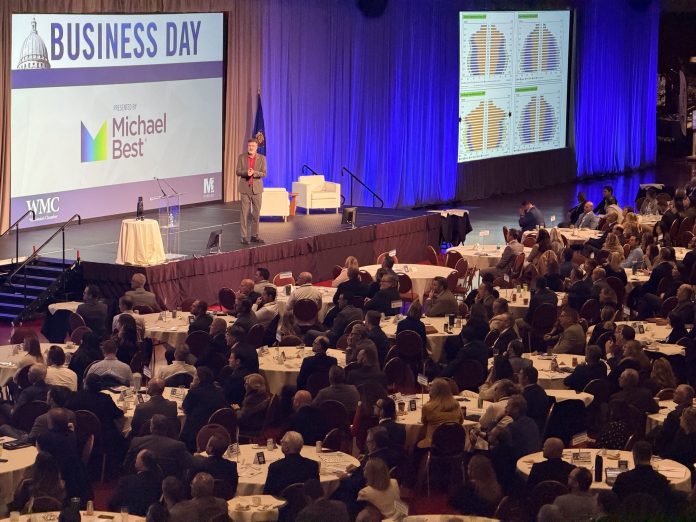
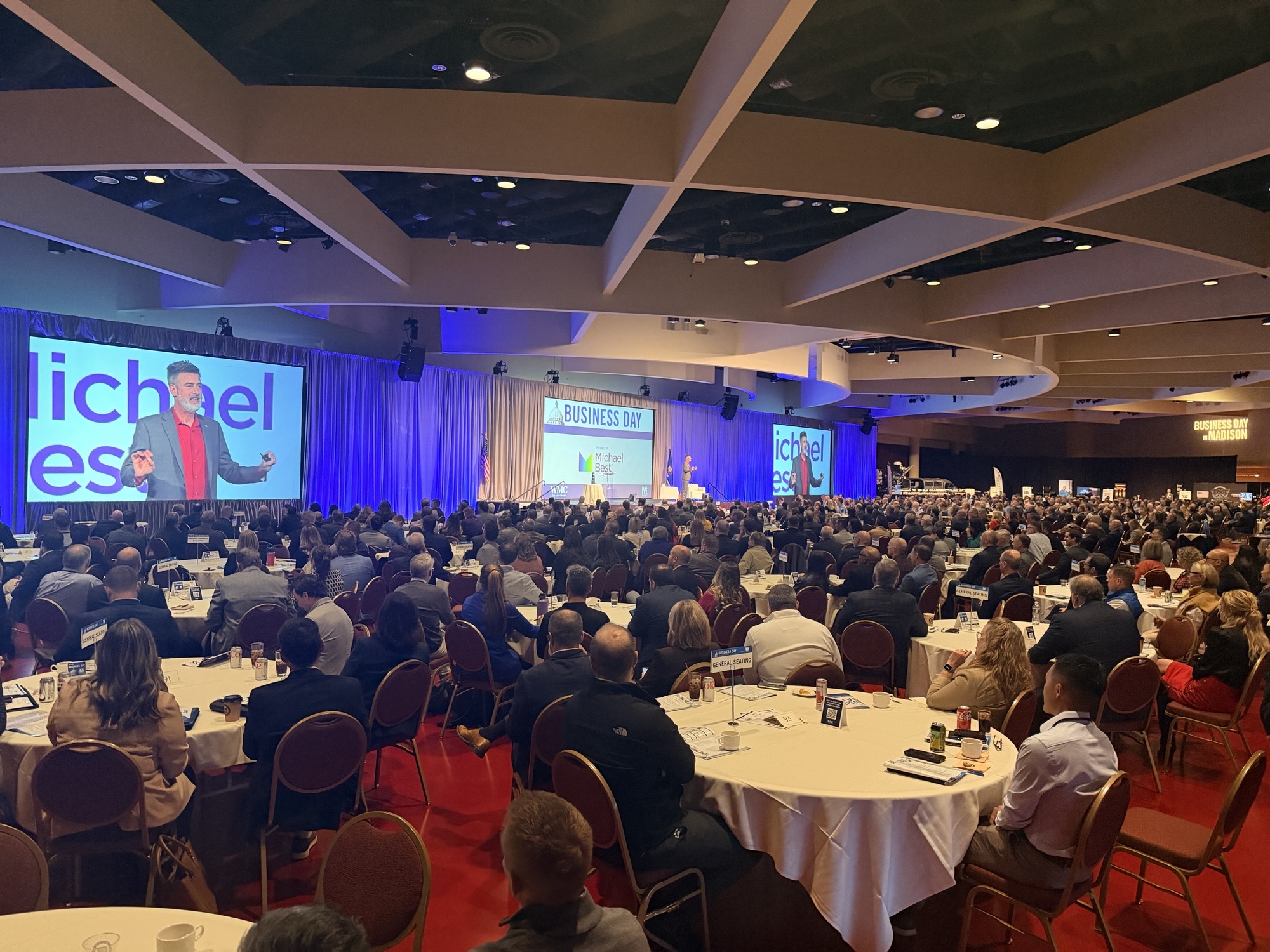
Amid lingering global trade uncertainty and a federal government shutdown that appears to have no end in sight, Wisconsin Manufacturers & Commerce held its annual Business Day event Thursday at Monona Terrace.
An estimated 900 attendees gathered to discuss issues facing Wisconsin’s $74 billion manufacturing industry, and while there is some cautious optimism about 2026, stubborn global headwinds are on their minds.
The most striking cautionary tale was told by Peter Zeihan, a geopolitical strategist and best-selling author of several books on geopolitical trends, including 2022’s “The End of the World Is Just the Beginning: Mapping the Collapse of Globalization.”
According to Zeihan, the more complex a manufacturer’s supply chain, the more disruption there will be. Those with fewer suppliers will have a better chance to adjust, he said.
Complicating matters is the understaffing of federal offices, including the U.S. Trade Representative’s office, at a time when new trade deals, prompted by President Donald Trump’s threat to raise tariffs, are being negotiated or executed with every U.S trading partner.
“Fully staffed up departments take five to seven years to do a trade bill … and so the trade agreements we have at this point are basically handshake deals to not yell at each other,” Zeihan said. “None of the non-tariff barriers have been addressed at all, and enforcement falls on them (trading partners), and they are not really feeling motivated to enforce them.”
According to Zeihan, the morning of the Business Day event brought the 532nd, 533rd and 534th tariff policy change since Jan. 20, the day Trump was inaugurated.
“No one knows what the rules are,” Zeihan said. “Most people don’t know who enforces them. We just have this background of ambient chaos that you still have to function in, which for manufacturing can get a little messy.”
Different manufacturers have different degrees of difficulty, he said. On one end, those with simple supply chains could write them all down on the back of the cocktail napkin; on the other end are manufacturers who have no idea who their fourth tier supplier is, much less their 14th tier supplier.
Zeihan used smartphones to illustrate how difficult it is to change complex supply chains, even for a company like Apple.
“The iPhone has 1,100 supply chain steps,” he said. “Apple, five years ago, decided to really pull out all the stops and try to move their supply chains away from China, and I’m happy to report that after five years, they’ve made some progress. Five years ago, 91% of the supply chain steps were involved in mainland China. Now, it’s only 90%.”
Another example is electronics, which is where we could “feel it most,” he said. The reason why the U.S., Canada and Mexico, the parties in the now defunct North American Free Trade Agreement, don’t do electronics but East Asia does has to do with labor structure.
Electronics are complex pieces of equipment that have dozens of different pieces that require different skill sets in assembling LCD screens, LED lights, motherboards, software and other components.
“You have all these things that require specialization, but not all specialized labor gets the same cost,” Zeihan said. “It’s not the same value-adds, and the advantage that East Asia has on the global system is you’ve got basically 13 different categories of labor and they shuttle the intermediate products back and forth among them.”
North America doesn’t have that, he said. “If we were to pick up that industry and move it back to North America, we’d have to do it with an American labor cost structure, and every product would probably end up costing 4 to 6 times as much.”
Zeihan said reinventing the structure and coming up with a completely new model that uses more automation (to save on cost) could be done, but that requires a lot of capital and we’re already in an environment of capital shortages. It won’t be done quickly — it could take a decade for the system to adjust — or cheaply, he said.
Machinery is another example, and this is where Wisconsin, with its heavy machinery manufacturing, has an advantage over other states. Zeihan said if tariffs force a reindustrialization of the American system, that requires increasing industrial plants and Wisconsin is the starting point.
“The reason that Wisconsin is the state with the highest support levels for the (Trump) tariff policy is that you rightfully don’t see it affecting you as much,” he said.
Ripple effects
Higher tariffs are already negatively affecting U.S. companies such as John Deere, which was already harmed by an agricultural slowdown, but others who rely on manufacturers are paying close attention as well.
Tim Cleary, executive vice president of Ideal Builders, a commercial builder in Madison, said higher tariffs on materials and other inputs have other effects.
“Just the overall ability to grow our company — that’s the impact,” Cleary said. “Manufacturing is a key part of our business. When they may not be able to fulfill orders, then they’re not going to expand, which means we don’t have anything to build, which makes it harder for us to maintain employment and advance and grow our company,” he said.
Cody Wickersheim, president and CEO of NorthCliff, a Berlin, Wisconsin, holding company that invests in diversified manufacturing, mining and other commercial areas, said there is a lot of idle capital waiting to be deployed while trade disputes are resolved.
“There’s a lot of capital sitting in purgatory,” Wickersheim said. “Thus, idle capacity. Thus, nobody wants to get rid of their employees because in the last five years you couldn’t find them.
“But now they’re starting to become less productive in terms of revenue per employee,” he said, “but nobody wants to get rid of them so they’re kind of hoping this all gets sorted out pretty darn quick.”
Kurt Bauer, president and CEO of WMC, said the effect of tariffs on the supply chain is a legitimate concern, but Wisconsin manufacturers have proven themselves to be incredibly nimble.
“They proved that during Covid,” he said. “I think they’re proving it right now. When (existing) supply chains are blocked, they find another way.”

