
We’ve written about it before for IBMadison.com readers, but H1N1 hasn’t gone away, and since this flu is perhaps of greater immediate danger to your business continuation plans than the economy in the next month, we’re now writing an update.
A short review
On April 15, 2009, the first U.S. case of H1N1 was confirmed. Two days later, a second was diagnosed. Five days after that, the CDC activated an Emergency Operations Center because the strain proved to travel from person to person.
On June 11th, the World Health Organization declared a global pandemic of the H1N1 flu virus based on the rapid-fire spread — not the severity — of the illness, which at the time had been reported in 70 countries. Since then, summer has come and gone and for the most part, most of us have likely been unaffected. Then the school season began and kids started getting sick. Happens every year, right?
Wrong.
This time, things are different, and failure to take steps now could potentially harm your business.
“It’s just the flu.” Or is it?
“Influenza is never nothing,” cautions Gwen Borlaug, infection control epidemiologist for the Wisconsin Division of Public Health, Bureau of Communicative Diseases, “and it causes 200,000 hospitalizations annually.” Every year is different, she said, and unpredictable. “If you’ve seen one influenza season, you’ve seen one influenza season.”
This latest H1N1 round has resulted in eight hospitalizations statewide thus far, but no deaths as of this writing.
There is an onslaught (some might say oversaturation) of H1N1 in the news, and its importance is elevating. “An easy way to demonstrate [the H1N1 significance] is in the level and number of federal and local agencies getting involved,” said Mike Gotzler, general counsel for The QTI Group, a human resources consultant and outsourcer in Madison, Wis. “They are acting differently than they have in the past.” With the Centers for Disease Control and the Occupational Safety and Health Administration posting vast amounts of H1N1 information online daily, it’s probably time to listen.
Workplace preparedness and planning will be key over the next several months, because H1N1 has already arrived. In fact, there are so many cases here that the health department has stopped counting. “[H1N1] is the only influenza strain circulating right now,” said Borlaug, who added that over 90% of the tested cases have been confirmed as H1N1. Chances are, if you or someone you know has the symptoms [see www.flu.gov], you have H1N1.
Once exposed to the virus, there is an incubation period that typically lasts between one and seven days, Borlaug said, though most people will display symptoms in two to three days and will remain infectious until 24 hours after the fever subsides. A typical bout with H1N1 is lasting three to five days.
Business owners: Beware.
From a legal standpoint, business owners have more than their health to be concerned about. If H1N1 infects a company, an owner could be found liable. Consider recent suits filed against various cruise line companies by passengers who contracted illnesses while on their cruise vacations. “These are the types of lawsuits we could end up seeing if H1N1 enters the workplace,” said Gotzler. Negligence claims like these could arise, charging employers with not taking reasonable steps to limit exposure to an illness, for example. However, prevailing in court is another matter, and Gotzler said an employee would have a difficult time proving they caught the disease while at their workplace.
Unlikely or not, companies can take steps to reduce exposure to lawsuits, as well as to take steps to be responsible to employees in general. First, check the national Web sites, including http://www.flu.gov and (in Wisconsin) http://www.pandemic.wisconsin.gov.
Take the checklists seriously and establish a plan now, not after the illness is racing through your business. “What I fear,” says Gotzler, “is that we will have people inundated with checklists, but not asking, from a legal standpoint, ‘why?’ [They should be asking], ‘What kind of exposure am I talking about? Are the claims that could come through the door big enough to bring my business down?’ Could be.”
Federal, state, and common law (and common sense) requires a business owner to provide a healthy and safe workplace. But in a pandemic situation, how clean can an office be? And what are the consequences to be considered when employees get sick, or potentially refuse to come in to work?
Worker’s Comp? PEO? Unemployment? In the end, who pays — employer or employee?
On a human relations front, if an employee must be away from work due to illness — in this instance, H1N1 — could they file for worker’s compensation? “Prevailing on a worker’s compensation claim would be difficult,” said Gotzler. “[Like a negligence case] the employee would have to prove that they contracted the illness while at work.”
A business does not need a positive confirmation of H1N1 in order to shut down, according to Gotzler. However, if an employer decides to err on the side of caution and closes an office for a week or two to ward off the illness, unemployment compensation could be filed by healthy employees who are being kept away. In fact, just a reduction in hours can warrant the filing of an unemployment claim.
“If an employer decides to shut down an office and tells its employees not to come to work, it is likely there will be some wage-and-hour violations. Usually, it’s not intentional, but the law is very technical and not always intuitive,” Gotzler said. He advises business owners to revisit their earned time off and leave policies now, before issues arise.
What may be more likely, Gotzler said, are the HR issues employers may have to deal with when it comes to sick exempt (salaried) employees and earned time off (ETO or PTO). While an employer is within its rights to send a sick employee home and request that they do not return until the illness passes, rules can get sticky:
- Although an employer need not pay a non-exempt (in this case, “hourly”) employee for time away from work, whether at the employee’s choosing or by employer mandate, the rules change for exempt (“salaried”) employees. As with hourly employees, if a sick, salaried employee remains home for a full-day on their own volition, that time away can be unpaid.
- If, on the other hand, the employer requires that a salaried employee remain home, that time away must be paid unless it is in full workweek increments.
- Here’s where it gets confusing a bit: If a sick, salaried employee is told to go home and “not do any work,” the employer is not obligated to pay that employee. But if that salaried employee chooses to work remotely from home after being told not to, for instance, they must be paid for the entire day, assuming the work totaled more than a “de minimis” amount — generally considered five or 10 minutes.
There are always exceptions to these rules, of course, and obviously, it’s difficult to monitor people’s activities once they’re at home.
In another scenario, what if a pregnant employee decides she will not work for a month for fear of contracting H1N1 or risking her baby’s life?
“If she’s sick, that’s one issue,” said Gotzler, “but if she’s healthy and just unwilling to come in, then it becomes the employer’s decision as to how to best handle that situation.” Employers can always be more generous than statutes allow, but exceptions must be consistent and defensible.
Then there is the issue of Family Leave laws: Gotzler advises that some H1N1 absences, whether for the employee’s own health or to care for a parent, spouse, child, or domestic partner, could be considered FMLA-qualified leave, entitling the employee to both job protection and the use of accrued time off.
But let’s face it. A small businesses owner dealing with a flu pandemic and struggling to stay open will probably ask their staff to come in if they’re able to work. “That’s a doomsday scenario,” Gotzler said. “You don’t want sick employees coming to work.”
HIPPA laws also preclude you from sharing an employee’s health information with others. So even when the staff inquires about a colleague, employers are not free to speak about a specific employee’s case. “General communications are key, not the individual case,” he said. “If you think there’s been an H1N1 exposure in the office, don’t say who’s been infected, just that you’ve done some research and ‘here is a course of action.’” But have that action plan in place.
The best way for business owners to approach the looming tentacles of H1N1 is to be prepared. “I can’t say it enough,” said Gotzler, “Go to any of the government Web sites out there and use the checklists available.”
At The QTI Group, a contingent of five project managers spent five days and a total of 40 hours working on the company’s pandemic plan. “It really made us think about things we may not have otherwise,” he said, “and it didn’t take too much time.” Their efforts resulted in a set of internal and external communication guidelines, an operations plan to determine who could work from home if necessary, and office closing contingencies.
“30 Second” Rule?
Regardless of what plan of action a business takes, practicing common sense is still the easiest, cheapest and best advice. Be mindful of what you’re touching, “You can pick up germs almost immediately,” Borlaug said. “The old ’30 second’ or ‘five second’ rule was developed by a layperson and really has no bearing on anything.” The use of surgical masks and gloves in the typical (i.e. non-medical or science-based) workplace are not necessary at this point in time, she added.
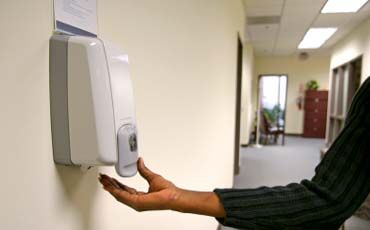
Hand sanitizers are encouraged, but not mandated. Employee vaccinations for the seasonal flu are also encouraged, and for higher risk employees (with chronic conditions or pregnancy), the H1N1 vaccine as well. Practice good workplace hygiene, washing hands often and up to the wrist for about 20 seconds, using warm water and soap; keep sneezes and coughs contained within tissues or elbows, keep common areas cleaned as best as possible, and stay home when illness sets in.
So is the wolf crying?
Nobody really knows. “I’ve seen my share [of scares],” said Gotzler, “Avian flu, SARS. It seems there’s always something. But this one is different. Typically, you don’t have to worry about entire school districts or branches of government closing. Will it happen? Who knows? But [H1N1] is not the ‘pandemic du jour.’”

