
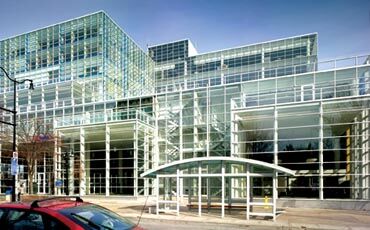

Whether you think carbon emissions are global menaces, or whether you think renewable energy is vital to a secure economic (and energy) future, or even whether you think it’s all hogwash, you probably haven’t escaped the hype about the green movement.
How could you? Talk of sustainability is everywhere these days, especially with a chunk of stimulus money devoted to it. But when it comes to green commercial buildings — i.e. the office of the future — what does all this jazz really mean?
IB recently spoke to Sherrie Gruder, a sustainable design specialist and energy program coordinator for the University of Wisconsin Extension’s Solid and Hazardous Waste Education Center, to get a better understanding of what this entails for business organizations and consumers in general.
So what are green buildings?
First, a simple definition: green building are structures that are energy-, water-, and resource-efficient and healthy for those who are living or working in them, as well as for the environment.
Whether it’s a new structure built from scratch, or an existing building being retrofitted, Gruder said green buildings are designed to stress high-priorities like clean indoor air, water conservation, energy efficiency, insulation standards, and solid waste management. Perhaps the best part is that you don’t have to undergo remodeling or plan new construction to engage in green practices: simply replacing the carpeting in your office provides an opportunity to “go green.”
Gruder offered some examples of the greening of commercial buildings. Some are very simple and some require more explanation, but they all are illustrations of the sustainable office.
Carpeting
Look for the amount of recycled content or fiber in carpeting, or whether manufacturers use backings that don’t have toxic glues that make people sick. In many cases, carpet squares are being used to replace old carpeting, which enables stains to be replaced rather than shampooed. (The old carpeting is then recycled).
Office Decor/Equipment
A lot of fabrics for curtains and chairs are being manufactured to meet Green Seal standards related to their impacts on human health.
Products with the Energy Star label (be they appliances, computers, water heaters, or boilers) help meet energy usage goals, as can the design of the building systems.
Buy Local
With green building, there is an emphasis on products that are locally derived. The lesser the distance they have to be shipped, the smaller the carbon footprint (in terms of energy usage) they will have. As Gruder explained, if you live in Wausau, there is a manufacturer of countertops made with concrete and recycled glass, and all the glass is locally derived. “That’s a lot different than buying a granite counter top that gets quarried in Europe or India or wherever,” she said, “so it has the environmental impacts of the quarry and then the material needs to get shipped overseas.”
Of course, there also is an economic angle to buying local. “Buying local is important because it keeps money in local economy,” Gruder noted. “It’s about [business] sustainability and local self-reliance.”
Building Orientation
In new buildings, the way the building is designed can impact daylighting and energy. Simply whether it has overhangs, how it’s oriented to the sun, and how it uses the mass of land can make a huge difference. An example of the latter is running the building long in the east-west direction with most windows on the north and south sides of the building to more efficiently, and with less energy use, cool them in the summer.
“Most energy use in offices is from lighting, but if you design an office building so that it gets natural daylight with windows and overhangs to shade it from the summer sun, then you are reducing number of lights you need on,” Gruder said.
She noted the Dane County Courthouse was designed in a way that brought the natural light deeper into the building, and so that desks situated closer to windows don’t need lights on for most to the day.
“Green is based on integrated design,” she explained. “Get your design team and engineering team and the building operations crew in a room at same time — really, any affected parties — and you discuss green goals for the building project.”
When the operations or facility management people get input into the design of a green building and are trained in operating this kind of structure, they tend to be more effective in operating the building more efficiently. Facility managers are but one choke point, however.
“Facilities managers are important, but what is really important is that existing buildings are commissioned where commissioning agents, typically engineering firms, go through to make sure systems are operating as designed and optimally,” Gruder said. “You could have a good building or have energy efficient system put in, but if they are installed so that a couple key ducts are closed or something is jammed open when it should not be, and the facilities managers don’t know how to interpret the control system, then the building won’t operate optimally.”
Lighting
One of best things you can do when designing a new building is not just install energy-efficient lighting, but also install controls — both photo sensors and occupancy sensors. That way, the green building becomes a smart building because if nobody is inside for 15 minutes, the lights will turn off. If there is a lot of daylighting coming in, the lights will turn off.
“It’s not just the lights,” Gruder noted, “it’s how they are controlled.”
Typically, a lighting designer will do that, perhaps one that is part of an architectural or engineering firm. “You might look at a multitude of products and how much energy they use, and what kind of light they give,” Gruder added. “For example, the trend now is to reduce amount of overall light in a room or office, but have task lights on the desks.”
Another trend is to have light not just come down but bounce up on ceilings, which distributes light more evenly, reduces glare, increases eye comfort, and improves work performance.
Manufacturing Practices
There are a number of things that go into responsible manufacturing practices, starting with the raw materials used, or what Gruder called “raw inputs and their emissions.” Responsible manufacturers would not use toxics in their products, nor would they use materials that, in their extraction from earth, created a lot of pollution. An example would be a mining process in which the mining of resources results in harmful chemicals running into local waterways.
Responsible manufacturers also tend to try to use less energy, and they use renewable sources of energy — everything from local landfill gas, to energy they capture from their own manufacturing process, to simply buying “green power.”
Green manufacturers tend to use less packaging or reusable packaging, or no packaging at all, and they design their products to be disassembled, recycled, and renewed. Take the office chair, for example; the better designers try to make it with the fewest component parts possible, and then they use materials that can be recycled or reused. Carpet manufacturers not only use non toxic glue for a healthier office environment and wool squares for conservation purposes, they make a product that can actually be composted at the end of its life.
According to Gruder, one of 100,000 accredited LEED (Leadership in Energy and Environmental Design) professionals, the biggest cost of operating a building is linked to personnel. If people are healthy and happy where they are working, which is largely dependent on the environment they work in, the cost to run a business decreases because you don’t have a lot of turnover.
2030 Challenge
Gruder encourages participation in the 2030 Challenge, which she described as a contest promoting a progressive reduction in the amount of carbon emissions that a building generates, decreasing from now until 2030, when the goal is zero net carbon impacts. Zero net energy buildings are ones that generate as much energy as they use on an annual basis.
Architecture 2030, which has issued the challenge, would like to upgrade energy consumption performance standards for new and renovated buildings. Under the program, which promotes onsite renewable power along with sustainable design strategies, fossil fuel reduction standards would begin at 60% in 2010 and progress to 70% in 2015, to 80% in 2020, to 90% in 2025, and then to carbon-neutral status in 2030. At that point, in a perfect world, buildings would use no greenhouse gas emitting energy to operate.
“There are a lot of things that go into the thought process, but it’s basically what we call a cradle-to-cradle process where you think about the impacts of the product from the time they are mined or harvested, to the end of their life,” Gruder said. “Instead of cradle-to-grave, which used to be when they were land-filled, it’s cradle-to-cradle. It’s about how do we save those resources and use them again?”
Sign up for the free IB Update — your weekly resource for local business news, analysis, voices and the names you need to know. Click here.

