
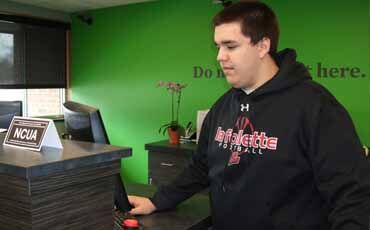

A young high school junior walks up to the teller window and withdraws cash from her savings account. Behind the console, 18-year-old Alex Kiefer checks the account on the computer and dutifully doles out the money. “Five, 10, 15 …” he counts aloud as he slaps the bills on the counter. A typical day, perhaps, at any financial institution around town, but this isn’t a typical place. This is Madison La Follette High School, where Kiefer is employed over his lunch hour at Dane County’s first in-high school credit union, which was established as a partnership with Summit Credit Union.
Though the in-school credit union idea is not unique around the country, it took five years for La Follette teacher Darrin Graham to bring it to Madison. A teacher in La Follette’s business information and technology department, Graham spent a year researching the concept before being joined by Memorial High School teacher Dave Thomas, who was also interested in pursuing the idea. For three years, the two worked side by side to gain momentum for the project. In January of 2009, the Madison Metropolitan School District sent out an RFP to area financial institutions, and Summit was selected as the financial partner.
Summit Credit Union, which also runs a branch at the Boys and Girls Club of Dane County, spent $100,000 transforming a room near the school’s main office into a credit union. “[We] believe it’s important for kids and young adults to have access and experience with financial tips and information, and establish good saving habits early in life,” said Summit’s president and CEO, Kim Sponem, who happens to be a 1985 La Follette grad. “Far too often, this type of information and experience comes after people get into financial trouble.
“My hope is that … [the La Follette branch] will become a hub for good, sound advice and resources that will be integrated into the curriculum in the classroom,” she said. Indeed, the school’s math and accounting students can observe concepts such as compound interest practiced under the same roof, and the small business will offer Graham’s marketing classes the opportunity to work in tandem with Summit staff on building-centered marketing campaigns and strategies.
There can be no better type of learning experience, in Graham’s mind. “Students are concrete learners,” he said. “They have a hard time dealing with things they can’t see, feel, or touch. So the idea of a credit union is kind of abstract to them.” This branch, he explained, gives teachers a starting point to talk to students about personal finance, budgeting, and saving. “Each year, those topics become more and more important on a local and national level.”
Earning experience
It’s all part of engaging students in something that they often don’t give serious thought to at this point in their lives: the future.
But Alex Kiefer is doing just that. His first job as a teller at the high school credit union is providing a launching point to a greater plan: first, to graduate in May, then to pursue accounting at UW-Whitewater in the fall, and one day, to have a career in either sports marketing or sports accounting.
Graham’s Career Internship class, aimed at juniors and seniors, teaches the importance of networking, good communication, cover letters, resumes, preparing for an interview, and how to dress professionally, and it certainly helped Kiefer during his first-ever interview for his first job. “I was nervous at first,” the senior recalled, “but class taught me what to expect.”
Five years ago, Graham started the Career Internship Program as a pilot with three students. It’s grown every year, and now includes 32 kids learning about business and trying to get ahead before they even graduate. What makes this program different than the previous cooperative education model the school used, according to Graham, is the program’s ability to help the teens find not just any job, but jobs in fields they’re actually interested in. For instance, several of his students are interning at a CPA firm nearby. “We want them exposed to as many facets of the business as possible, and want them working around people who dress and speak professionally,” he said.
Kiefer now works three hours a week and earns $12.32 per hour, but more importantly, the learning he is receiving extends beyond the classroom: He’s gaining social skills. “I like working with people,” he said. “I’m kind of shy and this is helping me with that.”
Kiefer’s work as a teller is never far from the gaze of Jenna Gordon, 30, branch manager at Summit’s Thierer Road location in Madison. Each weekday, Gordon, a 1998 La Follette grad, spends her lunch hour at the high school, overseeing the operation. Gordon was a part of the Summit hiring team, and said they were looking for well-rounded students with academic success and any other special attributes, such as involvement in extracurricular activities, sports, and community involvement. “Alex encompassed all of the essential characteristics,” she said, rolling off a long list of his accomplishments. After the interns were selected, Summit staff met with their parents to allay any fears and answer questions.
“This is fun,” Gordon said of her involvement with the program. “I’ve forged a lot of relationships with faculty and students. They’re asking a lot of questions, and the kids keep me updated on their plans for college or scholarship interviews they might have.”
Because the branch is operated – for the most part – like any of Summit’s branches, what the kids do with their money and their accounts is totally up to them, Gordon explained. Like any credit union member, they must first open a savings account with a $5 minimum deposit. If they have jobs, they can arrange for direct deposits of their paychecks into their accounts. If they meet other criteria and show some financial maturity, they might be able to establish a debit account with parental approval. Loan applications can also be submitted. There is no ATM on school premises, but there is a safe which is kept “at an undisclosed location,” according to Gordon.
This afternoon, several students visit the credit union, mostly to cash checks. One bespectacled senior approaches Kiefer’s window, and hands him the required form and account number. He wants to know if his employer deposited his paycheck. “How much do I have?” he asks. Kiefer responds, “$265.”
“Wow,” the student says, “I can go out and buy a half-ounce!” For an instant, the room is silent and quick glances are exchanged. His friend slaps him.”Shh! You sound like an idiot!” she accuses. He recoils, laughing, “I’m just kidding.”
The idea of an in-school credit union was “stupid, at first,” the teen said. “I thought it would be unsafe, that there would just be people coming in and that it would get robbed. And it would take up more parking in the parking lot,” he said. But since the branch opened a month ago, the student said he’s become a fan, and appreciates having access to his account.
Getting a head start
More teens wander in, some just to claim a free backpack the credit union is handing out to visitors, and others, with questions for Gordon. Enticing students with free cookies, backpacks, and water bottles works wonders to get them through the door, she laughs, but when students do have questions, Gordon is quick to provide financial education.
“We explain the difference between a bank and a credit union,” she said. “I get a lot of questions about student loans and scholarships. We talk about what they want to plan for … school? A car? They wonder how you can build credit without credit when you’re not yet 18. It’s all about paying themselves first, she said, “and planning for what they want while budgeting around their savings.” She hopes to get in front of at least 30% of the student body by the end of the semester.
At 12:15 p.m., the Summit Credit Union branch closes for the day. Kiefer balances the cash drawer and totals the checks. “Thankfully, I haven’t been off [count],” he smiles. Then he secures and locks the drawers and hands them over to Gordon for safe-keeping.
Kiefer is keeping an eye on his future. “This will all be good to put on a resume. It’s giving me a taste of the real world.”
Summit’s La Follette credit union branch is open Monday through Friday between 11:30 a.m. and 12:15 p.m. when school is in session. It is not open to the public. If the program is successful, the concept could be expanded. That’s what Graham hopes for. “Our long-term goal is to have a financial branch in each of Madison’s four high schools,” he said.
Sign up for the free IB Update — your weekly resource for local business news, analysis, voices, and the names you need to know. Click here.

